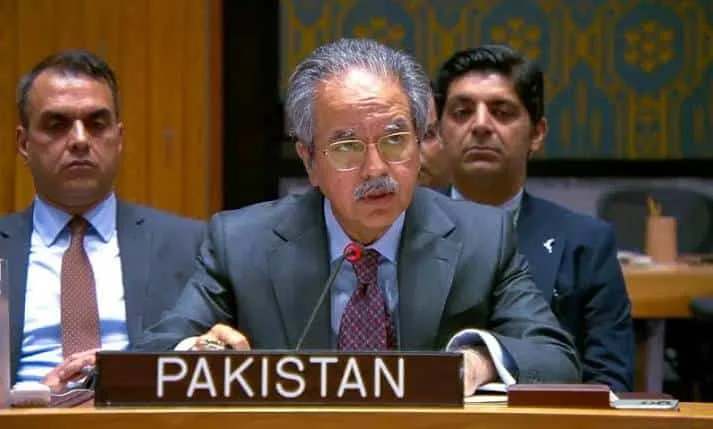



In a sharp and unyielding diplomatic showdown at the United Nations Security Council (UNSC) meeting on Afghanistan, Pakistan’s Permanent Representative to the UN, Ambassador Asim Iftikhar Ahmad, directly accused India of exploiting Afghan territory to run a sub-conventional war aimed exclusively at destabilizing Pakistan.
It was our expectation that the Taliban would take concrete and verifiable actions against terrorist groups such as the TTP, BLA and its Majeed Brigade, ISIL-K, ETIM and their affiliates that are operating with impunity on Afghan soil. Regrettably, they have failed to undertake… pic.twitter.com/ZdwqleomF4
— Permanent Mission of Pakistan to the UN (@PakistanUN_NY) June 8, 2026
The high-stakes diplomatic confrontation occurred during a formal review of the United Nations Assistance Mission in Afghanistan (UNAMA). Responding to remarks by Afghanistan’s representative, Nasir Ahmad Faiq, and a lengthy defense of humanitarian projects by the Indian delegation, Ambassador Ahmad dismantled New Delhi’s diplomatic narrative, labeling India a “serial violator of international law” and a “state sponsor of terrorism.”
The Pakistani envoy stated that India’s sudden, opportunistic alignment with the Afghan Taliban regime—which he described as “India’s newfound love for the Taliban”—is a calculated policy shift. This shift comes immediately after Pakistan’s highly successful March counter-terrorism operations, which destroyed sophisticated cross-border drone storage, technical support infrastructure, and ammunition depots used by militants to target Pakistani civilians.
“India’s key aims and objectives, even though under the garb of development or humanitarian assistance, are solely driven by the singular goal of destabilising Pakistan, including by using terrorist groups operating from Afghan soil. And that includes the TTP and the BLA, which acts as a proxy of India to perpetrate terrorism inside Pakistan.”
— Ambassador Asim Iftikhar Ahmad, Pakistan’s Permanent Representative to the UN
Escalating Cross-Border Conflict and Intelligence Seizure Metrics
The address to the Security Council included highly specific, audited data detailing the heavy toll Pakistan has suffered due to terrorism originating from Afghanistan:
-
The 2025 Casualty Toll: Ambassador Ahmad revealed that in 2025 alone, Pakistan reported more than 5,300 terrorist incidents, losing more than 1,200 innocent lives to cross-border attacks planned and executed from sanctuaries inside Afghanistan.
-
Seizure of Leftover Foreign Weapons: Pakistani security forces have documented more than 290 cases of advanced weapon seizures during counter-terrorism sweeps. These military-grade arms, night-vision optics, and drones are part of the multi-billion-dollar military arsenal left behind by departing foreign forces, which have been systematically acquired by the Tehreek-i-Taliban Pakistan (TTP) with external financial support.
-
The May 9 Police Massacre: The envoy highlighted a devastating, vehicle-borne improvised explosive device (VBIED) attack carried out by the TTP on a police post in Khyber Pakhtunkhwa on May 9, which resulted in the martyrdom of 15 police officers. Direct forensic and digital investigations traced the planning, financing, and command structure of the operation back to safe havens inside Afghanistan.
Critical Analysis: Narrative Warfare, the “Fitna-al-Hindustan” Vector, and Institutional Failures of UNAMA
The dynamic arguments exchanged during the UNSC session expose the structural collapse of regional security expectations five years after the Taliban’s return to power:
1. The Geopolitical Branding of “Fitna-al-Hindustan”
By formally using the term Fitna-al-Hindustan before the UN Security Council to describe the banned Baloch Liberation Army (BLA) and its elite Majeed Brigade, Pakistan is executing a sophisticated shift in its international narrative. The term explicitly connects the separatist insurgency in Balochistan to Indian intelligence financing and logistical networks.
Ambassador Ahmad highlighted that during the entire session, the Indian representative consistently refused to condemn either the TTP or the BLA. This omission validates Islamabad’s long-standing intelligence position: that New Delhi is using the shift in Kabul’s governance to build an anti-Pakistan proxy network along Pakistan’s western border, replacing its old intelligence infrastructure with covert operational cells.
2. Exposing the Tactical Veracity of the March Precision Strikes
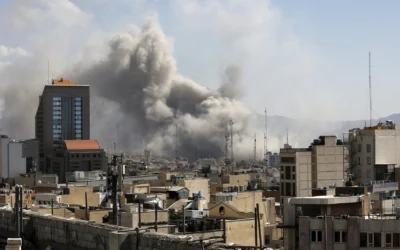
Ambassador Ahmad used the formal UN platform to strongly push back against the Afghan Taliban’s claims that Pakistan’s March 16 retaliatory airstrikes had hit a hospital or a drug rehabilitation center in Kabul. By highlighting that the Ministry of Information immediately released verified video footage of all six precision strikes, Pakistan demonstrated its commitment to transparency.
The visible secondary explosions in the footage proved that the targets were indeed highly secure ammunition dumps and drone storage facilities. This public presentation of evidence effectively turned the Taliban’s counter-claims into exposed propaganda, confirming that Pakistan’s security forces possess the intelligence capability to surgically target threat networks inside Afghanistan without causing civilian collateral damage.
3. A Sharp Institutional Critique of UNAMA Reporting Bias
Pakistan’s explicit criticism of the UN Secretary-General’s recent report and UNAMA’s monitoring methods marks a significant change in how Islamabad deals with UN agencies. The envoy exposed a major flaw in UNAMA’s reporting: the agency routinely categorizes neutralized terrorists and armed militants killed during cross-border operations under the broad umbrella of “civilian casualties.”
By failing to provide the vital context of cross-border aggression, ignoring the destabilizing accumulation of left-behind small arms, and downplaying Afghanistan’s massive underground hawala and hundi money laundering networks that fund terrorism, UNAMA is effectively shieldng the Taliban regime from international accountability. Pakistan’s public pushback demands a return to objective, fact-based reporting that holds the Kabul administration accountable for its international counter-terrorism commitments.
4. Weaponization of the IWT and Extraterritorial Operations
The Pakistani delegation skillfully expanded the debate beyond Afghanistan to expose what it characterized as India’s systematic defiance of international law across multiple fronts. By bringing up New Delhi’s recent unilateral declaration holding the historic Indus Waters Treaty in abeyance, Pakistan showed the council that India is willing to disrupt vital regional resource-sharing frameworks without legal justification.
When combined with references to India’s recorded involvement in extraterritorial assassination plots targeting dissidents in the United States and Canada, Pakistan presented a comprehensive picture of India’s foreign policy. This strategy effectively framed India not as a responsible global actor or a charitable donor in Afghanistan, but as an aggressive, destabilizing force operating in complete defiance of international norms.
5. Simple, Firm, and Non-Reversible Demands
Islamabad’s current policy toward the Afghan Taliban has moved completely away from strategic patience. The demand for “verifiable and non-reversible action” against terrorist sanctuaries makes it clear that Pakistan will no longer accept empty diplomatic promises or temporary relocations of militants away from the border.
While acknowledging the neutral mediation efforts of partner nations like Qatar, Turkiye, Saudi Arabia, and China, Pakistan used the UNSC forum to signal that the window for a peaceful, diplomatic course correction is rapidly closing. By explicitly stating that Pakistan has stopped these hostile designs before and will always act in self-defense under international humanitarian law, the state has reserved the right to launch continuous, independent military actions across the border as long as Kabul allows its soil to be used as a base for hostile actions.