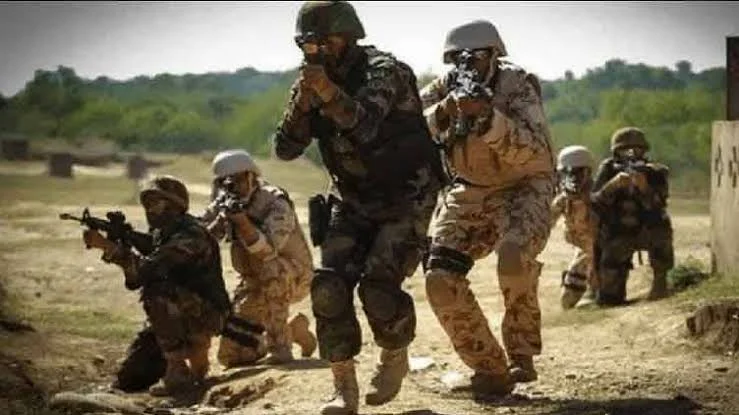





In a major counterterrorism operation, Pakistan’s security forces have eliminated 24 highly active terrorists during a series of intensive, intelligence-based operations (IBOs) conducted across the Bannu district and its adjoining areas.
The extensive joint operations, carried out by the Pakistan Army and local law enforcement agencies, were launched following a recent surge in asymmetrical attacks. These included vehicle-borne suicide bombings and systematic sabotage targeting police personnel and critical public infrastructure within the district.
According to the Inter-Services Public Relations (ISPR), the eliminated individuals belonged to the banned Tehreek-e-Taliban Pakistan (TTP)—officially designated by the state as Fitna al-Khawarij. Large caches of modern weapons and ammunition were recovered from the neutralized operational cells. State leadership, including President Asif Ali Zardari, Prime Minister Shehbaz Sharif, and Interior Minister Mohsin Naqvi, commended the high professional standards and swift coordination demonstrated by the field commanders during the 24-hour campaign.
Security forces have killed twenty-four Khwarij in last twenty-four hours during joint intelligence-based operations in Bannu district of Khyber Pakhtunkhwa@OfficialDGISPR #RadioPakistan #news https://t.co/n9wxTjNqtV pic.twitter.com/N7PReDLVSg
— Radio Pakistan (@RadioPakistan) July 17, 2026
Tactical Evolution: The Mechanics of the Miryan Assault
The recent intelligence-based offensive serves as a direct response to a distinct evolution in the adversary’s operational playbook. This tactical shift was vividly illustrated during Wednesday’s highly coordinated assault on the Miryan police station in Bannu.
Rather than relying purely on traditional hit-and-run gunfire, the attackers attempted a multi-phased siege entry:
Miryan Tactical Analysis:
- Phase 1: Heavy Kinetic Breaching
- Ramming an explosives-laden vehicle into the outer defensive perimeter
- Phase 2: Interdiction of Reinforcements
- Triggering pre-planted charges to collapse a key approach bridge
- Phase 3: Secondary Infrastructure Sabotage
- Planting IEDs under link networks and public institutions to delay response
Infrastructure Warfare and the Sabotage of Public Spaces
This trend of infrastructure-focused sabotage has steadily escalated throughout July. On July 3, coordinate explosive devices were used to target the Government Girls Middle School in Mama Khel, causing extensive structural damage to classrooms and boundary walls.
Concurrently, a separate terrorist cell planted an explosive-filled drum directly underneath a critical link bridge in the Bachki area of Jani Khel. While the Bomb Disposal Unit successfully defused the Bachki device before detonation, the dual incidents reveal a clear intent to disrupt regional logistics, hinder military mobility, and project a psychological atmosphere of insecurity across civilian sectors.
The threat is further compounded by the persistent use of remote-controlled improvised explosive devices (IEDs) along transit corridors. Earlier in the week, a remote-controlled IED struck a police armored personnel carrier conducting a routine patrol on the Wana-Jandola Road in the neighboring Tank district, resulting in the martyrdom of two police officers.
Cross-Border Sanctuaries
A defining factor behind the TTP’s high operational resilience remains its strategic exploitation of border geography. The federal government has repeatedly presented detailed technical evidence at international forums, including the United Nations Security Council, demonstrating how these militant networks maintain structured training grounds, financial supply loops, and operational freedom of movement within Afghan territory.
This external sanctuary allows cells to plan cross-border infiltrations, deploy advanced tactical gear, and orchestrate suicide vehicle-borne IED (SVBIED) strikes before attempts are made to slip back into the mountainous frontier.
To comprehensively counter this hybrid threat, the military and civilian leadership are executing the multi-layered counterterrorism strategy known as Azm-e-Istehkam, which operates under the mandate of the Federal Apex Committee on the National Action Plan.
Rather than relying solely on static defense, the strategy prioritizes continuous, proactive intelligence sweeps to intercept logistical supply lines before they enter urban centers. By upgrading the physical fortification of remote police outposts, enhancing local bomb disposal capabilities, and deploying rapid-response air support, security forces aim to permanently dismantle the support infrastructure of the insurgent networks across the western frontier.