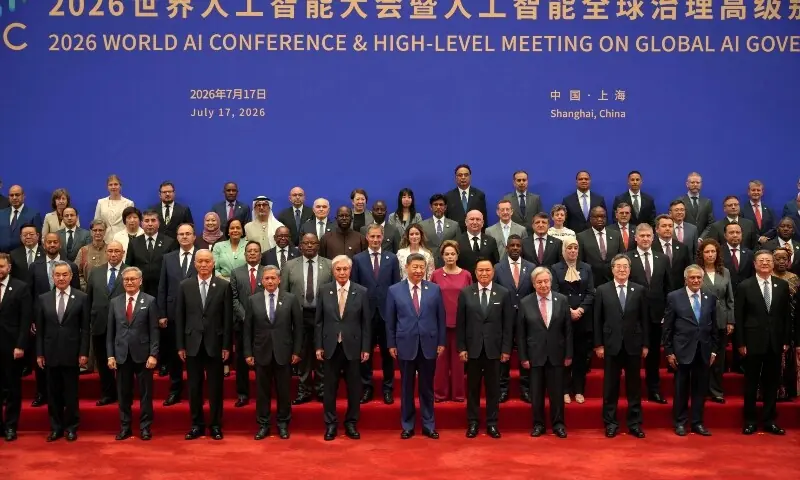



Chinese President Xi Jinping has forcefully positioned Beijing as the architect of a new global artificial intelligence order, using the opening ceremony of the premier World Artificial Intelligence Conference (WAIC) in Shanghai to challenge decades of American dominance over the rules governing the tech sector.
In a landmark address to an audience of international delegates, tech executives, and state leaders on Friday, Xi urged nations to “seize the rare and historic opportunity” of open-source AI. Pledging extensive state resources to help developing countries build their own digital infrastructure, Xi explicitly warned against the emergence of “new historical injustices” born out of unequal access to frontier technology.
The address represents China’s most calculated and comprehensive blueprint for the future of AI governance to date. By framing its highly advanced open-weight models as a global public good, Beijing is actively presenting a comprehensive alternative to Washington at a pivotal moment in the global race for technological supremacy.
Xi unveils China’s global AI vision, promoting open-source technology and challenging US leadership over global AI governance standards. https://t.co/HOHHdiO569 pic.twitter.com/1vwvWXGFDR
— ARISE NEWS (@ARISEtv) July 17, 2026
Open-Weight Models as a Global Disruption
Comparing the strategic significance of artificial intelligence to the invention of the steam engine and the discovery of electricity, Xi outlined a sweeping vision in which China will directly share its technology, computing expertise, and training models with nations across the Global South. This approach is engineered as a direct structural alternative to the US-led “Pax Silica”—a Washington-backed international initiative designed to lock down global AI networks, restrict advanced chip exports, and secure critical semiconductor mineral supply chains.
The timing of the speech aligns with massive technical breakthroughs within China’s domestic AI ecosystem, where open-weight models are making exponential gains against the heavily guarded, proprietary, closed-source systems developed by US giants like OpenAI and Anthropic.
Demonstrating this rapid convergence, Beijing-based artificial intelligence startup Moonshot AI unveiled its Kimi K3 model. The company officially classified it as the world’s largest open AI model by parameter count. The rollout occurred only a month after the US government abruptly restricted the export of Anthropic’s frontier-class models over national security concerns, leaving a massive market vacuum that Beijing is eager to fill.
WAICO: The Birth of an Intergovernmental Tech Bloc
A central pillar of China’s institutional offensive is the formal establishment of the World Artificial Intelligence Cooperation Organisation (WAICO). On Thursday, representatives from 29 founding nations gathered in Shanghai to sign the organisation’s founding instrument, establishing its permanent headquarters in the city.
The member bloc comprises a powerful coalition of developing and non-aligned economies, including Russia, Brazil, Belarus, Serbia, Cuba, and Venezuela, alongside 10 African and 12 Asian nations. Xi heralded the signing ceremony as a historic milestone that directly answers the long-standing demands of Global South nations for equitable participation in tech governance.
WAICO Structural Alignment (2026 Foundation):
- Permanent Secretariat: Headquartered in Shanghai, China
- Core Membership Base: 29 Founding States (Including Brazil, Russia, Pakistan, and major Afro-Asian blocs)
- Diplomatic Integration: Dedicated AI training centers embedded within BRICS, ASEAN, and the African Union
To cement this influence, Xi announced that China will finance and develop dedicated AI cooperation centers and training pipelines embedded directly within existing multilateral regional blocs, including BRICS, ASEAN, Latin American forums, and the African Union. The strategic move effectively ties China’s digital diplomacy to established geopolitical networks where Beijing already commands immense economic leverage.
Pakistan Anchors the Alliance as a Founding Member
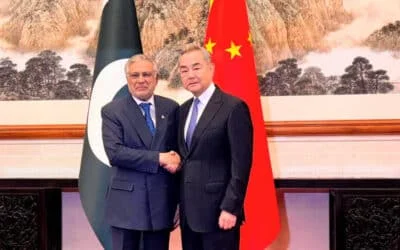
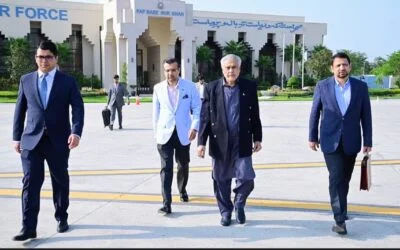
Pakistan has stepped forward as a key strategic anchor of the new organization. On Thursday, Deputy Prime Minister and Foreign Minister Senator Ishaq Dar officially signed the Agreement on the Establishment of WAICO in Shanghai on behalf of the state.
Deputy Prime Minister/Foreign Minister Senator Mohammad Ishaq Dar @MIshaqDar50, along with the Pakistan delegation, attended the opening ceremony of the 2026 World Artificial Intelligence Conference (WAIC) in Shanghai this morning, which was addressed by H.E. President Xi… pic.twitter.com/2j8iROvuSI
— Ministry of Foreign Affairs – Pakistan (@ForeignOfficePk) July 17, 2026
Attending the opening ceremony alongside the Pakistani delegation on Friday, Dar emphasized that Islamabad’s founding membership is rooted in securing technological sovereignty for developing economies. The Foreign Office issued a comprehensive statement detailing Pakistan’s vision for the alliance, noting that the state supports an inclusive and equitable global AI governance framework that provides wider access to emerging technologies.
By collaborating closely with fellow WAICO member states, Pakistan aims to help bridge the widening digital divide, ensuring that capability-building and technical infrastructure are shared transparently to advance socio-economic development across the region.
Human Control and the Mandate for AI Safety
For the first time, Xi also laid out an explicit, rigorous framework regarding AI safety, human oversight, and existential risk management. He called for all frontier artificial intelligence systems to remain under strict human control, urging member states to establish standardized early-warning and emergency-response mechanisms.
Warning of the severe dangers posed by autonomous, black-box systems that could potentially evade human oversight and lead to catastrophic loss-of-control scenarios, Xi signaled that China intends to lead the world not just in software deployment, but in setting the safety benchmarks that will govern international code.
The high-stakes gathering takes place as Washington and Beijing prepare for their first formal, government-level AI security talks under US President Donald Trump’s administration. Xi’s message is an unambiguous statement that China will not follow foreign diktats on technology or standards. As the conference shifts from an industry showcase to a geopolitical testing ground, Beijing has made it clear that it possesses the models, the institutional alliances, and the strategic willpower to chart its own independent course.