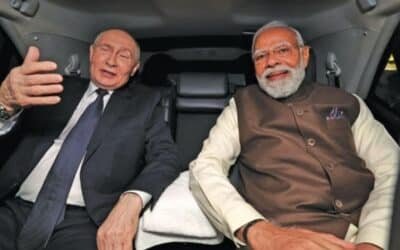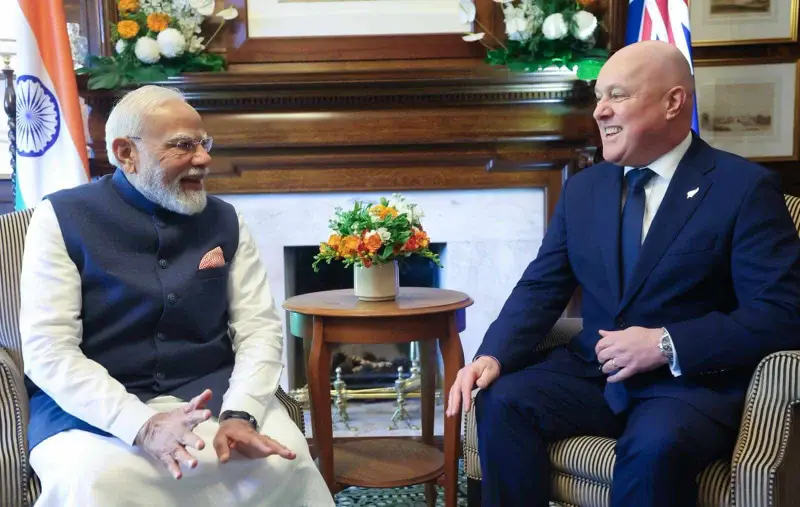


Marking the first official visit by an Indian head of government to New Zealand in forty years, Prime Minister Narendra Modi and his New Zealand counterpart Christopher Luxon formally elevated bilateral ties to a comprehensive “strategic partnership” on Saturday. The landmark diplomatic upgrade focuses heavily on tightening maritime defense cooperation, expanding joint naval exercises, and securing supply-chain security across the Indo-Pacific.
The historic summit, hosted at Government House in Auckland, concludes Prime Minister Modi’s multi-nation regional tour through Indonesia and Australia. The sudden consolidation of defense ties occurs amid heightened security anxieties across the Pacific, following China’s long-range ballistic missile test into the Pacific Ocean earlier this week. The diplomatic pivot underscores New Zealand’s shifting posture as Wellington actively seeks to counterbalance Beijing’s growing military and diplomatic footprint in the region.
Prime Ministers @narendramodi and @chrisluxonmp held productive talks in Auckland.
The two leaders decided to elevate India-New Zealand ties to a Strategic Partnership. They discussed expanding cooperation in sectors such as trade, investment, technology, agriculture, dairy,… pic.twitter.com/o6OQZ4OPa8
— PMO India (@PMOIndia) July 11, 2026
Driving Prosperity Through Security: The Indo-Pacific Balance
Receiving the Indian delegation with a traditional indigenous Māori welcome and a formal military guard of honor, Prime Minister Luxon characterized the strategic pact as an essential structural milestone. A joint executive statement affirmed both nations’ shared commitment to ensuring a free, open, peaceful, and prosperous Indo-Pacific maritime corridor.
During an executive press briefing, Luxon confirmed that the two leaders quickly canvassed the geopolitical implications of Beijing’s recent missile test. While skirting direct questions regarding whether the new alliance was explicitly engineered to curb China’s territorial and military ambitions, Luxon defended the necessity of the defense pact.
He noted that as a small trading and maritime nation, New Zealand must aggressively cultivate deep defense and trade relationships with like-minded democracies. The Prime Minister endorsed the emerging “multi-lattice” framework of overlapping security agreements in the Pacific, stating that this architecture is precisely how Wellington intends to drive long-term economic prosperity through reinforced regional security.
Diaspora Politics and the Free Trade Coalition Rift
The crown jewel of the diplomatic tour features a massive diaspora rally at Auckland’s Spark Arena, where over 10,000 members of New Zealand’s 300,000-strong Indian community gathered to support the Indian Prime Minister. This follows a massive community event in Melbourne, Australia, which drew nearly 30,000 attendees earlier in the week.
For Luxon, the high-profile visit serves as a crucial political platform ahead of New Zealand’s general elections this November. The Prime Minister has consistently championed the immense corporate advantages of a sweeping bilateral free-trade agreement signed between Wellington and New Delhi in April, which is currently awaiting final parliamentary ratification. Luxon has repeatedly urged domestic businesses to capitalize on India’s rapid economic expansion, calling it a generational opportunity to anchor New Zealand’s export growth for the next fifty years.
However, the trade agreement has triggered a severe political rift within Luxon’s own governing coalition. Hardline populist lawmakers from the New Zealand First party have openly revolted against specific legal provisions in the pact that grant relaxed visa access and streamlined immigration pathways for Indian students and skilled professionals.
The intra-coalition dispute exploded into public view when government minister Shane Jones publicly attacked the deal on a local radio program, stating he would never agree to what he termed a “butter chicken tsunami” entering the country. The comment drew immediate, fierce condemnation from Indian community leaders, who slammed the remarks as blatant, outright racism.
Sectarian Backlash and Extremist Threats
The commercial and strategic success of the summit has also had to navigate sharp domestic socio-religious friction. Ahead of Modi’s arrival, far-right evangelical preacher and self-proclaimed “apostle” Brian Tamaki launched a severe rhetorical attack on social media.
Posting an inflammatory video on Instagram, Tamaki accused the Indian Prime Minister of orchestrating the systemic persecution of Christians within India. He called on New Zealand citizens to execute a “tit-for-tat” retaliation, explicitly demanding the systemic purge of Hindus, Sikhs, and Muslims from New Zealand soil, while openly inciting his followers to target and burn down mosques and temples.
The hateful remarks were immediately flagged by New Zealand’s Race Relations Commissioner and regional multi-faith councils, who condemned the rhetoric as utterly appalling. Despite the domestic political and social undercurrents, the executive branch remained steadfast in its focus, locking in the Strategic Partnership Roadmap to 2030 to secure New Zealand’s defensive alignment with the world’s most populous democracy.