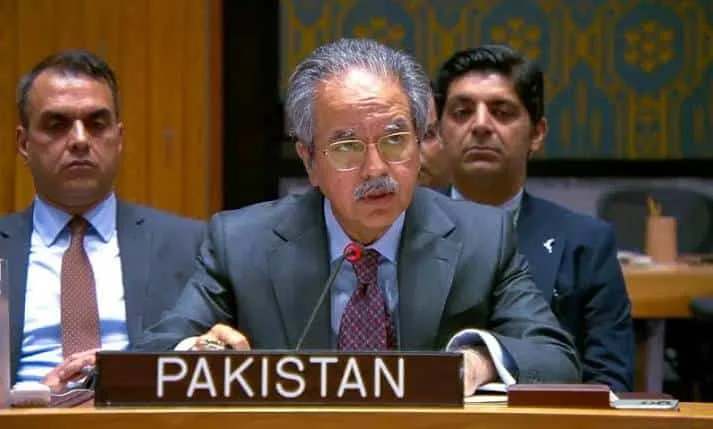




Speaking from the United Nations Headquarters in New York, Pakistan’s Permanent Representative to the UN, Ambassador Asim Iftikhar Ahmad, has formally endorsed the newly unveiled Muscat Plan of Action.
Labeling the initiative an “innovative pathway,” Ambassador Ahmad emphasized Pakistan’s strategic commitment to utilizing traditional, faith-based, and indigenous leadership to dismantle systemic hate speech, halt incitement to genocide, and reinforce localized peace mediation structures.
The high-level diplomatic endorsement comes concurrently with Pakistan’s intensive backchannel efforts at the UN Security Council, where Islamabad has issued an urgent plea to extra-regional powers to halt current kinetic operations and allow the “fragile” Middle East diplomatic track room to stabilize.
Pakistan Supports Muscat Plan of Action; Calls it Innovative Pathway to Address Hate Speech and Incitement to Genocide
– Our Press Release today pic.twitter.com/pS0oBkaTnm
— Permanent Mission of Pakistan to the UN (@PakistanUN_NY) June 12, 2026
1. Harnessing Local Credibility: The Muscat Framework
The Muscat Plan of Action—compiled through a joint partnership between the Sultanate of Oman, the UN Office on Genocide Prevention, and the Peacemakers Network—represents a fundamental shift in how the international body approaches mass atrocity prevention.
-
Cultural Legitimacy: Ambassador Ahmad highlighted that the plan uniquely galvanizes the historic authority and credibility of indigenous and traditional tribal leaders to counter radicalization and ethnic friction at the grassroots level.
-
The State’s Pledge: Reaffirming Pakistan’s foreign policy values of pluralism and inter-civilizational dialogue, the Ambassador stated that Islamabad will work continuously alongside international partners to dismantle the “twisted and flawed ideology” of hate speech, striving to transform fractured societies into “oases of peace, equality, and tranquillity.”
Statement by Ambassador Asim Iftikhar Ahmad,
Permanent Representative of Pakistan to the UN,
At the Security Council Briefing on Non-proliferation (1737 Committee)
(9thof June 2026)
*****President,
Pakistan is deeply concerned at the ongoing situation in the region marked by… pic.twitter.com/f5vLN6I4PK
— Permanent Mission of Pakistan to the UN (@PakistanUN_NY) June 10, 2026
2. Security Council Interventions: The Danger of Tenuous Ceasefires
Ambassador Ahmad carried this exact philosophy of proactive de-escalation into a vital UN Security Council briefing on non-proliferation, addressing the precarious shadow war currently playing out in the Persian Gulf.
-
The Warning on Fragility: Expressing profound concern over recent military strikes and counter-strikes, the Ambassador warned the council that recent flashpoints have “amply underscored the fragility of the situation” and magnified the risk of an uncontainable, wider war.
-
The Diplomatic Ultimatum: Directing his remarks at the broader international community, Ahmad argued that recent spikes in regional violence serve as a “stark reminder of the dangers associated with a tenuous ceasefire.” He implored all involved factions to “give diplomacy a little more chance,” insisting that the destructive cycle of structural instability must terminate for the sake of global economic security.
CRITICAL ANALYSIS: MULTILATERAL SOFT POWER AND THE MEDIATION CORRIDOR
Pakistan’s parallel diplomatic maneuvers at the UN this week reflect a sophisticated dual-track foreign policy strategy designed to project international soft power while solidifying its role as a vital regional balancer.
Institutionalizing Asymmetric Threat Mitigation
By throwing its weight behind the Muscat Plan of Action, the Pakistani diplomatic mission is addressing a critical vacuum in modern peacebuilding. Traditional state-to-state diplomacy is proving increasingly ineffective against decentralized, algorithmically accelerated radicalization.
The Muscat Plan’s focus on indigenous and faith-based mediators acknowledges that local influencers possess far greater trust and cultural capital than distant multilateral institutions. For Pakistan—a nation situated at a civilizational crossroads—pioneering frameworks that leverage local, traditional authority is a strategic imperative to combat cross-border hybrid threats and unconventional security challenges.
The Strategic Burden of the “Middle Man”
Simultaneously, Ambassador Ahmad’s statements at the UN Security Council reflect the high-stakes balancing act Pakistan is maintaining behind the scenes. As a primary co-mediator alongside Qatar in the broader regional standoff, Pakistan is acutely aware that a breakdown in communications will have immediate domestic consequences, ranging from destabilizing energy imports to disrupting vital maritime trade lanes.
The Ambassador’s critique of “tenuous ceasefires” serves as a direct message to major global actors: short-term tactical pauses are insufficient. Without institutionalized communication channels, advanced data transparency, and a collective willingness to transition from kinetic posturing to constructive dialogue, the international system will remain perpetually one miscalculation away from economic and structural collapse.
The Takeaway: Pakistan’s actions this week underscore a consistent thesis: enduring peace is an active, structural investment. Whether through the grassroots validation of the Muscat Plan or high-altitude diplomacy at the UNSC, Islamabad is systematically positioning its diplomatic infrastructure as an indispensable asset for global conflict resolution.