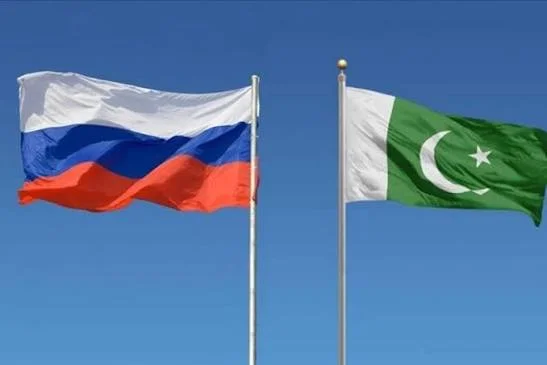


In a major diplomatic shift highlighting the changing global political order, Pakistan and the Russian Federation have agreed to formalize a comprehensive Economic Cooperation Programme extending through 2030.
The announcement was made by Federal Minister for Energy Awais Ahmed Khan Leghari during a high-level security and trade webinar titled “Pakistan-Russia Bilateral Relations in the Context of the Changing Global Order.” Minister Leghari, who co-chairs the Pakistan-Russia Intergovernmental Commission (IGC) alongside his Russian counterpart Sergei Tsivilev, declared that decades of Cold War-era mistrust have faded, transforming the bilateral relationship from that of an “unfriendly country” into a “reliable friend.”
The 2030 economic framework follows four successful summits between Prime Minister Shehbaz Sharif and Russian President Vladimir Putin. It is supported by a newly signed Readmission Agreement in Bishkek, designed to streamline visas, enhance business-to-business tracking, and strengthen institutional ties between Islamabad and Moscow.
🚨BREAKING: New Russia-Pakistan strategic deal to supercharge trade and defense ties, signaling a major shift toward a balanced foreign policy for Islamabad. pic.twitter.com/z2FYv8673q
— The Daily CPEC (@TheDailyCPEC) June 7, 2026
North-South Trade Corridor and Macroeconomic Metrics
The expanding partnership between Islamabad and Moscow focuses heavily on energy infrastructure, counter-terrorism coordination, and trans-continental shipping logistics. The underlying technical milestones highlighted by the Ministry of Energy and diplomatic attaches focus on several key areas:
-
The Gwadar-INSTC Maritime Connection: Pakistan has formally initiated steps to join the International North-South Transport Corridor (INSTC). This move directly aligns with a proposal by Russian Deputy Prime Minister Alexey Overchuk to link Russia’s landlocked trade routes with Pakistan’s deep-sea Gwadar Port, complementing China’s Belt and Road Initiative (BRI).
-
Resolving Financial Barriers: Both capitals are actively designing alternative clearing and payment mechanisms to bypass Western banking restrictions, ensuring smooth, uninterrupted transactions for large-scale crude oil and liquid natural gas (LNG) transfers.
-
The Kazan and St. Petersburg Forums: Pakistan’s growing ties with Russia were further demonstrated by the dispatch of a large diplomatic and corporate delegation to the Kazan Forum in May 2026, which will be followed by high-level participation in the upcoming St. Petersburg International Economic Forum.
Critical Analysis: The Eurasian Pivot, Gateway Maritime Strategy, and the Multipolar Security Balance
The finalization of the Pakistan-Russia 2030 economic roadmap represents a calculated realignment of Pakistan’s foreign policy within the shifting Eurasian landscape:
1. Diversifying Beyond Western Financial Spheres
The 2030 Economic Cooperation Programme shows that Pakistan is taking a pragmatic approach to diversifying its geopolitical relationships. By moving past old Soviet-era friction, Islamabad is building a strong partnership with a major global energy power.
Faced with unpredictable Western financial aid and strict IMF fiscal requirements, Pakistan’s energy sector is looking to Russia to secure long-term, discounted crude oil and liquefied natural gas. Overcoming payment mechanism challenges through alternative non-dollar systems allows Pakistan to safeguard its industrial sector from global supply shocks while anchoring itself firmly within the emerging Eurasian economic network.
2. Positioning Gwadar as Russia’s Gateway to the Arabian Sea
Connecting the International North-South Transport Corridor (INSTC) to Gwadar Port is a significant geographical victory for both nations. For Russia, a direct link to Gwadar offers a permanent, warm-water trade route to the Arabian Sea, the Middle East, and Africa, helping Moscow bypass European maritime blockades.
For Pakistan, this integration transforms Gwadar from a purely bilateral project with China into a multi-nation logistical hub for the entire continent. This dual alignment with both Beijing and Moscow enhances Pakistan’s strategic value, making the country an indispensable transit corridor for Eurasian trade.
3. Moscow’s Backing of Pakistan’s Middle East Mediation
The public appreciation from Russian leaders regarding Pakistan’s diplomatic efforts to defuse the war between the United States, Israel, and Iran highlights Islamabad’s growing reputation as a responsible regional mediator. Rather than viewing Pakistan simply through a localized South Asian lens, Moscow recognizes that Rawalpindi and Islamabad hold unique, trusted diplomatic access to both Washington and Tehran.
This shared diplomatic approach—including similar positions on ceasefire terms in Lebanon and Gaza—allows Russia and Pakistan to coordinate their actions at the UN Security Council and the Shanghai Cooperation Organisation (SCO), checking unilateral Western power and supporting a more balanced, multipolar global architecture.
4. Countering Regional Hostility and Western Containment
The insights provided by Special Assistant Tariq Fatemi and former Ambassador Masood Khan highlight the complex security challenges Pakistan faces while managing this historic pivot. As India continues to take an aggressive stance and cross-border terrorism from safe havens in Afghanistan threatens national stability, a closer relationship with Russia provides a valuable diplomatic counterweight.
Historically, New Delhi enjoyed exclusive defense relationships with Moscow; Pakistan’s successful effort to build regular security, strategic stability, and counter-terrorism consultations with Russia limits India’s ability to diplomatically isolate Pakistan. This evolving friendship ensures that Russia remains a balanced partner in South Asian security, recognizing Pakistan’s vital role in fighting terrorism and maintaining regional stability.