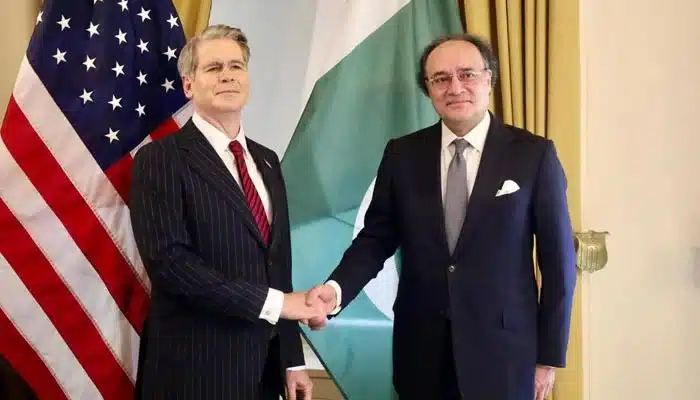





In a bold bid to shore up its foreign exchange reserves and reduce reliance on multilateral lenders, Finance Minister Muhammad Aurangzeb has formally requested a $10 billion Exchange Stabilisation Support Facility from US Treasury Secretary Scott Bessent.
The high-level request—first reported by Reuters and subsequently confirmed by Pakistani diplomatic officials in Washington—seeks a bilateral arrangement with a five-year maturity period. While the official readout from Pakistan’s embassy omitted the specific dollar amount, it verified that Aurangzeb pressed for US backing to strengthen Pakistan’s return to international capital markets, improve sovereign credit ratings, and rebuild foreign exchange buffers.
Deputy Prime Minister/Foreign Minister Senator Mohammad Ishaq Dar @MIshaqDar50 held a productive meeting today with ADB Vice President (South, Central and West Asia) Mr. Yingming Yang, ADB Vice President (Sectors and Themes) Ms. Fatima Yasmin, ADB Director Generals and officials,… pic.twitter.com/MsdFWPmFjU
— Ministry of Foreign Affairs – Pakistan (@ForeignOfficePk) July 22, 2026
Mechanics of the Proposed $10 Billion Backstop
The requested mechanism would operate under the US Treasury’s Exchange Stabilization Fund (ESF), serving as a crucial financial safety net rather than a standard foreign aid package:
-
Reserve Enhancement: Direct dollar liquidity or swap structures would immediately fortify Pakistan’s state-held foreign exchange reserves.
-
Currency Intervention: The facility provides the central bank with intervention capacity to stabilize the Pakistani rupee against sharp depreciation.
-
Debt Pressure Relief: By acting as a financial backstop, the mechanism reduces short-term debt servicing strain and lowers external borrowing costs.
-
Multilateral Independence: The five-year horizon aims to give Islamabad room to execute structural reforms without sole reliance on tranche-by-tranche multilateral disbursements.
The US Treasury declined to comment on the ongoing talks. However, diplomatic sources in Washington indicate a strong likelihood of approval, citing the Trump administration’s explicit interest in deepening economic engagement with Pakistan.
Strategic Analysis: Leverage, Timing, and Re-engagement
Islamabad’s $10 billion request represents a significant evolution in US-Pakistan bilateral relations, driven by macro-economic necessity and strategic realignments:
Capitalizing on Diplomatic Mediation Leverage
The timing of this financial request coincides with Pakistan’s active role in facilitating critical diplomatic channels during the ongoing US-Iran regional hostilities. By positioning itself as an indispensable regional mediator and peace-broker, Islamabad has effectively leveraged its diplomatic profile to negotiate tangible economic returns from Washington.
Shifting Away from Ad-Hoc Bails and Multilateral Bottlenecks
While Pakistan remains under a strict $7 billion International Monetary Fund (IMF) Extended Fund Facility, its reserves remain highly sensitive to regional shocks, external debt rollovers, and strict spending conditions. Securing a bilateral US Treasury backstop offers Islamabad a rare, high-volume liquidity cushion that buffers the nation against IMF disbursement delays and reduces vulnerability to shifts in traditional Gulf or Chinese deposit arrangements.
Signaling Market Confidence and Geopolitical Realignment
US Exchange Stabilization Facilities are historically rare and reserved for strategic partners facing systemic currency pressures. If granted, the $10 billion backstop would act as a powerful green light to international rating agencies and private capital markets. It signals that Washington is willing to underwrite Pakistan’s macroeconomic stability, laying the groundwork for increased foreign direct investment and improved credit ratings across global financial hubs.