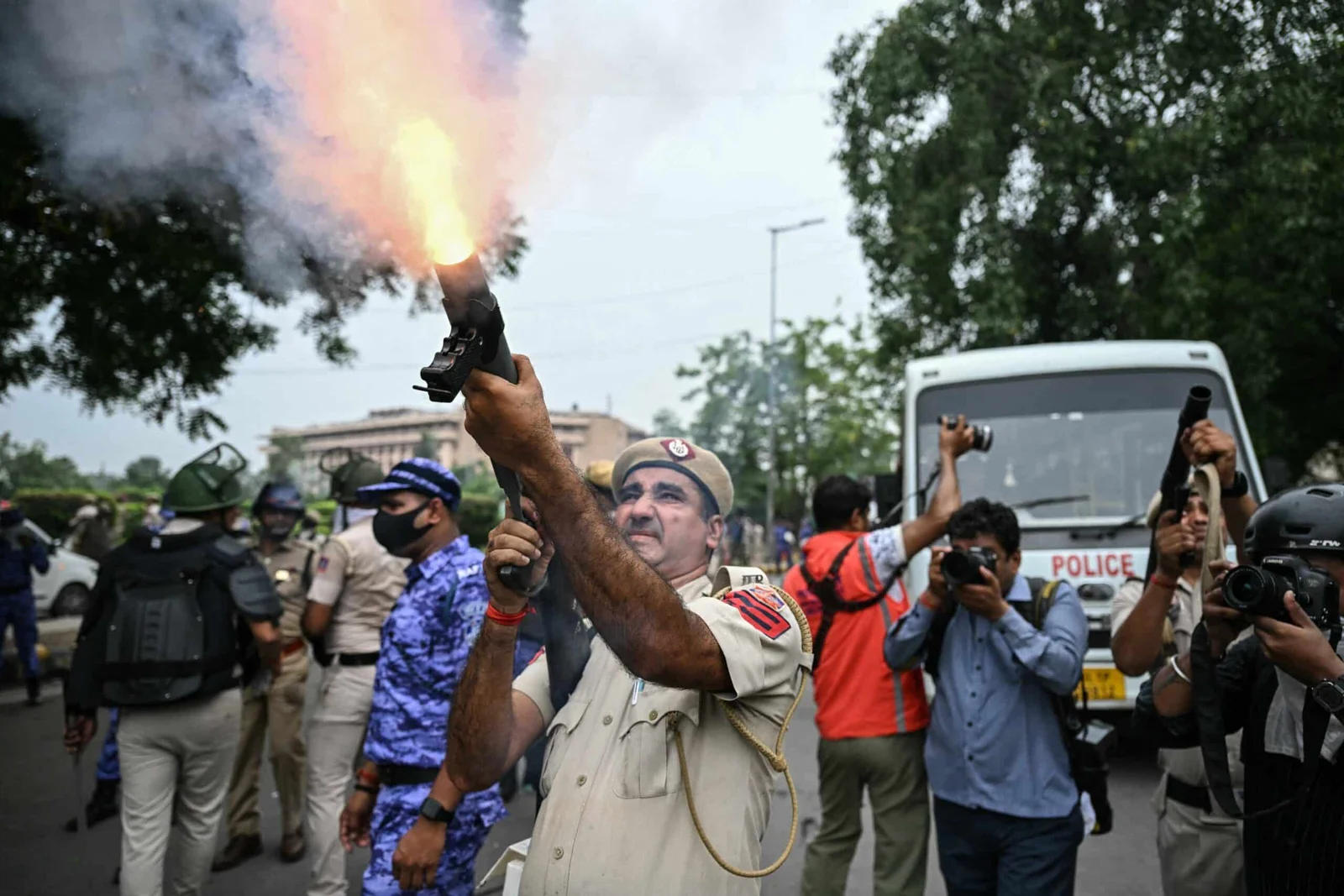





Security forces deployed tear gas and launched baton charges in the capital on Monday, moving to disperse thousands of student demonstrators who attempted to breach security perimeters to march on the Indian Parliament.
The mass demonstration, which coincided with the opening day of Parliament’s monsoon session, marks one of the largest public mobilizations in New Delhi in recent years. The youth-led march has emerged as an early political test for Prime Minister Narendra Modi’s third-term administration following the 2024 general elections.
Indian police violently repressed protesters as thousands gathered for a “Cockroach” movement march on parliament demanding the resignation of education minister Dharmendra Pradhan in New Delhi on July 20.
The movement, seen as a major challenge to Prime Minister Narendra Modi… pic.twitter.com/ZQkPB62fzs
— TRT World (@trtworld) July 20, 2026
Technical Failures Push Students to the Streets
The protests are centered around absolute structural breakdowns within India’s highly competitive national examination frameworks. Public anger boiled over following consecutive evaluation scandals earlier this summer:
-
The NEET-UG Leak: The high-stakes medical entrance examination, taken by roughly 2.2 million aspiring doctors, had to be completely re-administered under heavy security after a widespread paper leak rendered the initial testing invalid.
-
On-Screen Marking Discrepancies: A secondary institutional failure hit nearly 2 million high school candidates, who faced severe evaluation discrepancies linked to the central board’s automated digital marking systems.
Rise of the Satirical “Cockroach Janta Party”
The momentum behind the street rallies has been largely organized by the Cockroach Janta Party (CJP), a unique satirical movement that has rapidly mobilized millions of followers across digital platforms.
The party was founded in May by digital strategist Abhijeet Dipke. The group intentionally reclaimed a public insult after a high-ranking judicial official disparagingly compared unemployed youth and student activists to “cockroaches” during a court hearing. The CJP quickly turned the phrase into a rallying cry against the broader youth employment crisis. Government data highlights the underlying economic anxiety fueling the movement:
-
The national unemployment rate for citizens aged 15 and above stands at a manageable 3.1 percent.
-
However, youth unemployment (ages 15 to 29) skyrockets to 9.9 percent nationwide.
-
In urban centers, youth joblessness peaks at 13.6 percent, compared to 8.3 percent in rural sectors.
WHEN WILL I END THE FAST….!
Not withstanding my health my fast continues till after the Sansad Chalo March, and will be broken only under the following circumstances… pic.twitter.com/kaOGx2Nk4T— Sonam Wangchuk (@Wangchuk66) July 20, 2026
Escalation at Jantar Mantar and Strategic Demands
Tensions in the capital rose sharply over the weekend after Delhi Police forcibly removed renowned Ladakhi environmentalist and education reformer Sonam Wangchuk from the Jantar Mantar protest site. Wangchuk had spent 20 days on an indefinite hunger strike alongside CJP leadership before being transferred to a city hospital under state supervision.
Following his relocation, the CJP escalated its demands from calling for the immediate resignation of Union Education Minister Dharmendra Pradhan to demanding systemic political accountability from the Prime Minister.
From his hospital room, Wangchuk issued a handwritten note outlining specific conditions required to end his fast:
-
A formal government acknowledgment of accountability regarding the national examination failures and paper leaks.
-
Allowing the CJP marchers to safely reach Parliament to ensure their grievances are officially noted.
-
Alternatively, a cross-party delegation of lawmakers must meet him directly at the hospital to provide verified legislative assurances that the issue will be formally debated during the ongoing parliamentary session.
Political Standoff Echoes in Parliament
As Delhi Police implemented local communication blackouts and strictly enforced prohibitory orders across central New Delhi, the executive team initiated its first formal outreach to the movement. CJP spokespersons confirmed they met with a senior cabinet minister to hand over an official list of demands, including testing system restructuring and student compensation.
While Prime Minister Modi avoided addressing the ongoing street clashes during his pre-session remarks, the issue immediately disrupted legislative proceedings. Opposition lawmakers, led by Congress senior leader Mallikarjun Kharge, strongly condemned the police action in both houses of Parliament, accusing the ruling administration of using force to suppress the legitimate concerns of the nation’s youth.