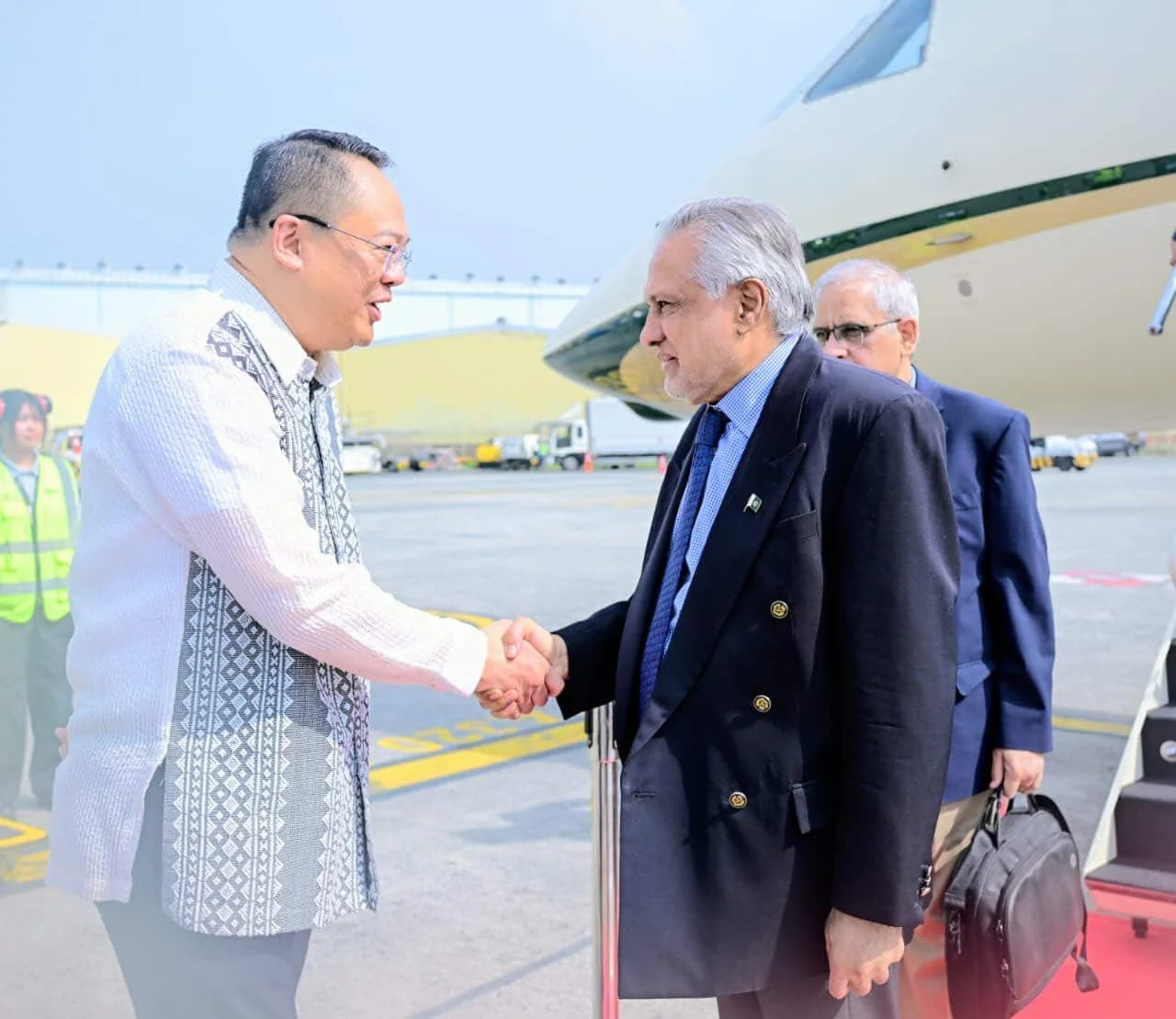




Deputy Prime Minister and Foreign Minister Senator Mohammad Ishaq Dar arrived in Manila on Wednesday to represent Pakistan at the 33rd ASEAN Regional Forum (ARF) Ministerial Meeting. The high-level gathering brings together foreign ministers and delegates from 27 member states alongside the ASEAN Secretary-General to address pressing Asia-Pacific political and security developments.
Upon landing, Dar was received by Elmer G. Cato, Assistant Secretary at the Philippines Department of Foreign Affairs, alongside Pakistan’s Ambassador to the Philippines Asima Rabbani. Pakistan, an active ARF member since 2004, is focusing its platform on promoting regional stability, economic connectivity, and conflict resolution through sustained diplomatic channels.
US Secretary of State Marco Rubio said the United States is still willing to negotiate an end to the Iran crisis but Tehran is not serious about talks, as the widening conflict disrupted two of the world’s most critical energy chokepoints https://t.co/lDVOVfOk4R
— Reuters (@Reuters) July 22, 2026
High-Level Sideline Engagements: Moscow, Dhaka, and the UN Axis
Beyond the primary ARF plenary, Dar utilized the summit’s sidelines to execute a series of strategic bilateral engagements:
-
Diplomatic Realignment with Bangladesh: Dar met with Bangladeshi Foreign Minister Khalilur Rehman—who also serves as President-elect of the 81st session of the UN General Assembly. The ministers lauded the revitalized trajectory of bilateral relations following Dar’s visit to Dhaka last year, specifically highlighting the operationalization of direct flights between Dhaka and Karachi after a 14-year hiatus.
-
Strategic Coordination with Russia: Meeting with Russian Foreign Minister Sergey Lavrov ahead of the main forum, both leaders reviewed bilateral ties across energy, trade, and regional transit corridors. They reaffirmed commitments to deepen high-level coordination within multilateral frameworks like the SCO and UN.
-
Institutional Ties at ADB Headquarters: Dar visited the Asian Development Bank (ADB) headquarters in Manila, holding structured talks with Leah Gutierrez, Director General for Central and West Asia. The discussion centered on ADB’s evolving funding pipeline for Pakistan and recognized the leadership of Pakistani professionals within the bank, while formally welcoming Nashita Mohsin as Pakistan’s new Executive Director to the ADB.
🔈 PR No. 1️⃣8️⃣0️⃣/2️⃣0️⃣2️⃣6️⃣
Curtain Raiser: Deputy Prime Minister/Foreign Minister to Attend the 33rd ASEAN Regional Forum Ministerial Meeting in Manila
🔗⬇️ pic.twitter.com/2KO6xAhdB6
— Ministry of Foreign Affairs – Pakistan (@ForeignOfficePk) July 21, 2026
Strategic Analysis: The Calculus Behind Pakistan’s ASEAN Push
Dar’s active engagement in Manila underlines a distinct recalibration of Pakistan’s foreign policy framework amidst complex global realignments:
Institutionalizing the “Vision East Asia” Strategy
For years, Pakistan’s primary diplomatic bandwidth was absorbed by immediate border frictions and Western security alliances. Dar’s presence at the 33rd ARF highlights Islamabad’s deliberate effort to institutionalize its “Vision East Asia” policy. By cultivating strong B2B and state-level relationships with ASEAN nations, Pakistan aims to diversify its trade routes, attract foreign direct investment, and integrate into Southeast Asia’s rapidly expanding supply chains.
The Strategic Value of “Sideline Diplomacy”
The timing of Dar’s meetings with Sergey Lavrov and Khalilur Rehman is highly tactical. With Pakistan playing an increasingly active mediation role in global hotspots—such as the US-Iran crisis—maintaining open, synchronized communication channels with Moscow provides Islamabad with broader geopolitical leverage. Concurrently, solidifying ties with Bangladesh reflects a pragmatic normalization process in South Asia, turning historical friction into functional economic cooperation through enhanced air connectivity and trade.
Financial Diplomacy and Multilateral Credibility
Dar’s visit to the ADB headquarters reinforces the economic dimension of his foreign policy mandate. By pairing security diplomacy at the ARF with institutional economic alignment at the ADB, Islamabad is signaling to international financial institutions that it remains committed to structural reforms, sustainable development projects, and securing multilateral support to buffer domestic economic stability.