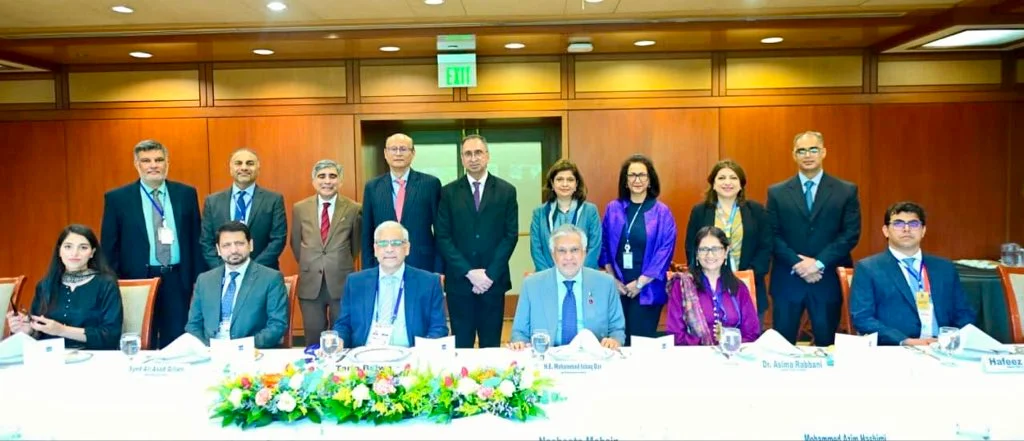





Deputy Prime Minister and Foreign Minister Senator Mohammad Ishaq Dar directly engaged senior leadership at the Asian Development Bank (ADB) headquarters on Wednesday, formally requesting an expedited processing timeline for financing Pakistan’s flagship Main Line-1 (ML-1) railway modernization project.
The high-level meeting took place on the sidelines of the 33rd ASEAN Regional Forum (ARF) Ministerial Meeting in Manila, where Pakistan is actively utilizing bilateral diplomacy to secure major regional economic and infrastructure commitments.
Deputy Prime Minister/Foreign Minister Senator Mohammad Ishaq Dar @MIshaqDar50 held a productive meeting today with ADB Vice President (South, Central and West Asia) Mr. Yingming Yang, ADB Vice President (Sectors and Themes) Ms. Fatima Yasmin, ADB Director Generals and officials,… pic.twitter.com/MsdFWPmFjU
— Ministry of Foreign Affairs – Pakistan (@ForeignOfficePk) July 22, 2026
Direct Appeal for ML-1 Consortium Leadership
During structured talks with ADB Vice President for South, Central, and West Asia Yingming Yang and Vice President for Sectors and Themes Fatima Yasmin, Dar framed the ML-1 project as a top national priority for Prime Minister Shehbaz Sharif’s administration.
-
Multilateral Consortium Push: Dar urged the Manila-based lender to maintain its proactive leadership role in forming and guiding a broader international financing consortium to bankroll the multi-billion-dollar corridor.
-
Accelerated Timelines: The Deputy Prime Minister specifically pressed ADB executives to shorten procedural review timelines to facilitate the rapid rollout of early-stage civil works.
-
Institutional Commitment: The ADB leadership reaffirmed its commitment to the project, explicitly acknowledging ML-1’s transformative capacity to overhaul Pakistan’s logistics, boost passenger mobility, and drive sustainable regional connectivity.
The initial phase of the upgrade, focusing on the 480-kilometer Karachi-Rohri sector, is slated to feature track renewals, modernized signaling networks, and structural foundation overhauls designed to support train speeds up to 160 kilometers per hour.
Expanding the Six-Decade Pakistan-ADB Partnership
The high-level delegation—which included Special Assistant to the Prime Minister Tariq Bajwa, Pakistan’s Ambassador to the Philippines Dr. Asima Rabbani, and Pakistan’s Executive Director to the ADB Nashita Mohsin—reaffirmed a partnership spanning over 60 years.
Beyond core transit infrastructure, both sides pledged to deepen collaboration across climate resilience initiatives, sustainable growth programs, and green energy transitions.
Dar also spent time engaging directly with Pakistani professionals holding senior positions within the bank during a working lunch hosted by Nashita Mohsin. He commended their contributions to the bank’s global mandate and encouraged closer coordination between international financial institutions and domestic policy planners.
Multilateral Coordination: Parallel Track Meetings with Moscow and Dhaka
Dar’s institutional push at the ADB coincided with intense sideline meetings with foreign counterparts attending the ARF summit:
-
Strategic Dialogue with Russia: Dar met with Russian Foreign Minister Sergey Lavrov to review progress on bilateral trade, energy supplies, and regional transit corridors, agreeing to maintain close contact across multilateral platforms like the SCO and UN.
-
Diplomatic Momentum with Bangladesh: Meeting with Bangladeshi Foreign Minister Khalilur Rehman—who is also President-elect of the 81st UN General Assembly session—Dar celebrated the renewed momentum in bilateral ties, pointing to the resumption of direct flights between Dhaka and Karachi as a key milestone in trade and people-to-people connectivity.
Strategic Analysis: The Economics Behind the ML-1 Urgency
Dar’s direct pitch to the ADB leadership highlights the vital economic realities facing Pakistan’s infrastructure strategy:
Overcoming Logistics Bottlenecks
The ML-1 rail artery carries nearly 80 percent of Pakistan’s passenger movement and up to 90 percent of its land freight traffic. Modernizing the corridor from Karachi to Peshawar is no longer merely a public transit initiative; it is a fundamental economic requirement. By shifting heavy cargo from road networks to high-speed rail, Pakistan stands to drastically lower domestic logistics costs, reduce fuel import demands, and improve supply chain efficiency for agricultural and industrial goods.
Diversifying Project Finance Mechanics
Historically envisioned primarily under the China-Pakistan Economic Corridor (CPEC) framework, the explicit push for the ADB to lead a broad multilateral financing consortium reflects a broader strategy to diversify capital sources. Securing multilateral anchor commitments from the ADB mitigates fiscal pressure on state coffers, increases global transparency standards, and builds international donor confidence to co-finance major long-term infrastructure projects.
Leveraging the Regional ASEAN Platform
By pairing transit project financing pitches at the ADB with diplomatic talks alongside major powers like Russia, Pakistan is maximizing its presence at the ASEAN Regional Forum. Islamabad is signaling to major Asian economies that its economic recovery hinges on position as a central trade hub connecting South Asia, Central Asia, and East Asian supply chains.