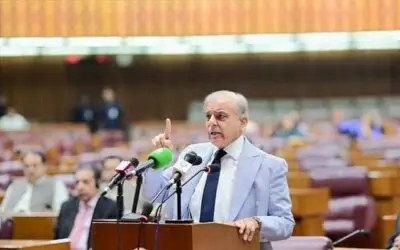





In a major development that challenges the federal government’s public claims of austerity and tight fiscal consolidation, Finance Minister Muhammad Aurangzeb has formally tabled a request before Parliament to regularize an unprecedented Rs3.684 trillion ($13.2 billion) in supplementary and technical supplementary grants.
Official budget documents reveals that the National Assembly is being forced to approve an overrun package more than four times higher than the Rs895 billion regularized during the previous fiscal year.
The multi-trillion-rupee bill represents a massive wave of unbudgeted state expenditure, presented to lawmakers as a legally binding fait accompli to retroactively authorize outlays that have already been fully consumed by the executive apparatus.
Finance Minister Muhammad Aurangzeb asked the parliament to give post-facto approval for a record Rs3.684 trillion supplementary grants for expenditure overruns and re-appropriation.https://t.co/ICruHU3zyl
— Dawn Business (@dawn_business) June 16, 2026
Dissecting the Deficit: Debt Servicing and Sector Overruns
The statutory documentation submitted by the Ministry of Finance details a structural breakdown across two operational cycles, explicitly highlighting that the funds could neither be met from allocated resources nor legitimately postponed under Articles 80-84 of the Constitution:
-
The Fiscal Year 2024-25 Legacy: An overwhelming Rs3.2 trillion of the total request pertains to the tail-end of FY25 (May 17 to June 30, 2024-25). This massive spike was driven almost entirely by an unsanctioned Rs2.6 trillion expansion in debt servicing costs, alongside Rs430 billion injected into the power sector and Rs23 billion for the Defence Division.
-
The Fiscal Year 2025-26 Outlays: For the current fiscal cycle (July 1 to May 15, 2025-26), the ministry is seeking retrospective sanction for Rs485 billion. This current-year overrun is led by Rs127.5 billion for grants and subsidies, followed by Rs112 billion for the power sector and Rs34 billion for defense services.
Inside the Line Items: Daanish Schools and Strategic Border Fencing
The detailed annexures of the supplementary demands expose highly specific, off-budget allocations that completely bypassed initial parliamentary oversight:
-
The Education Shift: Of the Rs57 billion supplementary allocation to federal education, a staggering Rs54 billion was routed into the Daanish Education Trust, alongside urgent bailout packages for Quaid-i-Azam University and Cadet College Hasan Abdal.
-
Defense & Civil Infrastructure: The military apparatus received an additional Rs34 billion for high-priority operational outlays, including the procurement of helicopter spare parts, the fencing of the Pak-Iran border, and the ongoing construction of the Defence Complex Islamabad (DCI), which included a localized Rs4 billion cash compensation package for the residents of Chauntra village.
-
The State Media Cash Inflow: In a highly unusual move, the Ministry of Information was granted Rs14 billion, which included an Rs11 billion bailout to Pakistan Television (PTV) for tariff adjustments and net-metering, alongside Rs2.80 billion dedicated entirely to launching a state-run English news channel.
Critical Analysis
The tabling of a record Rs3.684 trillion supplementary budget represents a profound institutional crisis, exposing how the state’s actual operational costs are fundamentally decoupled from the official budgets passed by Parliament.
The Constitutional Devaluation of the Power of the Purse
The sheer volume of these regular supplementary grants exposes an institutional bypass of Parliament’s primary constitutional authority: the power of the purse. Under the mechanics of the Federal Consolidated Fund, regular supplementary grants are treated as “charged expenditure.” Because these billions have already been spent by the finance ministry to avoid default or institutional paralysis, the Parliament cannot legally reject or amend the motion.
Lawmakers are reduced to a rubber-stamp body, granting post-facto legality to expenditures that were never debated during the formal budget session. This practice raises serious questions about the technical accuracy of the country’s macroeconomic planning, suggesting that initial budget estimates are frequently under-budgeted to present an artificial picture of fiscal discipline to international lenders like the IMF.
The Sovereign Debt Chokehold
The allocation of Rs2.6 trillion for unsanctioned debt servicing costs in the late stages of FY25 is an alarming confirmation that the domestic debt trap has entered a critical stage. This multi-trillion-rupee overrun demonstrates that volatile domestic interest rates and high short-term rolling treasury bills have completely overwhelmed the ministry’s projections.
When more than 70% of an emergency supplementary budget is consumed purely by interest payments rather than asset creation, the state’s fiscal space is effectively non-existent. It proves that the state is actively borrowing additional capital simply to cover the unbudgeted interest on its existing debt profile—the exact definition of a sovereign debt spiral.
The Subtext of the Paradoxical Allocations
The specific allocations within the FY26 package reveal glaring contradictions in the state’s narrative of fiscal tightening. The most stark example is the utilization of Rs127.4 billion for the PM’s Austerity Fund within a supplementary framework that is, by definition, an expansion of spending.
Similarly, spending Rs11 billion to shield PTV from net-metering tariff adjustments and injecting Rs1.4 billion for Frontier Corps security at the Reko Diq project in Balochistan highlights where the state’s true priorities lie.
While the general populace faces crushing utility bills and high inflation under strict IMF-mandated revenue targets, the state apparatus continues to shield its own entities, strategic state media, and elite educational networks through a multi-trillion-rupee backchannel spending pipeline.
The Takeaway: Muhammad Aurangzeb’s request for a Rs3.684 trillion regularization is a sobering reality check for Pakistan’s economic governance. It proves that despite rigorous rhetoric surrounding structural reform, the structural inefficiencies of debt servicing and the power sector continue to bleed the public kitty dry. If the state cannot align its actual, real-time spending with its official legislative budgets, the credibility of its fiscal forecasting will remain fundamentally compromised, leaving both domestic taxpayers and international sovereign creditors to shoulder the burden of an unaccountable executive ledger.