




The Rise of Online Scams and Global Concern
Online scams have become one of the fastest growing forms of organized cybercrime in the world. From investment fraud and fake job offers to romance scams and phishing campaigns, millions of people globally fall victim every year, losing their hard-earned money and often suffering personal hardship. In 2023, global losses from these schemes were estimated to be between $18 billion and $37 billion, illustrating the massive economic and social impact of online fraud.
Beyond financial loss, online scams are now closely linked to other serious crimes. They are tied to money laundering, corruption, trafficking in persons for forced criminality, and cybercrime networks that operate across national borders. These scam networks exploit digital platforms, weak regulatory environments, and gaps in law enforcement cooperation to expand rapidly. In Southeast Asia, for instance, clandestine scam centres in countries like Cambodia have been documented as hubs for forced labour and online fraud, with thousands of victims trafficked under deception and coerced into running scams.
It is in this context that the recent Global Partnership Against Online Scams agreement emerged from an international conference in Bangkok in December 2025, a development that marks a significant step in the global counteroffensive against cybercrime.
You May Like to Read: Developing Resilience in the Information Warfare Era
Bangkok Hosts a Global Initiative
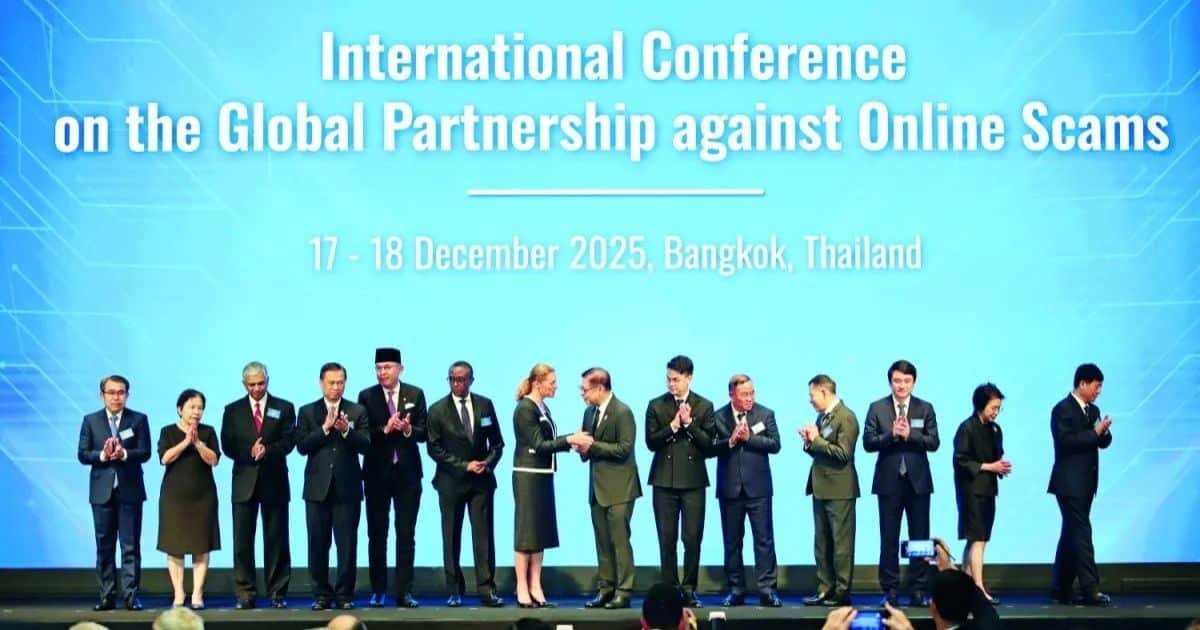
On 17-18 December 2025, Bangkok became the focal point of a major international effort to tackle online scams at the International Conference on the Global Partnership Against Online Scams. Co-hosted by the Thai Ministry of Foreign Affairs and the United Nations Office on Drugs and Crime (UNODC), the conference brought together representatives from more than 60 countries, international organizations, law enforcement agencies, civil society, and major private technology companies.
The gathering underscored the growing recognition that online scams are not a regional problem but a global threat that undermines trust in the digital economy and affects citizens across continents. Thailand, Bangladesh, Nepal, Peru, and the United Arab Emirates were among the states that formally signed the partnership agreement, a commitment to collective action against online fraud.
A global cooperation effort to combat online scams was formally launched in Bangkok as representatives from 58 countries gathered for a landmark conference to confront the rapidly expanding threat of transnational crime.
Listen to the story or get the full story in the 1st… pic.twitter.com/lnrqSQXJkf
— Bangkok Post (@BangkokPostNews) December 18, 2025
What the Bangkok Joint Statement Covers
The 2025 Bangkok Joint Statement, the official document that emerged from the conference, outlines a framework for international cooperation to combat online scams. This agreement, which remains open for endorsement by more countries and organizations, focuses on several key areas:
First, the statement calls for stronger law enforcement and prosecution cooperation against transnational cybercrime networks. By encouraging nations to establish national focal points and specialized units to handle scam prevention, prosecution, and victim protection, the pact aims to close gaps that criminals exploit when crossing borders.
Second, it emphasizes the importance of sharing information, digital evidence, and intelligence among governments and with private technology platforms. Given how rapidly scam operations adapt and migrate across jurisdictions, real-time data exchange is essential to effective disruption and investigation.
Third, the statement stresses victim protection and support, acknowledging that many individuals not only lose money but also face psychological harm and, in some cases, trafficking. The pact encourages countries to create pathways for restitution and rehabilitation for those affected.
Fourth, the partnership explicitly invites private sector engagement, recognizing that social media platforms, telecom providers, banks, and cybersecurity firms play a critical role in detecting, preventing, and reporting scams. Meta and TikTok actively participated in the event and signed on to support anti-scam measures, highlighting the need for shared responsibility across sectors.
Finally, the agreement underlines the urgency of implementing the recently signed United Nations Convention against Cybercrime, also known as the Hanoi Convention, which came into force in 2025 and provides a legal basis for cross-border cooperation on cybercrime matters, including online fraud.
Enforcement Mechanisms and Cooperation
Unlike earlier declarations that were largely aspirational, the Bangkok statement seeks to anchor commitments in practical and enforceable actions. Participating countries agreed to strengthen domestic legislation and enforce existing laws to counter online fraud. Some nations are already moving ahead; for example, Thailand has undertaken domestic legal reforms this year to empower authorities to freeze suspicious accounts, penalize financial facilitators of fraud, and streamline reporting mechanisms. Its Anti-Online Scam Operation Center (AOC 1441), a coordinated national hotline linking police, regulators, and financial institutions for rapid response, has already processed millions of reports and disrupted hundreds of thousands of scam accounts.
Another pivotal mechanism envisioned by the pact is enhanced intelligence sharing, particularly regarding complex financial flows, cryptocurrency transfers, and digital footprints of transnational scam groups. Scammers often use decentralized platforms and anonymous digital currencies to obscure their operations, making joint investigative tools and standardized protocols essential for tracing and freezing assets.
Role of the Private Sector and Technology Platforms
In an era where digital platforms are central to the spread of online scams, the Bangkok agreement marks a significant shift by formally incorporating private technology firms into the anti-scam architecture. At the conference, Meta presented insights into how artificial intelligence and automated tools can both enable and detect scam content, while TikTok pledged collaboration under the partnership’s terms.
This public-private cooperation aims to harness technological capabilities, such as AI-based detection systems, automated reporting, and content moderation, to identify scam patterns early and reduce their reach. While security and privacy concerns remain a challenge, establishing trust and protocols between governments and tech firms represents a strategic effort to tackle scams at their source.
Critiques and Challenges Ahead
While the Bangkok agreement is a promising milestone, its success will depend on sustained political will, resource allocation, and genuine implementation. Critics point out that many countries struggle with weak enforcement capacity, lack of technical expertise, and institutional barriers that make cross-border cooperation difficult. Without clear timelines, accountability mechanisms, and funding commitments, the pact risks remaining a statement of intent rather than a driver of measurable change.
Another challenge is the evolving nature of scam operations. As criminals increasingly adopt sophisticated technologies like AI to automate and personalize scams, law enforcement must keep pace with tools that are themselves continually evolving. Moreover, in regions where governance is weak or corruption weakens enforcement, criminal networks can persist despite international pressure.
Finally, there is the question of inclusivity. Some affected countries, including nations hosting significant scam operations, were absent from the conference due to diplomatic tensions. Effective global governance against online scams will require broad participation, including states with differing political contexts and enforcement capacities.
Myanmar’s Limited Crackdown: A Test of Political Will
Despite Myanmar’s high-profile raids on KK Park and other scam centers, experts warn that the crackdown may be largely symbolic. Many scam compounds remain operational, with workers and equipment rapidly relocating to other sites in Myanmar and abroad, including Cambodia and Mauritius. Some facilities continue to use Starlink to maintain online operations even after SpaceX cut off service, highlighting the resilience and adaptability of these networks. Observers note that without arresting the heads of transnational syndicates or seizing their wealth, the impact of raids may be limited, raising questions about Myanmar’s political will and the sustainability of enforcement efforts.
So they started cracking down on the scam call centers in Myanmar…by fkn blowing them up.
KK Park on the border of Thailand and Myanmar was where a Japanese high school student (and a Chinese actor) were held. All told 456 (out of 635) buildings were destroyed https://t.co/15MXVQWVjK pic.twitter.com/kFw37jcQRs— eric ゑリッ久 (@shinobu_books) December 19, 2025
Implications for Pakistan and the World
For Pakistan and countries alike, the Bangkok initiative signals a new era of global cooperation against digital threats that do not respect national boundaries. With millions of Pakistanis active online every day, efforts to protect citizens from scams, from bogus investment schemes to identity theft, are critical for public safety and economic confidence. The partnership creates frameworks that Pakistan can leverage to strengthen its own cybercrime laws, enhance cooperation with international partners, and engage with global tech firms on best practices.
You May Like to Read: A Multi-Stakeholder Approach to Improve Cybersecurity
Concluding
This pact reinforces the notion that cybercrime is not simply a law enforcement issue but a broader digital governance challenge, involving legal reform, technological innovation, public awareness, and international solidarity. As more nations ratify the UN Convention against Cybercrime and operationalize the commitments of the Bangkok statement, the global community moves closer to a structured and effective defense against one of the defining criminal threats of the digital age.
The Global Partnership Against Online Scams represents a hopeful step toward a safer digital world, but its impact will be judged not by words alone, but by the real outcomes it delivers for victims, societies, and the integrity of the global digital ecosystem.
Check out our latest video: