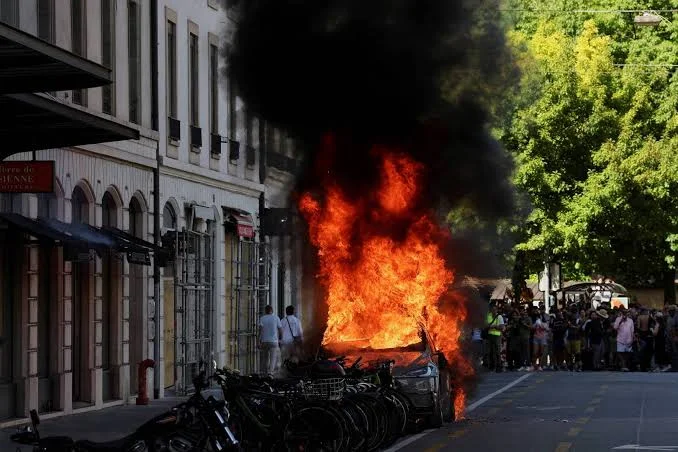


Violent kinetic clashes erupted across the urban center of Geneva on Sunday as an estimated 20,000 anti-globalization and anti-imperialist protesters transformed the Swiss diplomatic hub into a battlefield. The unrest ignited less than 24 hours before the formal commencement of the G7 Summit in the nearby French resort town of Evian, hosted by French President Emmanuel Macron.
What began as a peaceful cross-coalition march swiftly degenerated into an aggressive urban offensive when a highly organized vanguard of 600 “Black Bloc” militants broke through security cordons.
Riot police responded with a massive deployment of tear gas, stun grenades, and high-pressure water cannons to protect critical international infrastructure, including the heavily fortified European Headquarters of the United Nations.
A nine-year-old girl was killed in Chakwal in alleged firing by a CCD official, the CTD spokesperson said, adding that the official had been suspended and arrested. The girl’s father and brother are under treatment.
Visit our website: https://t.co/vURCUirZbS#TheNews pic.twitter.com/ZBEI17qpUC
— The News (@thenews_intl) June 15, 2026
Target Matrix: Vandalism of the Capitalist Apparatus
The demonstration, organized under the banner of the “No-G7” Coalition—an alliance of over 60 leftist unions, climate groups, and anti-war associations—initially marched to voice support for Palestinians, radical climate action, and anti-capitalism. However, Black Bloc elements quickly shifted the operational focus to systemic property destruction:
-
UN Infrastructure Bludgeoned: Masked rioters launched synchronized attacks using chunks of concrete, iron bars, and commercial-grade firecrackers against corporate and international targets. The offices of the UN’s International Telecommunications Union (ITU) and the regional headquarters of global consulting giant PricewaterhouseCoopers (PwC) sustained severe structural damage, with windows shattered and facades defaced.
-
The Tesla Torch: In a viral symbolic action along the parade route, a luxury Tesla vehicle was flipped, spray-painted with the slogan “Eat the Rich,” and completely torched.
-
The UN Blockade: Protesters attempted to storm the primary gates of the UN’s European headquarters, but were aggressively repelled by pre-positioned defensive lines of armored police vehicles and continuous water cannon barrages. Journalists trapped inside the UN compound reported a continuous loop of explosions, police sirens, and low-flying surveillance helicopters circling the airspace into the midnight hours.
The Border Friction: The Annemasse Cordon Fallacy
The scale of the violence inside Swiss territory has sparked immediate political friction between Swiss and French security administrations.
-
The Counter-Summit Shutdown: The “No-G7” coalition had originally designed a peaceful, structured “counter-summit” in the French border town of Annemasse to act as a pressure valve for public dissent. However, French border authorities pre-emptively banned the assembly and restricted movement across the border corridor.
-
The Swiss Backlash: Left with no outlet on the French side, the entire mass of agitated demonstrators concentrated within the streets of Geneva. Geneva Security Minister Carole-Anne Kast issued a sharp public rebuke, expressing deep regret that French authorities had failed to facilitate a public forum on their side of the border, effectively shifting the entire security liability onto Swiss law enforcement.
Critical Analysis
The explosive unrest in Geneva is the domestic manifestation of an incredibly tense, high-stakes international environment, as world leaders gather for what is being described as the most friction-filled G7 summit in a generation.
The Shadow of the 2003 Ghost
The decision by Geneva authorities to deploy a massive, multi-jurisdictional police presence was driven by the historical trauma of the 2003 G7 Evian Summit. Twenty-three years ago, anti-globalization riots caused tens of millions of dollars in uninsured property damage across Geneva and Lausanne, fracturing Swiss-French security cooperation.
While the police successfully held the line at the UN gates on Sunday, the tactical reality that 600 Black Bloc operatives could completely hijack a 20,000-strong march proves that the “No-G7” movement has successfully remobilized. They have tapped into widespread public anger over global inflation, the Eurozone’s lingering energy dependencies, and Western military spending.
The Strait of Hormuz and Western Disunity
The underlying catalyst for both the intense security state and the rage of the protesters is the lingering instability in the Middle East. This G7 summit represents the first major face-to-face gathering of Western allies since the intense conflict involving the United States, Israel, and Iran severely disrupted global commerce. While official summit talking points focus on permanently securing the Strait of Hormuz shipping lanes, the backroom reality is defined by severe diplomatic disunity among the G7 members.
Sources within the diplomatic corps indicate that German Chancellor Friedrich Merz and French President Emmanuel Macron are preparing to confront the U.S. delegation over its aggressive regional strategy. The European powers—whose economies are acutely vulnerable to maritime trade disruptions—are pushing for an immediate, institutionalized diplomatic off-ramp with Tehran. This stands in stark contrast to Washington’s preference for unilateral economic containment.
The protesters outside the UN see this internal G7 friction as absolute proof that the Western alliance is prioritizing imperialist resource control over human security and climate stability.
The Airport Vulnerability
The logistics of the Evian summit introduce a unique tactical vulnerability that Geneva security forces are frantically trying to manage. Because Evian lacks a major international aviation hub, the vast majority of world leaders—including U.S. President Donald Trump, British PM Keir Starmer, and Japanese PM Sanae Takaichi—alongside invited heads of state from India and Brazil, must land at Geneva International Airport before transferring to France via motorcade or helicopter.
By paralyzing the urban transport arteries of Geneva and forcing the deployment of emergency water cannons near the airport corridors, the Black Bloc has demonstrated that it possesses the asymmetrical capability to disrupt the transit lines of the world’s most heavily guarded statesmen, turning a logistical bottleneck into a high-leverage political statement.
The Takeaway: The smoke rising from the torched vehicles on the shores of Lake Geneva is a grim prelude to the formal negotiations in Evian. The G7 nations are no longer operating in an insulated bubble of global consensus; they are attempting to manage a fracturing international order while under active siege from their own domestic populace. If President Macron and his counterparts cannot use this week to deliver a credible, unified framework for Middle Eastern stabilization and maritime freedom, the violence in the streets of Geneva will be remembered as the opening salvo of a much larger crisis of Western institutional legitimacy.