


A fragile four-year truce shattered on Monday as Yemen’s Iran-aligned Houthi movement launched a coordinated barrage of ballistic missiles and explosive drones targeting Abha International Airport and two military bases in southwestern Saudi Arabia. The cross-border escalation followed a dramatic daytime bombing of the runway at Houthi-controlled Sanaa International Airport, an assault executed by Saudi-backed Yemeni government forces to block an Iranian passenger aircraft from landing.
The rapid cycle of strike and counter-strike marks the most severe disruption of the largely dormant conflict since an informal de-escalation agreement took effect in 2022. It threatens to reignite a brutal 11-year civil war and open a dangerous new front in the Middle East, precisely as the regional security architecture is buckling under a collapsing peace framework elsewhere in the Gulf.
Houthis BOMB Saudi airport after Sanaa strikes — ‘SUCCESSFUL OPERATION’
DRONES and MISSILES hit Abha International Airport
Warn ALL AIRLINES: Stay out of Saudi airspace https://t.co/GiOu5UQODj pic.twitter.com/ePzi8sWTV2
— RT (@RT_com) July 13, 2026
Blockade and Bombing: How the Crisis Unfolded
The immediate catalyst for the military flare-up was a sovereignty dispute over an Iranian passenger aircraft. Tensions had been mounting for days after the Houthis successfully operated a direct flight between Sanaa and Tehran—the first such direct civil transit in over a decade. The flight had carried a senior Houthi political delegation to Tehran to attend the state funeral of Iran’s late Supreme Leader, Ayatollah Ali Khamenei.
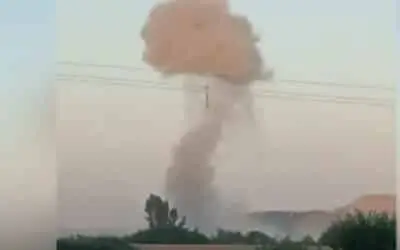
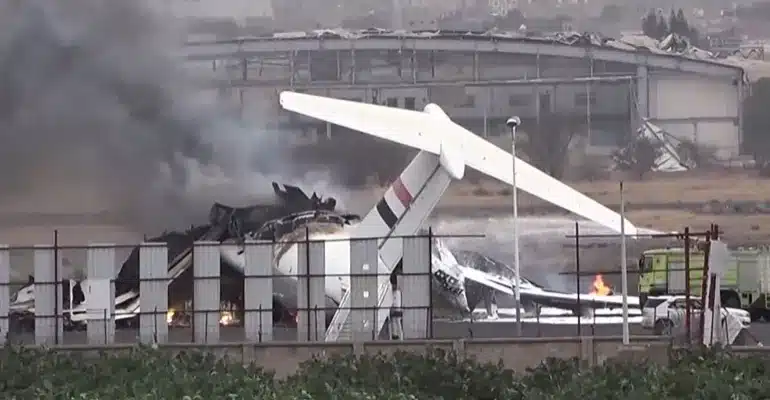
On Monday, as the Iranian flight attempted to return the rebel delegation to the capital, the internationally recognized Yemeni government, operating from its southern seat in Aden, ordered a pre-emptive strike on Sanaa’s infrastructure. Plumes of dark smoke were seen rising above the capital’s skyline as state-aligned forces targeted the main runways.
The Yemeni Ministry of Defense defended the runway bombing, asserting that Houthi militias had illegally refused to let national domestic carriers land while insisting on allowing an unauthorized Iranian vessel to violate sovereign Yemeni airspace. Government officials accused Tehran of using the cover of civilian diplomatic transport to illegally ferry military hardware, technical advisers, and strategic experts into Houthi-controlled territory.
Due to the physical destruction of the Sanaa runway, the incoming Iranian aircraft was forced to abort its landing and divert to the Houthi-held Red Sea port city of Hudaydah, located roughly 150 kilometers to the southwest.
The Retaliation: Ballistic Missiles Target Abha Airport
The Houthis reacted with immediate fury, declaring the strike a “blatant act of aggression” and blaming Saudi Arabia for enabling the airspace intrusion. Historically, all aircraft entering Yemeni airspace have required flight clearance from the Saudi-led military coalition, which intervened in the civil war in 2015 to back the recognized government.
Houthi military spokesperson Brigadier General Yahya Saree issued an emergency televised address, declaring that the assault on Sanaa’s civilian infrastructure had effectively “ended the de-escalation phase”. Saree warned that the action would not go “unanswered or unpunished”.
Hours later, the Houthi forces launched a heavy salvo of ballistic missiles and long-range attack drones toward Abha International Airport and adjacent Saudi air bases. The Saudi-led military coalition subsequently confirmed that its advanced air defense batteries had engaged and successfully neutralized the incoming aerial threats over the southern region. While the coalition reported no casualties or significant infrastructural damage, the attack triggered immediate regional logistical chaos, forcing commercial carriers like flydubai and Air Arabia to cancel all scheduled flights connecting the United Arab Emirates and Saudi Arabia to Abha.
In his military declaration, Saree issued a stern warning to all international airlines, advising commercial carriers to immediately cease overflying Saudi airspace.
“We warn all airline companies against using the airspace of the Kingdom of Saudi Arabia,” Saree announced. “These warnings must be taken with the utmost seriousness until the blockade on Sanaa International Airport is permanently lifted.”
International Alarm and the Cost of Conflict
The sudden outbreak of hostilities sparked deep anxiety among international diplomats, who have spent years attempting to codify a permanent peace agreement in Yemen.
At a rapidly convened emergency session of the United Nations Security Council in New York, Assistant Secretary-General Khaled Khiari expressed grave concern over the collapsing truce. Khiari warned that neither Yemen nor the broader, volatile Middle East can sustain another catastrophic cycle of regional escalation, calling on all state and non-state actors to immediately return to UN-monitored negotiations.
The United Kingdom’s representative at the UN issued a strong condemnation of the Houthi attacks, calling them reckless threats to Saudi sovereign security. Conversely, Iran’s Foreign Ministry strongly condemned the bombing of Sanaa’s airport, describing the destruction of the runway as a clear violation of international humanitarian law and an illegal act of aggression against civilian transit.
Yemen has been fundamentally fractured by a devastating civil war that began in 2014 when Houthi rebels seized control of Sanaa and expelled the internationally recognized government. The subsequent military intervention by the Saudi-led coalition in 2015 escalated the conflict into a massive proxy war. Over the last decade, the fighting has claimed more than 150,000 lives and triggered what the UN characterizes as one of the world’s most severe humanitarian crises, leaving over 22 million people dependent on humanitarian aid.
With the fragile 2022 truce now functionally dead, regional analysts fear the country is standing on the precipice of a full-scale return to open warfare.