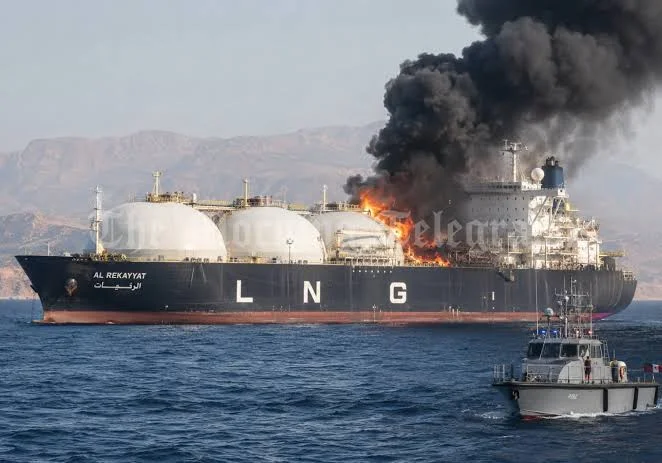





A critical international energy shipping lane was briefly plunged into a high-stakes maritime emergency on Tuesday after a Qatari-flagged liquefied natural gas (LNG) carrier, the Al Rekayyat, sustained significant damage and a severe onboard fire following an unprovoked attack on the Omani side of the strategic Strait of Hormuz.
The incident triggered intense international concern across global energy markets due to initial reports that the heavily loaded supertanker was at risk of a catastrophic explosion. However, subsequent emergency interventions by regional salvage teams and naval assets have successfully stabilized the vessel, preventing a breach of its highly protected cryogenic cargo systems.
A laden LNG carrier was struck by an unknown projectile near the Omani coast as it exited the Strait of Hormuz, a fresh attack that will fuel unease among shipowners and producers and tests a late-June peace deal https://t.co/QqH7FxSyrB
— Bloomberg (@business) July 7, 2026
The Technical Crisis Aboard the Al Rekayyat
The emergency unfolded within one of the world’s most critical maritime chokepoints, through which roughly one-fifth of global petroleum and LNG volumes pass daily.
-
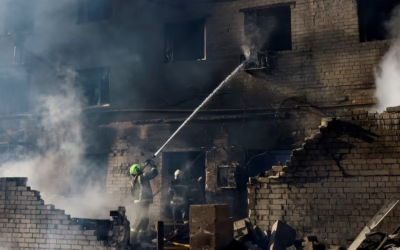
The Engine Room Outbreak: The attack directly struck the aft section of the Al Rekayyat, sparking a massive fire within the vessel’s primary engine room compartments. The rapid spread of the fire knocked out the ship’s power generation and propulsion, leaving it adrift in busy shipping lanes.
-
The Evacuation Protocol: Given the high thermal energy generated by the engine room fire and the potential threat to structural bulkheads, the captain initiated emergency protocols, resulting in the safe and successful evacuation of the entire crew by responding Omani and allied naval vessels.
-
The Containment Success: Despite early fears that the vessel was at risk of exploding, automated emergency shutdown systems and specialized internal fire barriers functioned exactly as designed. Independent maritime survey teams confirmed on Wednesday that the massive fire remained entirely confined to the engineering spaces, with absolutely no indication that the main LNG cargo tanks had been structurally compromised or breached.
Understanding LNG Shipping Security and Physical Mechanics
To understand the scale of the emergency, it is necessary to examine the physics of LNG transportation. LNG is natural gas that has been purified and super-cooled to approximately minus 162 degrees Celsius (minus 260 degrees Fahrenheit). This cryogenic cooling process transforms the gas into a liquid state, shrinking its molecular volume by roughly 600 times and making bulk intercontinental maritime transport economically viable.
In its liquid state, LNG itself is completely non-flammable and cannot explode; it requires vaporization into a gaseous form, a specific atmospheric concentration mixture with oxygen (between 5 and 15 percent), and an active external ignition source to become combustible.
Modern commercial LNG carriers are among the most sophisticated vessels afloat, employing a “defense-in-depth” structural architecture specifically engineered to withstand severe external kinetic impacts:
-
Double-Hull Construction: The ships are built with robust double hulls, separating the external sea environment from the cargo hold by several meters of reinforced steel space.
-
Cryogenic Containment Barriers: The LNG is housed within heavily insulated, multi-layered membrane or spherical tanks designed to maintain sub-zero temperatures throughout the voyage.
-
Boil-Off Gas Management: Because a fraction of the liquid naturally warms and transitions back to gas during transit—known as boil-off gas—the ships feature automated pressure-relief and vapor-capture systems that feed this gas directly into the ship’s propulsion turbines as a primary fuel source, preventing dangerous internal pressure spikes.
Industry experts emphasize that an engine room fire does not automatically trigger a cargo catastrophe. For a catastrophic explosion to occur at sea, a fire would have to burn unchecked for an extended period, warping the secondary insulation barriers, causing a massive structural rupture of the primary containment tanks, and allowing a massive, unmanaged gas cloud to form and ignite.
Geopolitical Fallout and the Vulnerability of Global Energy Corridors
The targeting of the Al Rekayyat underscores an alarming trend in modern hybrid warfare, where merchant shipping and global energy supply lines are increasingly viewed as legitimate, high-leverage targets by state and sub-national belligerents. Tuesday’s incident marks the second high-profile attack on an LNG carrier this year alone. In March, the Russian-flagged LNG tanker Arctic Metagaz was struck and set ablaze by Ukrainian naval drones in the Mediterranean Sea, forcing its crew to abandon ship.
With both the Eastern European and Middle Eastern conflicts regularly spilling into vital international waters, global marine insurance syndicates have significantly expanded “war risk” premiums across the Gulf of Oman and the Red Sea. International maritime security coalitions have increased patrols around the Strait of Hormuz, warning that while the Al Rekayyat successfully avoided a catastrophic environmental and physical disaster, the continued targeting of cryogenic energy shipping presents an ongoing vulnerability to global supply chain stability.