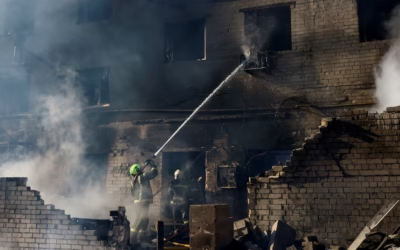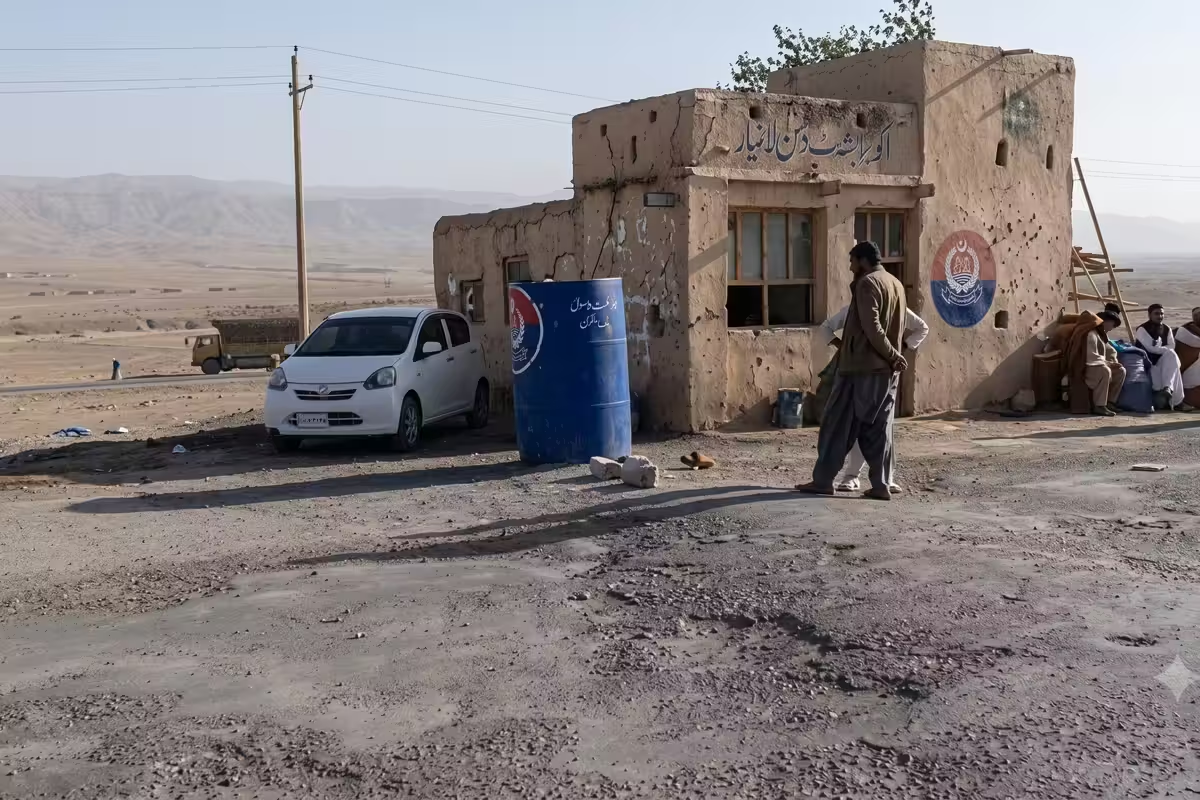



In a stark escalation of kinetic violence targeting critical state infrastructure in southwestern Pakistan, a heavily armed cell of insurgents launched a coordinated, multi-pronged assault on a critical protection post at the Mangi Dam construction project late Tuesday night. The initial breach and subsequent intense firefight resulted in the martyrdom of at least nine law enforcement personnel, including two senior Station House Officers (SHOs), and the temporary abduction of eight additional police constables.
In response to the tactical breach, an immediate combined tactical maneuver comprising paramilitary forces, the Balochistan Police, and Counter-Terrorism Department (CTD) operators initiated an aggressive clearance operation. The joint counter-offensive successfully tracked down the hostile cell, eliminating fifteen insurgents and successfully recovering all eight abducted law enforcement personnel from militant captivity.
DG ISPR MESSAGE FOR THE FACILITORS OF TERRORISM IN PAKISTAN:
Pakistan will not be deterred, and will show no rationality, proportionality, or talks while you lay your hands on our children and police. pic.twitter.com/jBdox0peYw
— Mohsin Ali (@Mohsin_o2) July 8, 2026
Executive Accountability: Administrative Suspension and a 15-Day Fact-Finding Mandate
In the immediate aftermath of the operational breach, the provincial executive moved swiftly to enforce administrative accountability. Chief Minister Sarfraz Bugti authorized the immediate suspension of the Ziarat Superintendent of Police (SP), an action officially confirmed via a government notification by Shahid Rind, the Chief Minister’s Aide for Media and Political Affairs.
To systematically dissect the operational failure, the provincial administration has formally constituted a high-powered, four-member inquiry committee. Legally empowered to summon personnel, examine forensic site evidence, and co-opt technical experts, the committee has been issued a strict 15-day deadline to deliver an exhaustive, fact-finding dossier. The investigative panel’s mandate includes:
-
Chronological Mapping: Reconstructing the precise sequence of tactical events leading up to, during, and directly following the breach at the infrastructure post.
-
Assessment of Readiness: Evaluating the defensive deployment, situational preparedness, command-and-control continuity, and tactical coordination of all responding security agencies.
-
Probing for Lapses: Investigating potential instances of institutional negligence, dereliction of duty, command failure, or operational cowardice among the personnel assigned to the installation.
-
SOP Evaluation: Reviewing whether the existing Standard Operating Procedures (SOPs) and physical security fortifications guarding the Mangi Dam infrastructure were analytically sound and fully implemented.
-
Reconstruction Recommendations: Formulating immediate, mid-term, and long-term security overhauls to harden critical infrastructure assets across Balochistan, alongside proposing systemic institutional and administrative reforms to suppress future vulnerabilities.
The Evolving Security Matrix: Decentralization, Urban Drift, and Operational Convergence
The localized violence at Mangi Dam unfolds against a more complex, alarming geopolitical transformation within Pakistan’s southwestern theater. While local provincial spokesmen have pointed toward the banned Tehreek-e-Taliban Pakistan (TTP) as the likely perpetrator, independent defense analysts warn of a highly dangerous development: potential operational and tactical convergence between historically distinct ideological actors.
Any structured alliance combining the religious-extremist networks of the TTP with the ethno-nationalist separatist cells of the Balochistan Liberation Army (BLA) represents a severe force multiplier against the state. This evolving threat landscape presents three major challenges to the current counter-terrorism architecture:
1. The Decentralization of Asymmetric Violence
Militancy is no longer confined to remote, highly militarized border pockets within Balochistan and Khyber Pakhtunkhwa. Insurgent cells are demonstrating advanced logistics and long-range intent, moving beyond rural guerrilla warfare to directly threaten vital public infrastructure, energy corridors, and major foreign investment projects across the mineral-rich province.
2. The Drifting Focus to Urban Centers
The foiled plot in Karachi on Tuesday, which resulted in the apprehension of two highly trained BLA operatives, coupled with a recent lethal ambush targeting Pakistan Rangers personnel, strongly signals that insurgent syndicates are actively pursuing an urban drift strategy. By transplanting asymmetric violence into the country’s economic hubs, militant actors seek to maximize psychological impact, disrupt commerce, and attract international media visibility.
3. Critical Gaps in Pre-Emptive Intelligence
While Pakistan’s frontline forces have repeatedly proved their capacity to neutralize hostile threats once active contact is established—as evidenced by the elimination of 15 insurgents during the Mangi Dam clearance operation—the broader security apparatus remains largely reactive. The primary benchmark of sustainable success must shift from post-incident kinetic containment to proactive, intelligence-led interdiction. This requires a significant escalation of state funding into human intelligence (HUMINT), signal intercept networks, digital surveillance, and inter-agency data synchronization connecting provincial CTDs, military intelligence, and local policing units.
The Regional Frontier: Demanding Accountability Across the Durand Line
The persistent cross-border dimension remains a fundamental roadblock to achieving sustainable domestic stability. Islamabad continues to voice deep diplomatic frustration regarding the safe havens and strategic depth that anti-Pakistan militant groups utilize within neighboring Afghanistan.
Despite repeated bilateral warnings and clear international counter-terrorism obligations, the interim Afghan Taliban administration demonstrates a continued reluctance to execute decisive, verifiable military operations against TTP sanctuaries operating from Afghan soil.
National defense strategies must recognize that domestic kinetic clearing actions offer only temporary relief if the structural external infrastructure supporting these insurgent networks remains intact. Consequently, Pakistan is keeping sustained diplomatic and security pressure on Kabul to ensure that foreign soil cannot be used as an active launching pad against Pakistani state installations.
Political Resolve: Total Elimination of Terror Networks
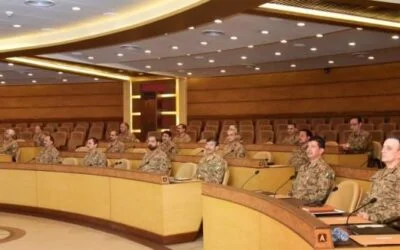
Presiding over a high-level emergency security session in Ziarat, Chief Minister Sarfraz Bugti met with the grieving families of the fallen police officers and visited wounded personnel undergoing emergency medical treatment.
Issuing a direct directive to the heads of all provincial law enforcement and paramilitary divisions, Chief Minister Bugti asserted that the ongoing operations against armed groups and their clandestine urban facilitators will be carried out with swift, overwhelming force. The provincial executive emphasized that under no circumstances would anti-state elements be granted the political breathing room or operational space to regroup, instructing all security components to maximize inter-agency coordination to assert the absolute writ of the state.