


In a major diplomatic move aimed at expanding its defense footprint across the African continent, Pakistan’s military command has established a comprehensive bilateral security framework with the Republic of Ghana.
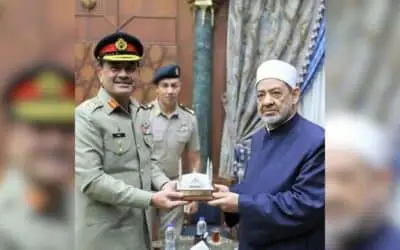
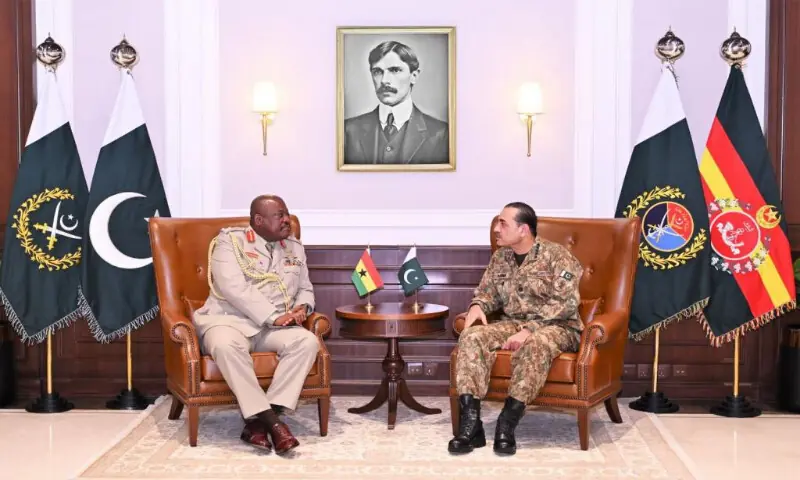
The agreement was finalized at the General Headquarters (GHQ) in Rawalpindi during an official state visit by the Chief of Defence Staff of the Ghana Armed Forces, Lieutenant General William Agyapong, who called directly on Pakistan’s Chief of Defence Forces and Chief of Army Staff (COAS), Field Marshal Syed Asim Munir.
According to a formal statement released by the Inter-Services Public Relations (ISPR) on Thursday, the high-level defense talks focused on matters of deep mutual interest, West African regional security metrics, and tactical defense cooperation. Recognizing the growing threat of transnational militancy, both military leaderships formally resolved to upgrade their military-to-military relations, placing a heavy operational focus on joint tri-services training, counter-terrorism doctrines, and collaborative defense production.
Tri-Services Integration and High-Level Security Consultations
The Ghanaian defense delegation executed a highly synchronized series of meetings across Pakistan’s unified military command structure, marking a significant deepening of institutional ties between Islamabad and Accra:
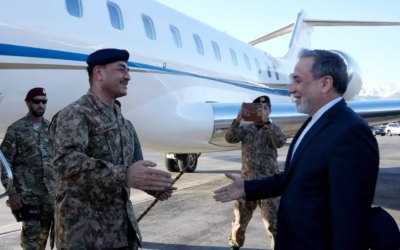
The GHQ Tri-Services Contingent: Upon arrival at the military headquarters in Rawalpindi, Lieutenant General Agyapong was presented with a formal guard of honor by a smartly turned-out tri-services contingent of the Pakistan Armed Forces.
The Strategic Maritime Dialogue: Separately, Ghana’s National Security Coordinator, Abdul Razak Osman, held an extensive strategy session with the Chief of the Naval Staff, Admiral Naveed Ashraf. The meeting focused on maritime security in the Gulf of Guinea, anti-piracy operations, and joint naval engineering projects.
The Aerospace and Air Defense Axis: National Security Coordinator Osman, accompanied by Lieutenant General Agyapong, subsequently called on the Chief of the Air Staff, Air Chief Marshal Zaheer Ahmed Baber Sidhu. The air chiefs discussed modernizing radar systems, pilot training programs, and the potential export of Pakistan’s advanced aerospace hardware.
During the extensive briefings, the visiting Ghanaian dignitaries highly commended the Pakistan Armed Forces for their extreme professionalism, operational readiness, and continuous role in anchoring regional stability across South and Central Asia.
Critical Analysis: The African Pivot, Counter-Insurgency Export, and Defense Production Autonomy
The high-profile visit of Ghana’s military and national security leadership highlights a calculated realignment of Pakistan’s defense diplomacy, driven by several key global and regional structural dynamics:
1. The Strategic Logic of Pakistan’s “Look Africa” Defense Pivot
The engagement with Ghana’s top military brass is a clear example of Pakistan’s broader “Look Africa” foreign policy initiative. As traditional geopolitical alignments shift, Islamabad is actively working to diversify its diplomatic and military relationships beyond its historical focus on South Asia and the Middle East. By positioning itself as a reliable security partner for Ghana—one of West Africa’s most stable democracies and a major contributor to regional peacekeeping missions—Pakistan is building valuable diplomatic capital. This strategy helps secure geopolitical support within international forums like the United Nations, while opening up new corridors for economic and security cooperation across the continent.
2. Exporting Pakistan’s Field-Tested Counter-Terrorism Doctrine
The agreement to focus heavily on joint training and counter-terrorism operations reflects Ghana’s growing concern over the spread of violent extremism in the Sahel region. As militant groups push southward toward coastal West African states, Ghana is looking to upgrade its defensive capabilities. Pakistan’s armed forces offer a unique asset: a highly sophisticated, field-tested counter-insurgency doctrine developed over decades of active operations along its western borders. By exporting this tactical expertise to Accra, Pakistan is establishing itself as an essential security anchor for West Africa, helping to contain regional instability before it threatens wider international shipping and commercial lanes.
3. Expanding the Market for Pakistan’s Domestic Defense Production
The formal resolution to cooperate on defense production marks an important step forward for Pakistan’s domestic military-industrial complex. Faced with strict fiscal constraints, Pakistan is looking to transition from an importer of foreign military hardware into an exporter of high-quality, cost-effective defense technology. Ghana’s military modernization requirements provide an ideal market for Pakistan’s indigenous manufacturing capabilities, including small arms, armored vehicles, and light tactical aircraft. Securing defense export contracts in West Africa helps lower the overall cost of production for Pakistan’s own military requirements, driving technological innovation and boosting the national economy.
4. Deepening Institutional Security Ties Across the Global South
The synchronized meetings involving the National Security Coordinator of Ghana, the Chief of the Naval Staff, and the Chief of the Air Staff show that this visit was designed to achieve deep, institutional integration rather than mere symbolic cooperation. By aligning Ghana’s national security architecture directly with Pakistan’s unified tri-services command, both nations are building an independent security framework within the Global South. This structural relationship enables both capitals to address regional vulnerabilities cooperatively, reducing their shared reliance on Western military interventions and supporting a more balanced, multipolar international security architecture.