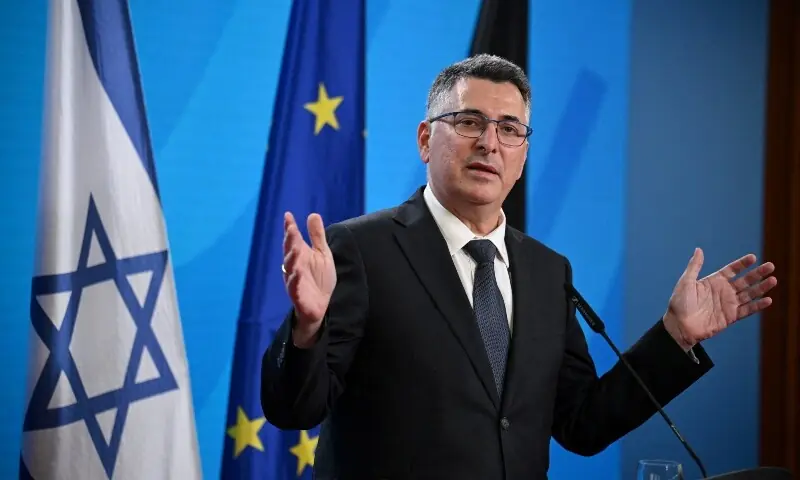




A severe diplomatic rupture has emerged between the European Union and the State of Israel following an intense public dispute on social media platform X. Israeli Foreign Minister Gideon Saar officially announced the suspension of “all contact” with the EU High Representative for Foreign Affairs and Security Policy, Kallas, triggering one of the most volatile diplomatic standoffs between Brussels and Jerusalem in recent years.
The crisis was ignited by a June 12 investigative report from European news agency Euractiv, which cited multiple unnamed diplomats and senior officials confirming that High Representative Kallas explicitly compared Israel’s treatment of Palestinians in the West Bank and Gaza to South Africa’s apartheid-era system of legally enforced racial segregation during an official state visit to Mexico last month.
While Kallas attempted to defuse the escalating situation by posting a direct message to Saar reinforcing her desire for respectful, constructive dialogue and the EU’s unwavering commitment to a two-state solution, the Israeli Foreign Minister swiftly rejected the overture. Saar labeled the High Representative’s reported comments as “shameful and libelous,” accusing her of “acting obsessively and with blatant unfairness toward the State of Israel.” He declared that all diplomatic lines would remain entirely frozen until the EU’s top diplomat issues a formal retraction.
Timeline of EU-Israel Diplomatic Deterioration
The current suspension of communication follows a series of sharp regulatory and diplomatic clashes between the European bloc and Israel’s right-wing coalition over territorial expansion:
May 2026 Sanctions Enforced: The diplomatic ground shattered last month when the European Union bypassed Israeli protests to impose binding asset freezes and travel bans on three extremist individuals and four entities. The bloc held them legally responsible for “serious and systematic human rights abuses against Palestinians in the West Bank.” Foreign Minister Saar firmly rejected the decision at the time, accusing Brussels of overreaching its mandate.
The Multilateral Apartheid Language Alignment: The escalating rhetoric marks a broader systemic shift within international institutions. Earlier this year, both the European Union’s executive organs and the United Nations issued joint assessments officially likening Israel’s West Bank zoning, displacement, and military outpost policies to South Africa’s historic apartheid frameworks.
The Settlement Obstacle: The European External Action Service (EEAS) has consistently intensified its public documentation of Israel’s illegal settlement expansions in the occupied West Bank. The bloc maintains that these state-backed projects directly violate international law and act as the primary structural obstacle to achieving a viable, sovereign Palestinian state.
Critical Analysis: Fractured Consensus, International Precedents, and the Threat of Absolute Isolation
The unprecedented public fallout between High Representative Kallas and Foreign Minister Saar highlights deep structural shifts in the Euro-Mediterranean geopolitical landscape:
1. The Weaponization of Diplomatic Silence as a Foreign Policy Tool
Foreign Minister Gideon Saar’s decision to sever all direct communication with the EU’s top diplomat is a high-stakes political gamble designed to exploit internal European political divisions. By isolating High Representative Kallas and demanding a formal retraction, Jerusalem is trying to set a strict diplomatic boundary against the growing use of the “apartheid” framework by European officials.
However, this tactic of diplomatic silence risks cutting off Israel’s primary institutional channel to its largest trading bloc at a time of severe international isolation. Rather than forcing a retreat, freezing out the High Representative may inadvertently strengthen the position of EU member states advocating for stronger economic and political penalties against the occupation.
2. The Institutionalization of the Apartheid Analogy
The fact that High Representative Kallas reportedly used the apartheid comparison during an international visit to Mexico shows that this language has moved from human rights NGOs into mainstream European diplomacy. For years, Israeli officials successfully dismissed such comparisons as fringe rhetoric.
However, its recent adoption in official statements by both the EU and the United Nations indicates a major shift in how the West Bank occupation is viewed legally and politically. By comparing Israel’s dual-legal system in the occupied territories—where settlers live under civilian law and Palestinians under military rule—to historic South Africa, top diplomats are laying the conceptual groundwork for more aggressive, long-term international legal actions and potential disinvestment campaigns.
3. Deepening Fractures Within the European Union’s Core Consensus
The public clash between Saar and Kallas has exposed the deep, unresolved divisions among the EU’s 27 member states regarding Middle East policy. While the High Representative represents the bloc’s official consensus on the illegality of the settlements and the necessity of a two-state solution, member nations remain deeply divided.
Countries like Spain and Ireland have aligned with Kallas’ sharp stance, moving forward with independent arms suspensions and formal state recognition of Palestine. Conversely, other member states continue to prioritize close defense and intelligence ties with Jerusalem, actively working to block binding, bloc-wide economic embargoes. Saar’s public counter-attack is carefully calculated to appeal to these pro-Israel factions within the EU, attempting to undermine Kallas’ authority by claiming her statements do not reflect the unified position of the entire European continent.
4. The Geopolitical Impact of Mexico as a Diplomatic Forum
It is highly significant that High Representative Kallas reportedly chose a diplomatic forum in Mexico to deliver these critical remarks. This choice highlights a broader effort by European leadership to align their foreign policy narratives with the Global South, where criticism of Israel’s territorial policies is widespread.
By using an international visit to discuss the West Bank and Gaza, the EU is attempting to build a wider, multipolar coalition on global justice issues. This strategy, however, places Brussels on a direct collision course with Israel’s leadership, which views any attempt to globalize the critique of its domestic security policies as a direct threat to its national sovereignty and international standing.