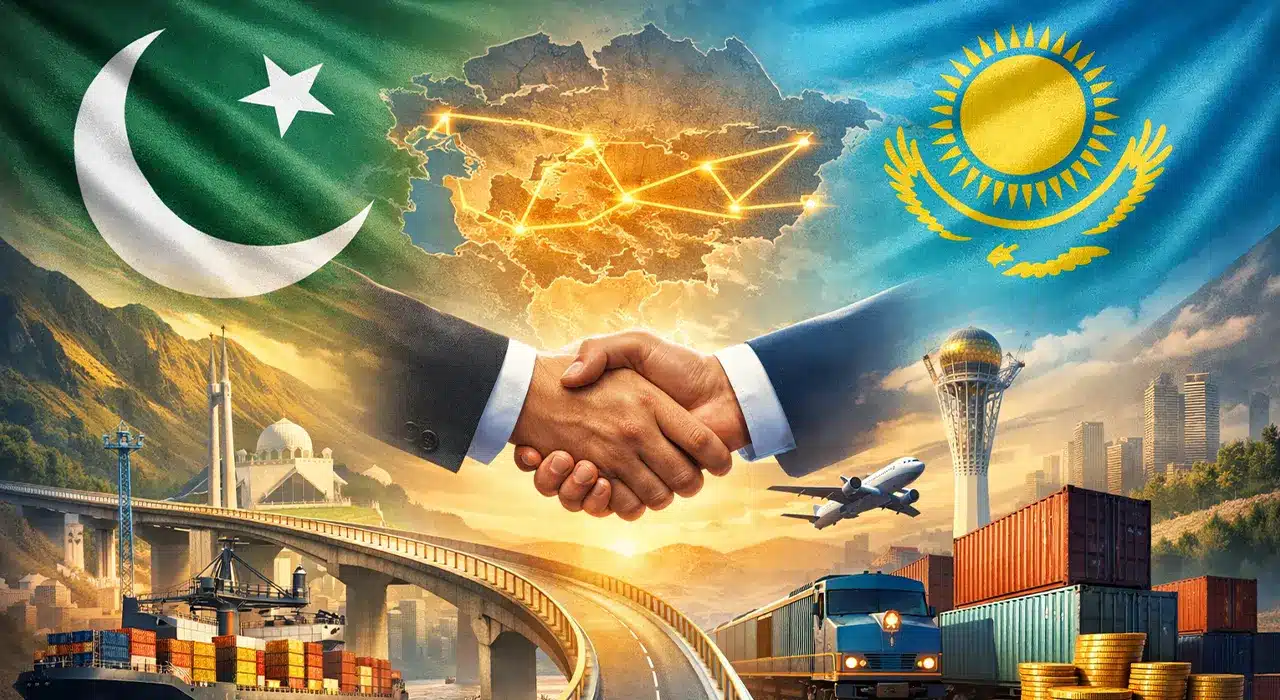





In a move that reshapes the geopolitical landscape of Central and South Asia, the President of the Republic of Kazakhstan, H.E. Kassym-Jomart Tokayev, concluded a historic state visit to Pakistan on February 4, 2026. At the invitation of Prime Minister H.E. Muhammad Shehbaz Sharif, this visit—the first by a Kazakh President in 23 years—marks the formal elevation of bilateral ties to a Strategic Partnership.
The two leaders signed a Joint Declaration outlining a “new chapter” of cooperation, focusing on eight key pillars ranging from high-level political dialogue to climate change and defense.
Joint Declaration On Establishing Strategic Partnership Between The Islamic Republic of Pakistan and The Republic of Kazakhstan (2/2)
🔗⬇️ https://t.co/aQZGPth0Sr pic.twitter.com/E0CJfehcE4
— Ministry of Foreign Affairs – Pakistan (@ForeignOfficePk) February 4, 2026
Reaching a $1 Billion Trade Goal
A central theme of the summit was the transformation of economic ties. The leaders set an ambitious target to increase bilateral trade turnover to USD $1 billion in the coming years. To facilitate this, several landmark agreements were signed, including:
- Transit Trade Agreement: A critical framework to streamline the movement of goods.
- Customs Cooperation: Mutual administrative assistance to reduce bureaucratic hurdles.
- Financial Integration: A Memorandum of Understanding (MoU) between the State Bank of Pakistan and Kazakhstan’s Financial Market Agency to enhance banking and fintech ties.
Trans-Afghan Connectivity and Logistics
Recognizing their roles as transit hubs, the leaders committed to the Trans-Afghan Railway corridor. This initiative aims to link Central Asia to the Arabian Sea through various multimodal routes, including:
- Kazakhstan-Turkmenistan-Afghanistan-Pakistan (KTAP)
- Kazakhstan-Uzbekistan-Afghanistan-Pakistan
- Kazakhstan-Kyrgyzstan-China-Pakistan (via the Karakoram Highway)
To boost B2B and people-to-people contacts, the leaders agreed to evaluate the re-launching of direct flights in the near future.
Defense, Security, and Extradition
In a significant step toward regional stability, the two nations signed a formal Extradition Treaty and an agreement on Combating Crimes. They also explored the establishment of a High-Level Security Dialogue, co-chaired by Kazakhstan’s Secretary of the Security Council and Pakistan’s National Security Advisor. Both sides agreed to continue joint military exercises and vocational training exchanges.
Technological and Educational Synergy
The visit saw the inauguration of several academic centers, including the Al-Farabi Cultural Center at Quaid-e-Azam University. In the tech sector, MoUs were signed between:
- NADRA (Pakistan) and National Information Technologies (Kazakhstan) for digital infrastructure.
- Ignite (Pakistan) and Astana Hub (Kazakhstan) for startup and innovative technology collaboration.
Climate Action and “Planetary Greening”
Both nations, vulnerable to glacier melting and water scarcity, pledged to collaborate on climate resilience. Prime Minister Sharif supported President Tokayev’s initiative to declare April 22 as the International Day for Planetary Greening and welcomed the proposal for a UN Water International Organization.
Regional Stability and Diplomatic Support
The leaders discussed the situation in Afghanistan, emphasizing that Afghan territory must not be used for activities threatening other countries. Furthermore, they reaffirmed that a peaceful settlement of the Jammu and Kashmir dispute in accordance with UN Security Council resolutions is imperative for lasting peace in South Asia.
Visa Facilitation
To promote tourism, both sides agreed to work toward including Pakistan in the Kazakh e-visa regime, matching the conducive visa policies already offered by Pakistan to Kazakh citizens.