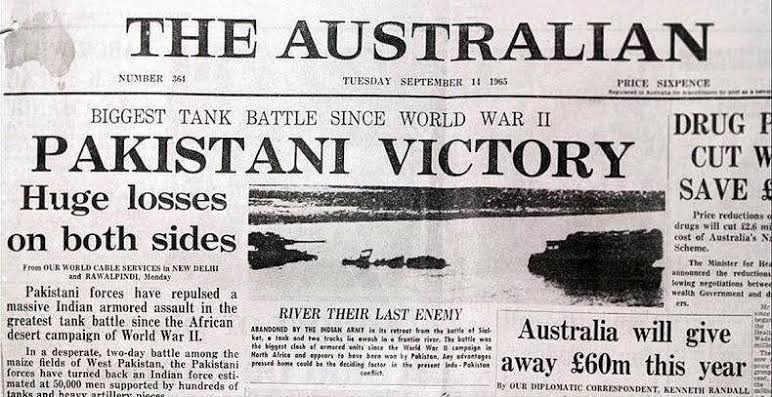




Some wars end when the guns fall silent. Others continue long after, not on the battlefield but in the institutions, doctrines and national character they leave behind. The 1965 War belongs to this second category. It lasted only seventeen days, yet its legacy has outlived every soldier who fought in it, shaping the way Pakistan thinks about its own defence six decades later.
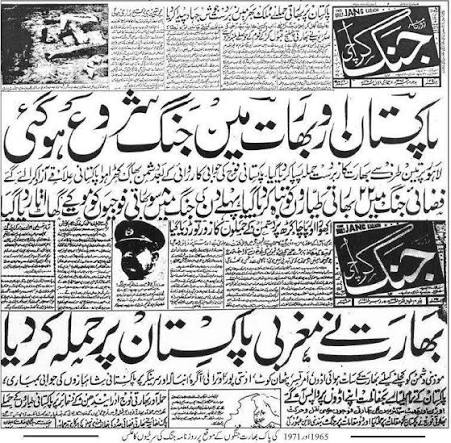
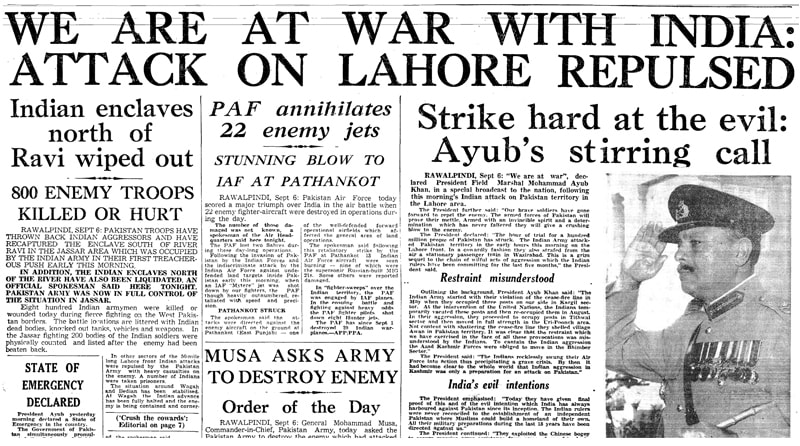
Jang Newspaper from 1965: War between India and Pakistan Starts.
To understand why 1965 still matters, it is worth remembering what the war actually settled. India entered September 1965 believing that speed and numbers would decide the outcome, that a rapid thrust across the international border would place Lahore within reach before Pakistan could organise a response. What the Indian high command had not accounted for was the combination of a disciplined military and a population unwilling to treat the war as someone else’s fight. Farmers near the front lines fed soldiers from their own kitchens. Students queued to donate blood. Radio broadcasts and patriotic songs did not merely entertain; they held a frightened, uncertain country together. When the war ended, the border had barely moved, but something more durable had been established: the conviction that Pakistan could not be intimidated into submission by superior numbers alone.
That conviction did not remain frozen in 1965. It has been tested, refined and rebuilt across three subsequent generations, and each test has left its own mark on how Pakistan organises its defence today.
From Conventional Deterrence to Strategic Balance
The most visible legacy of 1965 is the seriousness with which Pakistan has approached the question of deterrence. A country that watched a numerically larger neighbour attempt a quick, decisive war concluded that the only durable safeguard against repetition was a deterrent so credible that the calculation itself would no longer be attempted. The pursuit of a full-spectrum deterrence posture in the decades that followed, culminating in a robust and diversified strategic capability, was in many ways an answer to the very question 1965 had asked: how does a smaller power ensure that its larger neighbour never again gambles on a swift military solution. Whatever one’s view of nuclear weapons in general, their role in preventing a fourth full-scale war between the two countries is difficult to dismiss.
Building an Indigenous Defence Base
A second, quieter legacy lies in Pakistan’s steady move away from dependence on imported hardware. The 1965 War exposed how vulnerable a military can be when its equipment, spares and ammunition are subject to the political decisions of foreign suppliers. That lesson produced a long, patient effort to build indigenous defence production — from the Heavy Industries Taxila’s tank programmes to the joint development of the JF-17 Thunder with China, to steadily expanding capabilities in radar, drone and naval shipbuilding technology. None of this happened overnight, and none of it happened by accident. It happened because a generation of planners understood that a nation which cannot arm itself is a nation whose defence policy is ultimately written elsewhere.
The Air Force’s Enduring Standard
If any single service carried the psychological weight of 1965 into the decades that followed, it was the Pakistan Air Force. The speed and precision with which PAF pilots met a numerically superior adversary in September 1965 set a benchmark that shaped training, doctrine and institutional pride for generations of airmen. That standard has not been allowed to erode. Continued modernisation of the fleet, investment in airborne early warning systems, and the integration of increasingly sophisticated multirole aircraft all trace their institutional lineage back to a squadron of pilots who refused to be outnumbered in spirit even when they were outnumbered on paper.

Widening the Battlefield
Perhaps the most significant shift since 1965 has been the recognition that the battlefield itself has changed shape. The war of 1965 was fought along recognisable fronts, with tanks, aircraft and infantry meeting in relatively conventional configurations. The threats facing Pakistan today rarely announce themselves so clearly. Militancy nurtured across a porous western border, information warfare designed to shape public perception rather than capture territory, and attempts to destabilise the country from within have all required the armed forces to develop capabilities that the planners of 1965 never had to contemplate. Marka-e-Haq in 2025 was, in this sense, not a departure from the spirit of 1965 but its logical continuation — proof that the same institutional resolve which held the line at Lahore and Sialkot could be adapted to a far more complicated security environment.
The Civilian Dimension, Then and Now
It would be incomplete to speak of 1965’s legacy purely in terms of hardware and doctrine. The war’s most distinctive feature was the fusion of civilian resolve with military effort, and this too has left its mark. Whenever Pakistan has faced periods of heightened tension in the years since, the instinct to rally behind the armed forces rather than around them has repeated itself, from the border skirmishes of later decades to the more recent confrontations that tested public morale as much as military readiness. This is not blind nationalism; it is the institutional memory of a country that once discovered, almost by necessity, that a soldier defends better when he knows an entire nation stands behind him.
Sixty Years On
None of this is to suggest that Pakistan’s defence challenges have been resolved once and for all. Every generation since 1965 has faced its own version of the same underlying question: whether preparedness, unity and strategic clarity are sufficient to offset an adversary’s numerical or economic advantages. So far, the answer each time has been yes, though never without cost, and never without the discipline to keep adapting rather than resting on past achievement.
Sixty years after the guns of September fell silent, the lesson of 1965 has not required revision, only extension. Preparedness is not a state a nation arrives at and then maintains unchanged; it is a habit that must be renewed with each new form of threat. The soldiers of 1965 answered the challenge of their time with courage and unity. The institutions, capabilities and national resolve built in the decades since are Pakistan’s answer to the challenges of this one. Wars, as history repeatedly teaches, should never be sought or romanticised. But the readiness to face one, should it ever be forced upon a nation again, remains 1965’s most enduring gift to the Pakistan of today.