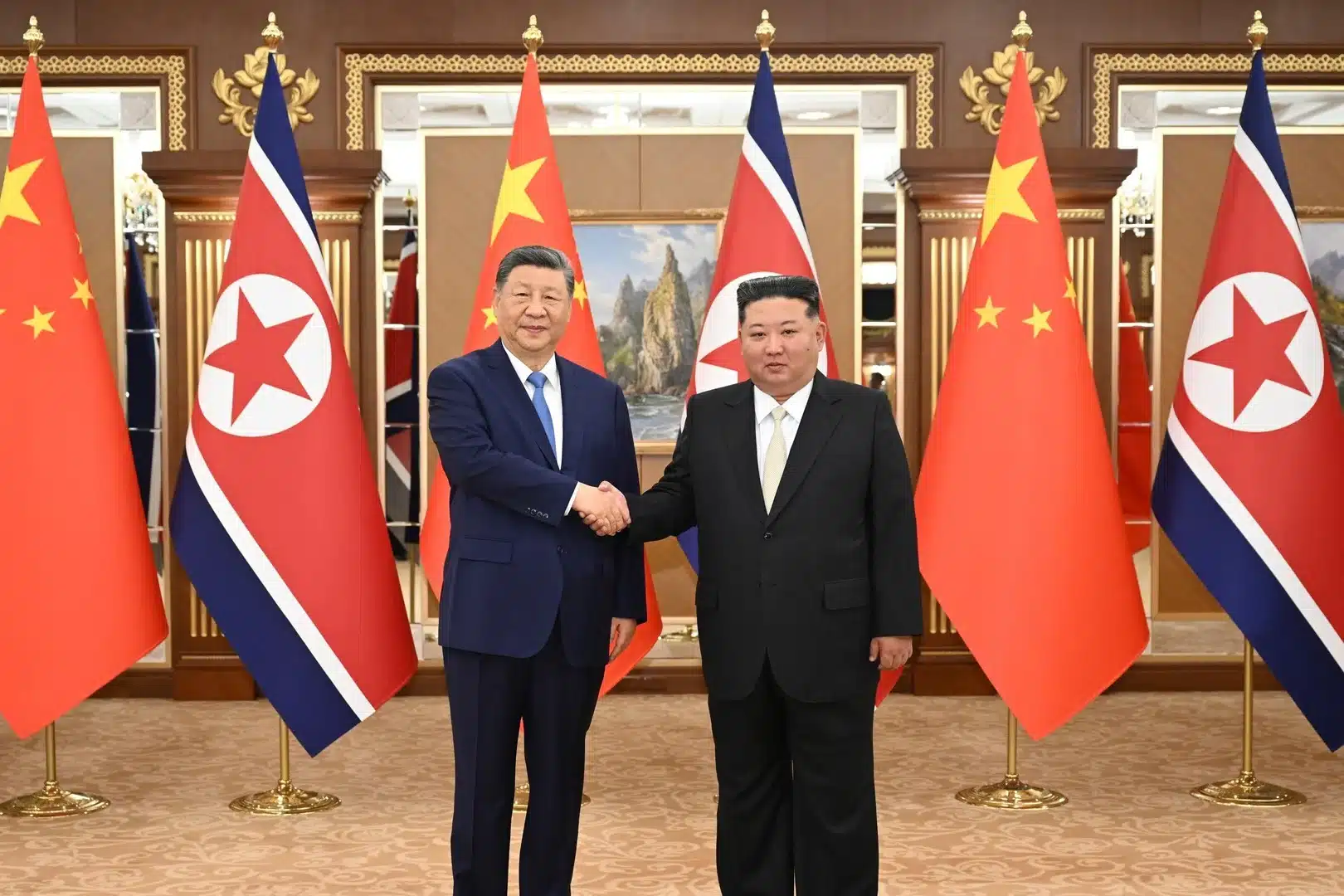
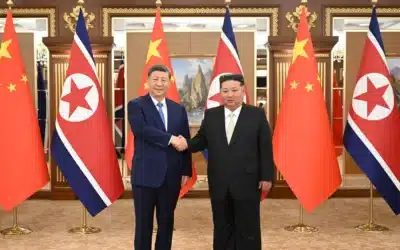




In a major geopolitical demonstration of regional alignment, Chinese President Xi Jinping concluded the primary session of his rare, two-day bilateral summit in Pyongyang, reassuring Supreme Leader Kim Jong Un that Beijing’s commitment to safeguarding their common strategic interests remains absolute and unyielding.
The high-profile visit—marking Xi’s first trip to China’s reclusive neighbor in seven years and his first international voyage of 2026—was met with an elaborate red-carpet reception. Accompanied by his wife, Ri Sol Ju, Kim Jong Un welcomed the Chinese delegation at the capital’s historic Kim Il Sung Square, featuring a full tri-services honor guard, ceremonial flower presentations by local youth, and a formal 21-gun salute.
Chinese President Xi Jinping was welcomed in Pyongyang this week by North Korea’s leader Kim Jong Un for the first visit since 2019. Here’s a potted history of their close, and sometimes tumultuous, relationship.
🔗: https://t.co/sE6dZ0mCSa pic.twitter.com/yLvUF1OcjF
— Al Jazeera English (@AJEnglish) June 9, 2026
According to official summaries released by the Xinhua News Agency, President Xi stated that bilateral relations between the two communist nations have entered a “new historical starting point.” He emphasized that China’s firm support for Kim Jong Un’s leadership of the socialist cause will remain completely unchanged, regardless of fluctuating global dynamics.
Strategic Architecture and Multipolar Defense Alignments
The high-level discussions focused on strengthening strategic communication and coordinating policies across a wide array of shared portfolios, including defense, technology, diplomacy, and cross-border trade:
-
Sovereignty and Security Shields: The official Chinese summary noted that both leaders agreed to enhance strategic communication to firmly protect their respective sovereignty, national security architectures, and long-term development interests.
-
The Anti-Hegemonic Mandate: In remarks published by North Korean state media during a formal evening banquet, President Xi explicitly urged a joint effort to oppose external hegemony, authoritarianism, and any active conspiracies to revive militarism that could threaten the stability of East Asia.
-
Revitalizing Cross-Border Corridors: Following the complete lifting of pandemic-era border restrictions, Xi emphasized that both nations must capitalize on newly restored border crossings to accelerate economic cooperation and expand people-to-people exchanges.
Critical Analysis: The Eurasian Security Quad, Sovereign Asset Dynamics, and the Strategy of Containment
The deliberate messaging coming out of the Pyongyang summit reveals a highly calculated effort by Beijing to manage its security environment and shape its long-term strategy against Western influence:
1. Balancing North Korea’s Financial Pivot Toward Russia
The timing of President Xi’s visit is closely tied to North Korea’s shifting economic dependencies. Over the past several years, Pyongyang’s economy has received a significant boost from expanding military and trade ties with Moscow, driven by North Korea’s supply of artillery and manpower to support Russia’s defense industrial base. This influx of Russian capital and technical assistance has significantly increased Kim Jong Un’s leverage, allowing him to be less dependent on Chinese trade.
By traveling to Pyongyang personally and offering strong diplomatic support, Xi is reasserting China’s position as North Korea’s primary economic and political partner. Beijing wants to ensure that while Pyongyang builds ties with Moscow, it remains anchored to China’s long-term regional strategy.
2. North Korea as a Vital Strategic Asset in the Eurasian Quad
As noted by global security analysts at the Foundation for Defense of Democracies, the Xi-Kim summit serves as a clear reminder that Beijing views North Korea as a vital strategic asset rather than a diplomatic burden. In the current global landscape, China, Russia, North Korea, and Iran form a coordinated Eurasian security alignment.
While these nations have different domestic priorities, they share a core strategic interest in blunting and counterbalancing U.S. power projection. A stable, secure North Korea acts as a crucial buffer state for China, tying down American naval, air, and missile defense assets in East Asia and keeping Western forces away from China’s immediate land borders.
3. The Counter-Containment Strategy Against the U.S. and Japan
President Xi’s explicit warning against “conspiracies to revive militarism” is a direct reference to the tightening security alliance between the United States, Japan, and South Korea. Following recent agreements at the Shangri-La Dialogue in Singapore regarding a potential military-logistics support pact between Tokyo and Seoul, Beijing is deeply concerned about the creation of a U.S.-led defensive framework in East Asia.
By strengthening its treaty alliance with North Korea, China is signaling to Washington and Tokyo that any attempt to aggressively contain or pressure Beijing will be met with a unified counter-front, utilizing North Korea’s advanced missile and strategic capabilities as a deterrent.
4. Bypassing Western Diplomacy and Extending the Status Quo
The growing strength of North Korea’s parallel relationships with both Moscow and Beijing provides Kim Jong Un with a powerful shield against international pressure. As long as China guarantees a stable strategic environment and provides essential economic backing, North Korea can continue to ignore diplomatic outreach from Washington and Seoul regarding denuclearization.
This setup allows Beijing to manage the pace of diplomacy on the Korean Peninsula, ensuring that any future negotiations regarding regional security must go through China and align with its long-term vision for a multipolar international order.