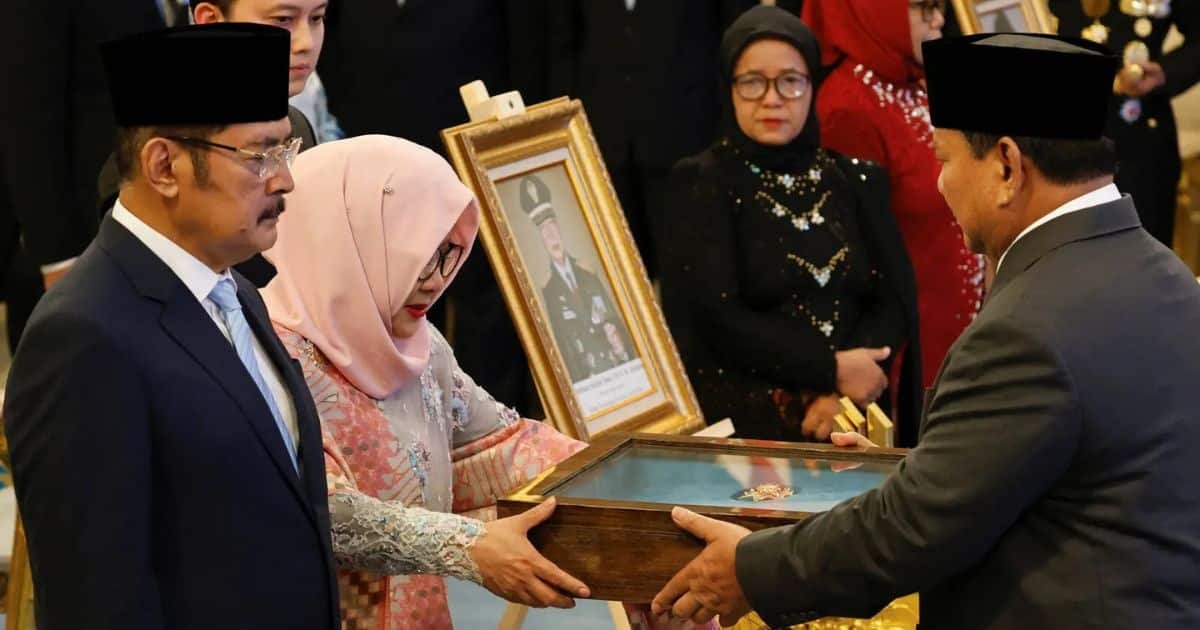


Indonesia’s President Prabowo Subianto posthumously awarded the title of “National Hero” to former President Muhammad Soeharto during a televised National Hero Day ceremony at the Presidential Palace, igniting fierce backlash from activists, victims’ families, and rights groups over the late leader’s legacy of alleged mass atrocities.
Indonesia’s former president Muhammad Soeharto, whose 30-year rule was marked by alleged rights abuses, was named a “national hero” on Monday, sparking backlash after his death https://t.co/1sMpShAbL8 pic.twitter.com/e8zQ8GZjFI
— Al Jazeera English (@AJEnglish) November 10, 2025
Soeharto, who ruled Indonesia for 32 years until 1998, received the honor alongside nine others for contributions to national development. Prabowo, a former general and Soeharto’s ex-son-in-law, presented the award to Soeharto’s daughter Siti Hardiyanti Rukmana and son Bambang Trihatmodjo. An announcer praised Soeharto as a “hero of the independence struggle” from Central Java.
You May Like To Read:Pakistani AI Startup Jams Joins OpenAI, Marking Indus Valley Capital’s First Exit
Siti urged the public to reflect on her father’s lifelong service: “Please remember what my father had done, from when he was young until he was old, all his fights for this country and the Indonesian people.”
Soeharto seized power from founding President Sukarno in 1967 amid a violent purge of alleged communists, resulting in over 500,000 deaths. His regime invaded East Timor in 1975, causing hundreds of thousands of fatalities, and was marked by military crackdowns on dissent, widespread corruption benefiting his family, and severe restrictions on free speech. Backed by the US as a Cold War anti-communist ally, Soeharto’s ouster followed 1998 student protests triggered by the Asian financial crisis. He apologized for past errors but faced no trials due to health issues.
State Secretary Prasetyo Hadi defended the designation: “It is part of how we honor our predecessors, especially our leaders, who undoubtedly have made extraordinary contributions to the nation.”
Yet, protests erupted outside the palace with banners reading “Stop the Whitewashing of the General of Butchery” and “Thousands Died But The Country Chose to Forget.” The Commission for the Disappeared and Victims of Violence (KontraS) condemned it as “immoral” and a normalization of impunity. Over 500 activists, academics, and civil society members sent an open letter to Prabowo, calling the move a “betrayal of victims and democratic values” and a distortion of history.
Culture Minister Fadli Zon, who vetted candidates, insisted all met requirements after public consultation and research.
Prabowo, accused by critics of expanding military influence, has deep ties to Soeharto’s Golkar party, which holds key cabinet posts. This decision underscores ongoing debates over historical reckoning in Indonesia’s young democracy.
Check out our latest video: