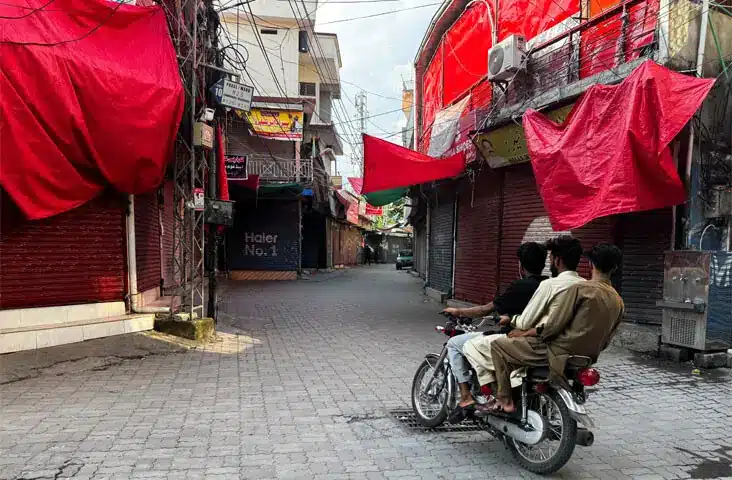





In an unyielding policy declaration following months of escalating civil unrest, the Azad Jammu and Kashmir (AJK) government has officially ruled out any possibility of a blanket amnesty for the leadership and active cadres of the proscribed Joint Awami Action Committee (JAAC). Holding the group directly responsible for fatal violence, systemic public destruction, and subverting the state’s economic stability, the regional executive vowed to proceed with maximum legal penalties against individuals spearheading the agitation campaign.
The administrative breakdown was delivered during a high-level joint press conference in Muzaffarabad by AJK Chief Secretary Flight Lieutenant (Retd) Khushal Khan and Inspector General of Police (IGP) Captain (Retd) Liaqat Ali Malik. The briefing came as a partial strike called by the banned group continued to fragment daily operations across the Muzaffarabad and Poonch divisions, even as commercial activity cautiously resumed in the Mirpur division under tight paramilitary security.
The Reserved Seats Impasse and Expanded Agitation
The central point of friction between the state and the JAAC remains the committee’s uncompromising demand to completely abolish the 12 seats within the AJK Legislative Assembly. These seats are legally reserved for Jammu and Kashmir refugees who migrated to mainland Pakistan following the 1947 partition. Ahead of the upcoming legislative elections scheduled for July 27, the JAAC has utilized this politically sensitive issue—traditionally bound by complex constitutional parameters, separate voter registration rolls, and the historical Karachi Agreement of 1949—as a rallying point for region-wide civil disobedience.
Chief Secretary Khushal Khan asserted that while the government repeatedly offered the JAAC constitutional avenues to address the reserved seats dispute—including an all-parties conference, a dedicated assembly floor debate, or direct legal recourse through the Supreme Court—the group rejected every option. Instead, the administration alleges that the JAAC continually expanded its manifesto from two initial welfare points to an unmanageable list of over 38 demands, with some factions using negotiations to aggressively demand changes to the AJK Interim Constitution and the traditional oath taken by lawmakers.
Tactical Drift: Allegations of Armed Violence and Human Shields
The press conference featured severe allegations regarding the changing nature of the JAAC’s field operations. The top administrative brass stated that the group’s leadership has fundamentally fractured over the ongoing mediation track, leading radicalized wings to deploy increasingly violent, anti-state tactics on the ground.
Operational Violations and Security Assets Targeted:
-
Assault on Law Enforcement: IGP Liaqat Ali Malik detailed that during a routine checkpoint inspection on June 5, JAAC militants opened fire on security forces, triggering an exchange that left one activist dead and injured two police officials alongside JAAC leader Umar Nazir. Forensic post-mortem data indicates the deceased was shot from within his own vehicle, suggesting friendly fire among the agitators.
-
Attack on Infrastructure: The IGP confirmed that JAAC activists carried out a targeted assault on the Rawalakot Combined Military Hospital (CMH), killing three on-duty police officers and harassing medical personnel. To date, four law enforcement personnel have been killed and 97 wounded, prompting the state to register 145 criminal cases, place 155 suspects on the Fourth Schedule of the Anti-Terrorism Act (ATA), and arrest 572 individuals.
-
Sabotage of Relief Pipelines: Authorities alleged that highways were blocked by felling trees, commercial cargo trucks were torched, and an attempt was made in Rawalakot to hijack state-managed humanitarian relief supplies.
-
Exploitation of Vulnerable Demographics: Both the Chief Secretary and IGP asserted that the JAAC has systematically placed women and children at the forefront of their sit-ins to serve as human shields, with intelligence indicators suggesting weapons are being concealed beneath burqas to prevent law enforcement intervention.
Prime Minister Rathore Stiffens Stance as Political Mediation Shifts
Commenting on the standoff from the executive office, AJK Prime Minister Raja Faisal Mumtaz Rathore declared that the era of “political blackmail has been buried.” He confirmed that while the state’s backchannels remained open, the JAAC consistently showed zero flexibility and actively chose to sabotage prior implementation agreements.
Isn’t this what we’ve been asking from them since Day 1?
We asked them not to leave dialogue. They showed zero flexibility. I personally appealed to them on numerous occasions to call off their lockdown, end their campaign of agitation and return to the table. They ignored.… pic.twitter.com/DPnCaDIeM0
— Faisal Mumtaz Rathore (@PMofAJK) June 23, 2026
The premier noted that reports of the JAAC approaching Jamiat Ulema-i-Islam-Fazl (JUI-F) Chief Maulana Fazlur Rehman to mediate the crisis vindicates the government’s stance that issues must be resolved through civilized, democratic dialogue within the system, rather than through intimidation. In a public message, Maulana Fazlur Rehman confirmed he has accepted the invitation to mediate, but urged the JAAC leadership to immediately postpone its sit-ins and halt its agitation campaign so that a credible pathway for negotiation can be carved out without coercive pressure.
Prime Minister Rathore warned that any fresh ultimatums or attempts by the banned committee to launch an aggressive “long march” on the capital city of Muzaffarabad will be met with the full force of law enforcement. “Negotiations will never be held at gunpoint,” the premier emphasized, reassuring citizens that the state will fully uphold its writ, restore internet connectivity once security clearance is achieved, and guarantee long-term public order across the valley.
Critical Analysis: Structural Volatility and the Politics of Refusal
The AJK state’s decision to place the JAAC under the First Schedule of the Anti-Terrorism Act and completely rule out a blanket amnesty marks a decisive shift from defensive crisis management to aggressive legal enforcement. This zero-tolerance approach reveals a critical structural realization within the state apparatus: the JAAC’s campaign has evolved far beyond an economic protest over electricity tariffs and flour prices, mutating instead into a deep-seated constitutional challenge to the institutional status quo of Azad Kashmir.
By targeting the 12 legislative seats reserved for refugees settled in mainland Pakistan, the JAAC is attempting to rewrite the demographic and political architecture that has governed the region’s legislative balance for decades. The state’s aggressive response—highlighting the group’s alleged rejection of the Karachi Agreement and their demands regarding the parliamentary oath of accession—is a calculated move to reframe the JAAC in the public eye. The government is shifting the narrative away from a grassroots public welfare movement and painting it instead as an externally influenced, ideologically compromised campaign that threatens the core strategic alignment between Muzaffarabad and Islamabad.
However, the state’s hardline approach carries immense internal risks. While the economic argument regarding the heavy fiscal burden of a Rs25 billion subsidy package is mathematically sound, using terms like “human shields” and alleging the concealment of weapons under traditional attire without releasing immediate supporting evidence could alienate local communities.
Furthermore, relying on a veteran political mediator like Maulana Fazlur Rehman indicates that despite the fiery rhetoric of Chief Secretary Khushal Khan, the state recognizes that a purely kinetic or legal crackdown cannot fully dissolve a highly organized regional mobilization. If the JUI-F mediation fails to bring a fractured JAAC leadership to the table, the government’s refusal to grant amnesty could trap both sides in a dangerous escalatory cycle, transforming the upcoming July 27 elections into a volatile flashpoint for local stability.
Conclusion
The confrontation between the AJK administration and the proscribed Joint Awami Action Committee has reached a critical bottleneck where compromise is hindered by deep mutual distrust. The state has made it clear that while it remains willing to accommodate legitimate public grievances within existing constitutional frameworks, it will no longer allow its administrative authority to be eroded by road blockades, infrastructure attacks, or armed defiance under the guise of civil political action.
For permanent stability to return to Azad Kashmir, the JAAC leadership must heed the advice of neutral mediators, abandon its militant posturing, and accept the state’s offer to transition its demands into formal legislative or judicial review tracks. Continued reliance on aggressive street leverage will not pressure the state into concession; instead, it will only harden institutional resistance, prolonging economic disruptions and civilian hardships while forcing a heavily militarized enforcement of the state’s writ across the region.