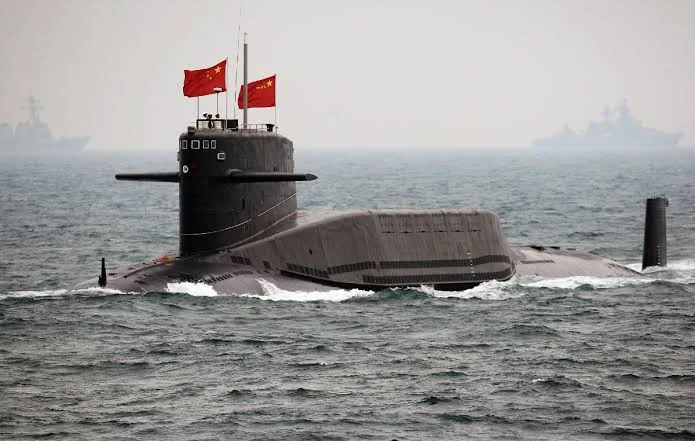




In a direct demonstration of its expanding blue-water naval power, the Chinese military successfully test-fired a long-range strategic ballistic missile from a nuclear-powered submarine into international waters. The high-profile launch marks a rare public display of China’s undersea nuclear deterrent, drawing swift diplomatic pushback and security concerns from regional powers across the Indo-Pacific.
According to China’s state-run Xinhua News Agency, a strategic nuclear submarine of the People’s Liberation Army Navy (PLAN) launched the missile—outfitted with a dummy warhead—at exactly 12:01 PM local time. The projectile flew along a pre-planned trajectory before landing precisely within “designated waters” in the South Pacific Ocean.
The Chinese Ministry of Defense defended the launch, describing it as a “routine arrangement” under the military’s annual training calendar. Beijing stated that the test fully complied with international law and established maritime practices, reiterating that the launch was not directed against any specific country or regional target.
China test-fired a ballistic missile from a nuclear submarine in the Pacific Ocean, underscoring its efforts to project power in the region https://t.co/kQ65AewTxu
— Bloomberg (@business) July 6, 2026
Strategic Significance of the Undersea Launch
While China conducted a rare intercontinental ballistic missile (ICBM) test from land into the Pacific Ocean two years ago, launching a strategic weapon directly from a submerged nuclear submarine signals a major advancement in Beijing’s second-strike survivability. Independent maritime intelligence platforms tracked the exercise, noting that China deployed two specialized satellite tracking vessels to the Pacific region to monitor the missile’s trajectory and data telemetry in real time.
Military analysts view the operation as an intentional demonstration of superpower status, mirroring the regular operational testing parameters implemented by the United States and Russian ballistic missile fleets.
Regional Backlash and Diplomatic Pushback
Despite Beijing issuing advance notifications to several neighboring countries before the countdown, the scale and location of the test triggered sharp condemnation from traditional Pacific security partners.
-
Australia’s Critique on Transparency: Speaking from a press conference in Suva, Fiji—where Australia and Fiji simultaneously signed a new mutual defense treaty—Australian Foreign Minister Penny Wong labeled the launch as “destabilizing.” Wong emphasized that the test occurred within the broader context of China’s rapid, unchecked military buildup, noting a persistent lack of transparency and reassurance regarding Beijing’s true strategic intent.
-
New Zealand and the Nuclear-Free Zone: New Zealand Foreign Minister Winston Peters expressed deep frustration, revealing that Wellington was officially notified of the test just hours before it took place. Peters condemned the use of the South Pacific as a missile testing site and explicitly pointed out that the weapon was fired into the South Pacific Nuclear Free Zone. This zone was established under the 1986 Treaty of Rarotonga—a pact whose protocols China ratified in 1987, pledging not to test or threaten the use of nuclear weapons within the region.
-
Japan’s Exclusive Economic Zone: The Japanese government lodged its own grave concerns regarding the surge in Chinese military activities. Tokyo revealed that China’s Coast Guard had issued warnings the previous day concerning falling space debris close to Japan’s waters. While Japanese government sources confirmed that the missile ultimately impacted outside of Japan’s Exclusive Economic Zone (EEZ), officials still formally urged Beijing to reconsider future tests of this magnitude.