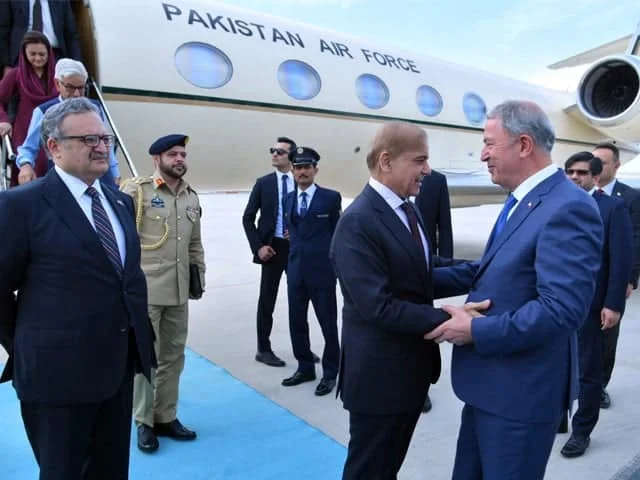




Directly following a high-profile presence at the state funeral ceremonies in Tehran, Prime Minister Shehbaz Sharif arrived in Istanbul on a pivotal bilateral visit at the invitation of Turkish President Recep Tayyip Erdoğan. The executive transition from regional crisis management in Iran to structured economic diplomacy in Türkiye underscores Islamabad’s ongoing strategy to secure long-term capital investments, modernize critical infrastructure, and stabilize its macroeconomic outlook.
The visit focused on moving the exceptional, deeply rooted defense and political alliance between Pakistan and Türkiye into a highly integrated economic partnership, backed by state-level institutional guarantees.
Istanbul, July 4 2026.
Prime Minister Muhammad Shehbaz Sharif held a series of meetings with senior executives of Türkiye’s leading business groups and industry organizations in Istanbul, reaffirming Pakistan’s commitment to strengthening economic cooperation and attracting… pic.twitter.com/koKCQcLZFT
— Prime Minister’s Office (@PakPMO) July 4, 2026
The Digital Corridor: Navigating the 5G Frontier
A central outcome of the Prime Minister’s high-level engagements was a strategic meeting with Turkcell Chief Executive Officer Ali Taha Koç, where Pakistan formally proposed the creation of a Pakistan-Türkiye Digital Corridor.
This specialized bilateral framework is designed to upgrade regional digital connectivity, facilitate secure cross-border data flows, and integrate critical digital infrastructure. The state has invited Turkcell to lead several high-value technological interventions:
-
Next-Generation Deployment: Establishing institutional partnerships for comprehensive 5G rollout, network optimization, and advanced spectrum management across Pakistan.
-
Localization of Supply Chains: Encouraging joint ventures for the local manufacturing of telecommunications equipment and software development to enhance domestic capability.
-
Capacity Building: Developing collaborative programs for digital skills development and rapid technology transfer to strengthen the domestic technology ecosystem.
Turkcell’s leadership welcomed the strategic initiative, confirming a strong corporate interest in entering long-term partnerships that match Pakistan’s forward-looking digital transformation agenda.
SIFC Mandate: Securing Strategic Corporate Commitments
During a dedicated business conference and successive executive sessions with the Union of Chambers and Commodity Exchanges of Türkiye (TOBB) and leading corporate conglomerates, Prime Minister Sharif showcased Pakistan’s improving macroeconomic indicators and investor-friendly policy framework.
The Prime Minister explicitly briefed Turkish business leaders on the role of the Special Investment Facilitation Council (SIFC). The council provides an authoritative, single-window facilitation mechanism that coordinates federal and provincial entities to provide institutional support, transparency, and predictability for foreign strategic investors.
The state secured direct commitments across multiple key economic sectors:
-
Energy & Infrastructure: In talks with Çalık Holding Chairman Ahmet Çalık, the Prime Minister finalized operational openings in energy distribution, infrastructure development, and upcoming state privatization pipelines.
-
Maritime & Logistics: The state invited the Albayrak Group to significantly expand its footprint in maritime infrastructure, port modernization, and logistics networks, directly linking Turkish logistical expertise with Pakistan’s national connectivity strategy.
-
Institutional Private Sector B2B Linkages: In coordination with TOBB, Pakistan proposed a structured institutional mechanism for regular private-sector engagement. The state formally invited a high-level TOBB business delegation to conduct an immediate investment scouting mission to Pakistan.
Power Sector Modernization: The Three Structural MoUs
The bilateral talks build upon a concrete energy framework established during recent high-level inter-ministerial consultations in Istanbul. Pakistan and Türkiye have formally signed three comprehensive Memoranda of Understanding (MoUs) targeted at reforming, commercializing, and digitalizing Pakistan’s power sector by directly adopting Türkiye’s successful post-privatisation governance model.
The formal agreements establish structured institutional partnerships between core state entities:
1. Market Development and Energy Exchange
Signed between Pakistan’s Independent System and Market Operator (ISMO) and Energy Exchange Istanbul (EPIAS), this agreement creates a framework for electricity market development, competitive market operations, and the formulation of modern ancillary services regulations.
2. Transmission Efficiency and Grid Operations
Concluded between ISMO and the Turkish Electricity Transmission Corporation (TEIAS), this partnership targets power system operations, transmission planning, grid stabilization, and the transfer of technical expertise to minimize line losses.
3. Distribution Management and Digitalization
Executed between the Power Planning and Monitoring Company (PPMC) and the Turkish Electricity Distribution Corporation (TEDAS), this MoU provides a technical mechanism for the modernization, structural reform, and comprehensive digitalization of Pakistan’s electricity distribution companies (DISCOs).
Through these strategic agreements, Pakistan’s Ministry of Energy aims to enhance the financial sustainability, service delivery, and regulatory oversight of the national grid, utilizing Turkish technical assistance to advance its domestic power sector reform program.