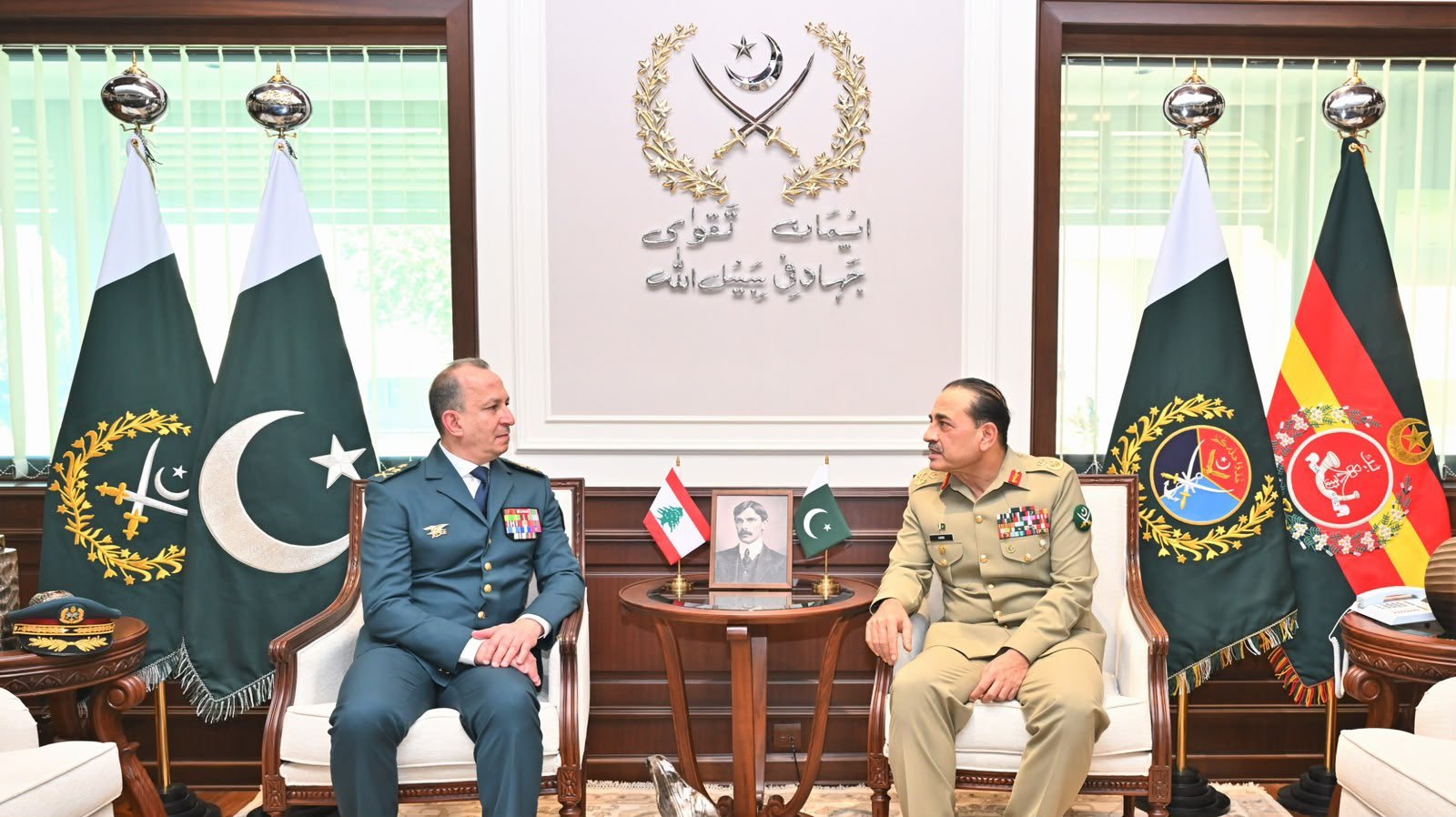




In a major diplomatic and military development intersecting with the Middle East peace process, the Commander-in-Chief of the Lebanese Armed Forces, General Rodolphe Haykal, met today with Pakistan’s Chief of Defence Forces and Chief of Army Staff, Field Marshal Syed Asim Munir, at the General Headquarters (GHQ) in Rawalpindi.
#WATCH: Lebanese army chief Rodolphe Haykal meets Pakistani military leader Syed Asim Munir at the General Headquarters in Rawalpindi, a source with knowledge of his visit said it was “linked to the Pakistani mediation” between #Tehran and #Washington https://t.co/Hz9oVSdhPF pic.twitter.com/bHeB2nHHI9
— Arab News (@arabnews) June 9, 2026
General Haykal, who arrived in Pakistan following a weekend departure from Beirut, was presented with a formal guard of honor by a smartly turned-out tri-services contingent upon his arrival at the military headquarters.
According to an official statement released by the Inter-Services Public Relations (ISPR), the two military heads engaged in detailed discussions regarding the rapidly evolving regional security environment, bilateral defense cooperation, and structural frameworks to expand institutional military-to-military linkages.
Frontline Logistics, State Collapse, and the Strategic Casualties of the Levant
The bilateral talks at GHQ occur against the backdrop of catastrophic conflict metrics inside Lebanon, highlighting the immense pressure on the country’s formal military architecture:
-
The Scale of Displacement: Since intense border hostilities flared in early March, extensive Israeli airstrikes and ground maneuvers have resulted in the deaths of 3,593 Lebanese citizens and left another 10,990 injured, causing over one million people to be displaced from their homes.
-
The Yellow Line Incursion: Despite a fragile regional truce, the Israel Defense Forces (IDF) have maintained their deepest ground invasion in a quarter-century. Israeli troops currently occupy roughly 2,000 square kilometers—nearly one-fifth of Lebanon’s total sovereign territory—enforcing a de facto “Yellow Line” buffer zone extending a dozen kilometers inside the country.
-
Institutional Capacity Building: At the center of the Rawalpindi discussions was an explicit commitment to enhance professional interactions and joint training initiatives, designed to preserve the operational readiness of the Lebanese Armed Forces (LAF) as a stabilizing, neutral state institution.
Critical Analysis: Backchannel Mediation, the Lebanon Front Inseparable Clause, and Post-War Stabilization
The unexpected arrival and subsequent GHQ sessions involving General Rodolphe Haykal expose the critical backchannel role Islamabad is playing in resolving the broader Middle East war:
Pakistan as the Central Conduit for U.S.-Iran Backchannel Talks
General Haykal’s high-profile visit to Rawalpindi is directly tied to Pakistan’s role as the primary international mediator negotiating an end to the war between the United States, Israel, and Iran. Field Marshal Asim Munir has emerged as a key negotiator trusted by both Washington and Tehran to convey terms and build a compromise framework.
The Lebanese military command’s decision to send its top general to the GHQ proves that the formal Lebanese state views Pakistan’s backchannel as the most viable path to securing its own sovereignty, bypassing traditional European or Arab diplomatic routes in favor of Rawalpindi’s direct intelligence-backed mediation.
Testing the Inseparable Clause of the Peace Treaty
The timing of these talks is highly significant because of the diplomatic battle over whether the region’s conflicts can be settled separately. The United States and Israel have attempted to negotiate a standalone deal with Iran that completely excludes the Lebanese theater, leaving the IDF free to dismantle Hezbollah’s remaining border infrastructure.
However, Tehran has explicitly countered that a ceasefire in Lebanon is an integral, inseparable component of any agreement with Washington. By hosting General Haykal at GHQ, Field Marshal Munir is directly addressing this diplomatic bottleneck, bringing a critical representative of the Lebanese state into the core negotiations to ensure that any final U.S.-Iran peace treaty includes concrete guarantees for Lebanon’s territorial integrity.
The Structural Weakness and Critical Neutrality of the LAF
The meeting highlights the unique, difficult position of the Lebanese Armed Forces within the wider war. The LAF is not actively participating in the kinetic war against Israel; that conflict is being fought almost exclusively by Hezbollah’s paramilitary wings in the south. However, the LAF remains the only universally respected, cross-sectarian state institution left in Lebanon.
By building closer ties with Pakistan—a major contributor to United Nations international peacekeeping operations—General Haykal is looking to strengthen his army’s institutional standing. If a permanent ceasefire is reached, the LAF will be legally required to move south to police the border zone; securing training, logistics, and institutional support from Pakistan is essential for the army to effectively take control of the region and prevent a total collapse of the state.
Navigating the Post-Ceasefire “Final Throes” Reality
The GHQ sessions occurred on the exact day that U.S. President Donald Trump announced that international negotiators are finally in the “final throes” of securing a regional peace agreement. Pakistan’s Prime Minister Shehbaz Sharif also confirmed that a comprehensive U.S.-Iran agreement was nearly finalized before a brief weekend spike in direct missile testing temporarily slowed down the process.
The military talks between Munir and Haykal serve to finalize the security and peacekeeping arrangements that will go into effect the moment the main diplomatic treaty is signed, ensuring that Lebanon’s formal defense forces are prepared to stabilize the Levant once the superpower confrontation concludes.