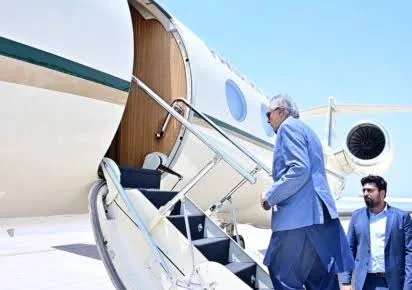
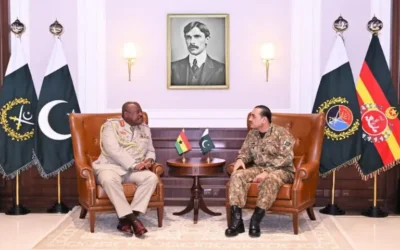
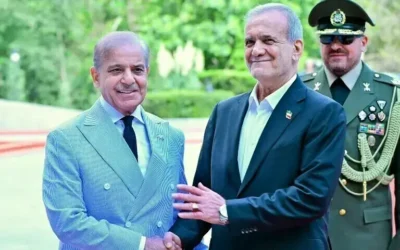
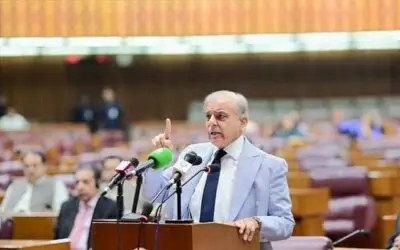


Pakistan’s Deputy Prime Minister and Foreign Minister, Senator Mohammad Ishaq Dar, arrived in Cairo on Saturday to participate in the fourth ministerial meeting of the “R-4” diplomatic framework. Scheduled for Sunday, June 21, the quadrilateral summit will convene the foreign ministers of Egypt, Saudi Arabia, Turkiye, and Pakistan to address rapid geopolitical developments, coordinate security strategies, and reinforce stability across the Middle East.
Upon arrival, Deputy PM Dar was received by Nazih El Naggary, Egypt’s Assistant Foreign Minister for Policy Planning, alongside Pakistan’s Ambassador to Egypt, Aamir Shouket. On the sidelines of the principal summit, Dar is scheduled to hold bilateral consultations with his Egyptian counterpart, Dr. Badr Abdelatty, and call on Egyptian President Abdel Fattah El-Sisi to discuss deepening trade, defense, and political cooperation.
The R-4 framework, which held its previous session in Islamabad in March, serves as a vital intra-regional vehicle for alignment among four of the region’s largest political and military stakeholders.
CRITICAL ANALYSIS
The fourth R-4 summit in Cairo occurs at a highly precarious moment for Middle Eastern diplomacy, functioning as a critical regional counterweight and support mechanism for the ongoing U.S.-Iran implementation talks. Convening immediately after the finalization of the “Islamabad MoU” which paused the U.S.-Iran conflict, the R-4 bloc represents a deliberate shift toward “regional ownership”—a diplomatic strategy aimed at stabilizing the Middle East through regional powers rather than relying strictly on external enforcement.
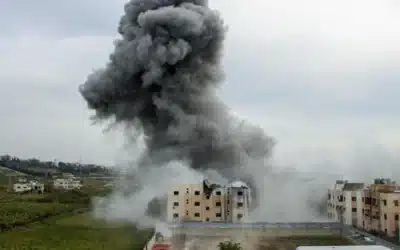
The primary challenge facing the R-4 alliance is the enforcement gap between grand diplomatic consensus and realities on the ground. While the bloc successfully aligns the geopolitical weight of Islamabad, Riyadh, Cairo, and Ankara, its collective leverage remains indirect over immediate disruptors, such as active kinetic exchanges between Israeli forces and non-state actors in Lebanon. Consequently, the Cairo summit is expected to pivot heavily toward constructing multilateral pressure mechanisms, particularly supporting the 60-day U.S.-Iran negotiation window and advocating for a durable, enforceable ceasefire in Gaza and Lebanon.
Furthermore, the R-4 meeting serves an important secondary function: safeguarding the strategic alignment of its members. By integrating Pakistan’s diplomatic mediation with the economic and geographic influence of Saudi Arabia, Egypt, and Turkiye, the framework establishes a resilient buffer zone capable of absorbing regional economic shocks—such as shipping disruptions in the Red Sea or the temporary closure of the Strait of Hormuz. The institutional success of the R-4 will ultimately be measured by its ability to transition from a platform for high-level consultation into a concrete, crisis-management coalition.