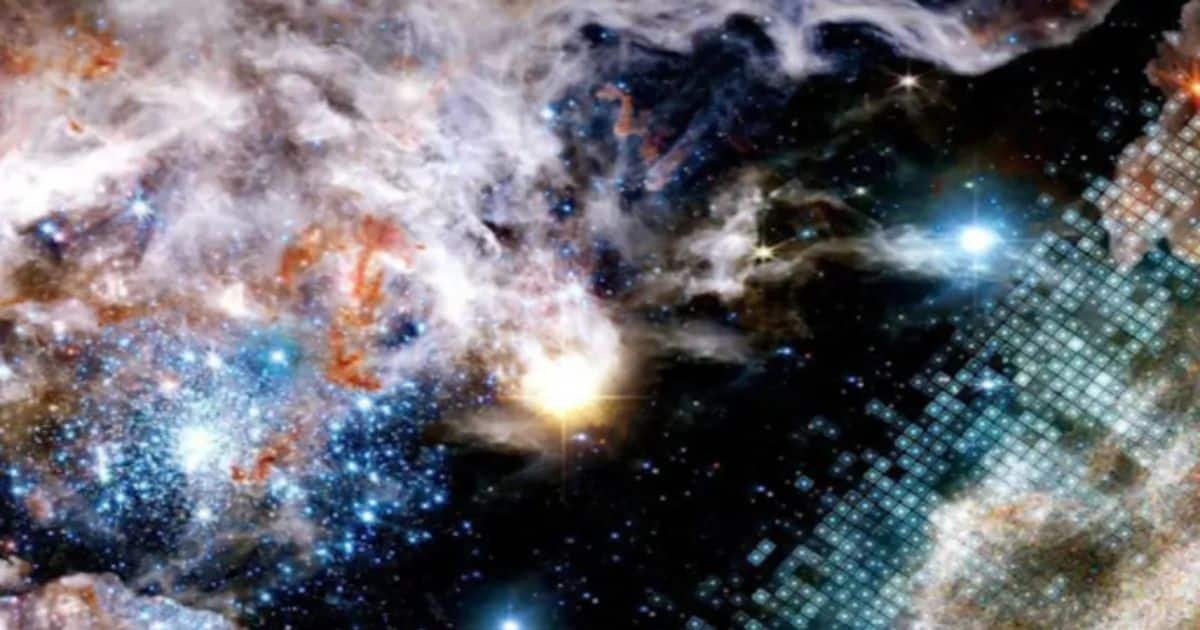





Researchers from Tsinghua University announced a major leap in deep-space exploration with the development of an AI model named ASTERIS. Published in the journal Science, this breakthrough technology uses computational optics and advanced algorithms to enhance astronomical imaging, allowing scientists to detect signals from the most distant reaches of the universe. The model effectively removes “noise” from space telescope data, such as thermal radiation and background sky interference, which often hides faint celestial objects from view.
The team demonstrated the model’s power by applying it to data from the James Webb Space Telescope (JWST). ASTERIS increased the telescope’s detection depth by 1.0 magnitude, making it capable of seeing objects 2.5 times fainter than previously possible. This enhancement led to the identification of over 160 candidate galaxies from the “Cosmic Dawn” period, roughly 200 million to 500 million years after the Big Bang. This discovery triples the number of known galaxies from that era found using traditional methods.
Chinese scientists develop AI model to push deep-space explorationhttps://t.co/AArCwUV9e2 pic.twitter.com/EDlBNADUA8
— CCTV (@CCTV) February 21, 2026
Unlike older techniques that rely on stacking multiple images, ASTERIS treats astronomical data as a 3D volume across space and time. This “spatiotemporal denoising” allows it to distinguish random noise from the actual, ultra-faint light of ancient stars. Experts believe this AI platform could become a universal tool for next-generation telescopes, helping humanity solve mysteries regarding dark matter, dark energy, and the origins of the cosmos.
You May Like To Read: