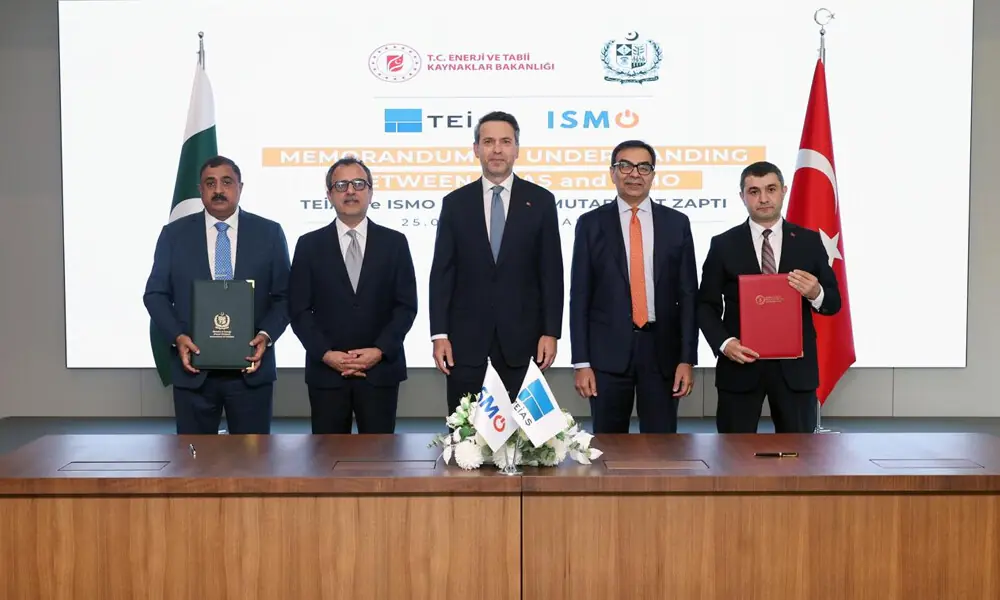



In a major step toward restructuring its domestic power sector, Pakistan has signed three landmark memorandums of understanding (MoUs) with the Republic of Türkiye. The agreements aim to overhaul Pakistan’s power system operations, accelerate the privatization of state-owned electricity distribution companies (DISCOs), and build long-term institutional capacity.
The bilateral agreements were formalized during high-level ministerial consultations held in Istanbul. The Pakistani delegation was led by Federal Minister for Energy (Power Division) Sardar Awais Ahmed Khan Leghari and Adviser to the Prime Minister on Privatization Muhammad Ali, alongside Turkish Minister for Energy and Natural Resources Alparslan Bayraktar. The agreements mark a strategic shift toward applying international best practices to resolve the systemic financial and administrative challenges within Pakistan’s energy infrastructure.
Three cooperation accords focus on electricity market development, transmission planning and post-privatisation governance as Islamabad seeks to modernise the power sector.
Read more at:https://t.co/eIpBQwZbCO pic.twitter.com/nsAJrP59vD— Profit (@Profitpk) June 25, 2026
The Institutional Framework: Connecting Market Operators and Regulators
The three MoUs establish direct institutional bridges between corresponding energy entities in both nations. They are designed to transfer technical expertise, implement modern post-privatization governance frameworks, and digitalize electricity networks.
-
Independent System and Market Operator (ISMO) and EPIAS: Pakistan’s newly established ISMO partnered with Turkiye’s Energy Exchange (EPIAS) to collaborate on electricity market development, competitive pricing mechanisms, and the introduction of regulations governing ancillary services.
-
ISMO and TEIAS: A secondary agreement was executed between ISMO and Turkiye’s Transmission System Operator (TEIAS), focusing on long-term transmission system development, network expansion, and the stabilization of power system operations.
-
Power Planning and Monitoring Company (PPMC) and TEDAS: Pakistan’s PPMC signed an accord with the Turkiye Electricity Distribution Corporation (TEDAS) aimed at modernizing and digitalizing the electricity distribution sector, with a specific focus on curbing line losses and improving billing recovery.
The agreements lay out comprehensive frameworks for continuous joint training programs, technical study visits, and joint engineering projects between the respective technical teams.
Emulating the Turkish Model for DISCO Privatization
A major focus of the inter-ministerial consultations was the restructuring and commercialization of Pakistan’s struggling distribution sector. The Pakistani delegation conducted a detailed review of Türkiye’s successful privatization model. Over the past 23 years, Ankara successfully transformed its state-dominated energy infrastructure into a privately driven, competitive market, tripling its total energy asset base through transparent concession models.
Minister Leghari reaffirmed Islamabad’s commitment to delivering a transparent, competitive, and investor-friendly bidding process as Pakistan prepares to offer its first batch of three DISCOs to private buyers. The structural reforms currently underway across these state-owned entities focus on improving corporate governance, establishing policy consistency, and creating commercially viable market structures capable of attracting major global consortia. Minister Bayraktar confirmed that Turkish investors are closely monitoring these regulatory updates and expressed Ankara’s readiness to provide full technical assistance to help safeguard Pakistan’s energy supply security during this critical structural transition.
Critical Analysis: Strategic Technology Transfer and the Challenge of Implementation
The execution of these three institutional MoUs reveals an important realization within Pakistan’s economic managers: the long-term financial sustainability of the power sector cannot be achieved through piecemeal tariff hikes alone. It requires a complete overhaul of the market’s underlying architecture. Partnering with Türkiye is highly strategic. The Turkish energy sector successfully navigated a transition from an inefficient, state-subsidized model to a profitable, unbundled private marketplace—the exact transformation Islamabad is attempting to pull off.
By aligning the newly formed ISMO with EPIAS and TEIAS, Pakistan is attempting to move away from a rigid, single-buyer model toward a competitive multi-buyer market. This shift is crucial for lowering the state’s crippling capacity payment liabilities. Furthermore, the partnership between PPMC and TEDAS targets the weakest link in Pakistan’s energy value chain: the operational inefficiencies and collection deficits of regional DISCOs. Using Turkish experience in distribution digitalization and smart-grid management could provide a blueprint for cutting down circular debt at the source.
However, the real-world success of these MoUs hinges on overcoming deep local challenges. Unlike Türkiye’s privatization phase, Pakistan’s power sector is burdened by an immense circular debt overhang, aging transmission networks incapable of handling peak wheeling loads, and significant political resistance to removing subsidies.
While emulating the Turkish concession model is an excellent theoretical framework, attracting reputable Turkish or global investors to purchase stakes in high-loss DISCOs will remain difficult unless the federal government can guarantee absolute regulatory certainty, insulation from currency volatility, and an independent tariff-setting process free from political interference. Without these fundamental domestic adjustments, these agreements risk becoming high-level administrative exercises rather than drivers of structural change.
Conclusion
The signing of these agreements in Istanbul represents a well-timed, practical advancement in Pakistan-Türkiye strategic relations, moving the partnership from traditional diplomatic alignment into deep, technical energy collaboration. By leveraging Türkiye’s proven expertise in power system operations, transmission planning, and market deregulation, Pakistan is equipping its core energy institutions with the tools needed to manage a complex transition.
If these institutional partnerships are supported by firm political will at home to enforce regulatory updates and protect private investments, they will play a vital role in stabilizing Pakistan’s energy sector. This will help build a transparent, efficient market capable of powering sustained industrial growth and easing the financial burden on the national treasury.