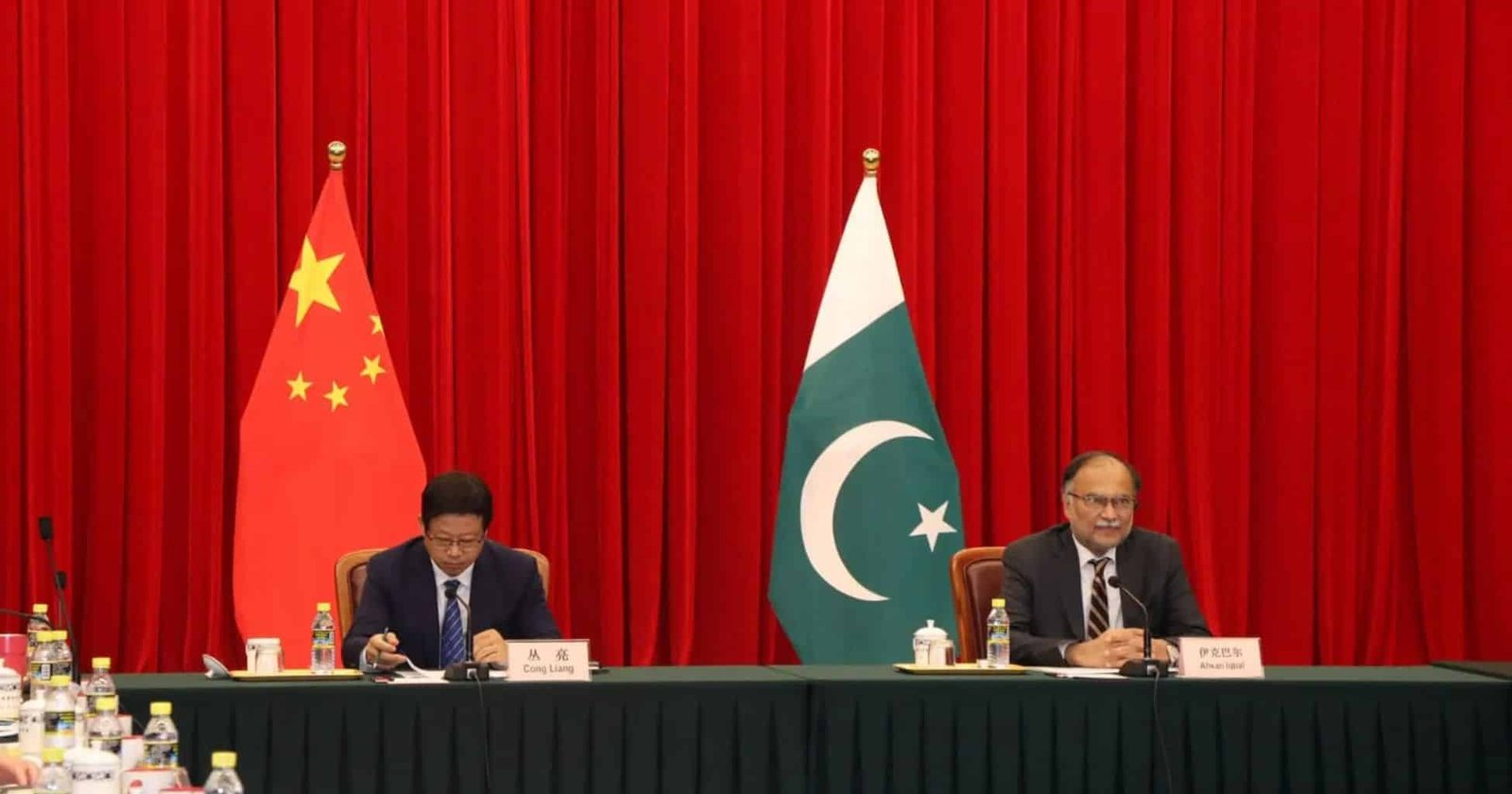





In a significant step forward for the China-Pakistan Economic Corridor (CPEC), the Government of Pakistan today announced a groundbreaking agreement with China to form a consortium of bilateral and multilateral partners to finance the $7 billion Mainline-1 (ML-1) railway project. The announcement came from Planning and Development Minister Ahsan Iqbal, who confirmed that this agreement, a key outcome of Prime Minister Shehbaz Sharif’s recent visit to China, also includes a comprehensive four-year action plan (2025-29) for the second phase of CPEC. This new phase is set to deepen strategic cooperation and transform the partnership into a “China-Pakistan community with a shared future.”
You May Like To Read: Pakistan Navy, and China’s Collaboration Leads to Major Offshore Gas Discovery
Financing Consortium for the ML-1 Railway
Minister Iqbal stated that the financing for the 1,700-km Karachi-Peshawar railway line, a crucial artery for the country’s economic and logistical connectivity, will be secured through a consortium comprising the Asian Development Bank (ADB), Asian Infrastructure Investment Bank (AIIB), China, and Pakistan. He emphasized that this collaborative financing model reflects the strong international confidence in the project’s viability and its strategic importance for the region. The minister also revealed that China has provided assurances of financing not only for ML-1 but also for the Karakoram Highway, with negotiations expected to conclude within one month. The accelerated progress on these projects underscores the unwavering commitment of both nations to infrastructure development, a cornerstone of CPEC’s success.
Four-Year Action Plan (2025-29) for CPEC’s Second Phase
The new action plan, spanning from 2025 to 2029, is designed to enhance political trust, strengthen trade relations, and foster deeper people-to-people connections between Pakistan and China. The second phase of CPEC will place a strong emphasis on agriculture modernization and industrial development, with provisions for third-party participation. This will allow other countries to join the corridor’s development, showcasing its inclusive and open nature.
Key initiatives under the action plan include:
- Industrial Cooperation: Both nations have agreed to make full use of the Framework Agreement on Industrial Cooperation to accelerate industrialization, boost exports, and encourage Chinese firms to invest in Pakistan. This includes the development of mining industrial parks and investment in the mining sector.
- Agricultural Modernization: Cooperation will be promoted in various agricultural domains, including crop cultivation, animal husbandry, agro-processing, and capacity building in areas like seed technology and drip irrigation. This focus aims to boost food security and productivity across Pakistan.
- Special Economic Zones (SEZs): The plan supports enterprise investment in SEZs, particularly in Karachi and Islamabad, by offering preferential policies and creating a supportive business environment.
High-Quality Development with Robust Security
The new action plan aligns the Belt and Road Initiative (BRI) with Pakistan’s 5Es Framework—Exports, E-commerce, Equity, Environment, and Empowerment—ensuring a synergy between the two nations’ development strategies. It will focus on implementing both large-scale, landmark projects and smaller, high-impact “small and beautiful” livelihood projects. This dual approach guarantees both high-quality development and inclusive growth, while a continued emphasis on security ensures a stable environment for all projects.
The agreement solidifies the shared vision of both nations for an even closer partnership in the new era. It reinforces the deep, time-tested friendship between Pakistan and China, moving beyond traditional cooperation to build a community with a shared future that is prosperous, secure, and resilient.
You May Like To Read: Fundamental Shifts in Air Superiority Paradigm Driven by AI, and Drone Technology