


Pakistan and Israel engaged in a heated debate at an emergency session of the United Nations Security Council (UNSC) on Thursday, with Islamabad leading a strong condemnation of Israel’s recent strike in Qatar that targeted Hamas leaders. Pakistan described the attack as “illegal, unprovoked, and a threat to regional stability.” The session was convened at the request of Algeria, Pakistan, and Somalia, and was supported by France and the United Kingdom.
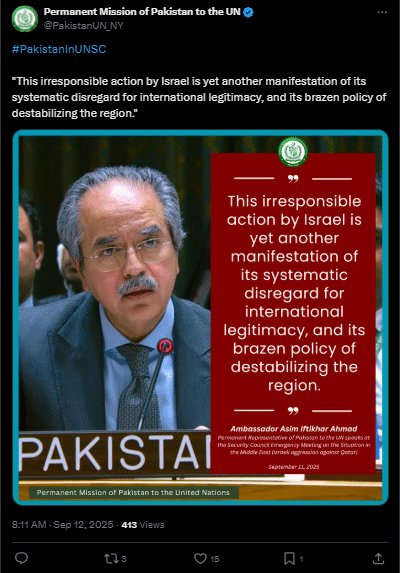
Pakistan’s Ambassador Condemns Israeli Actions
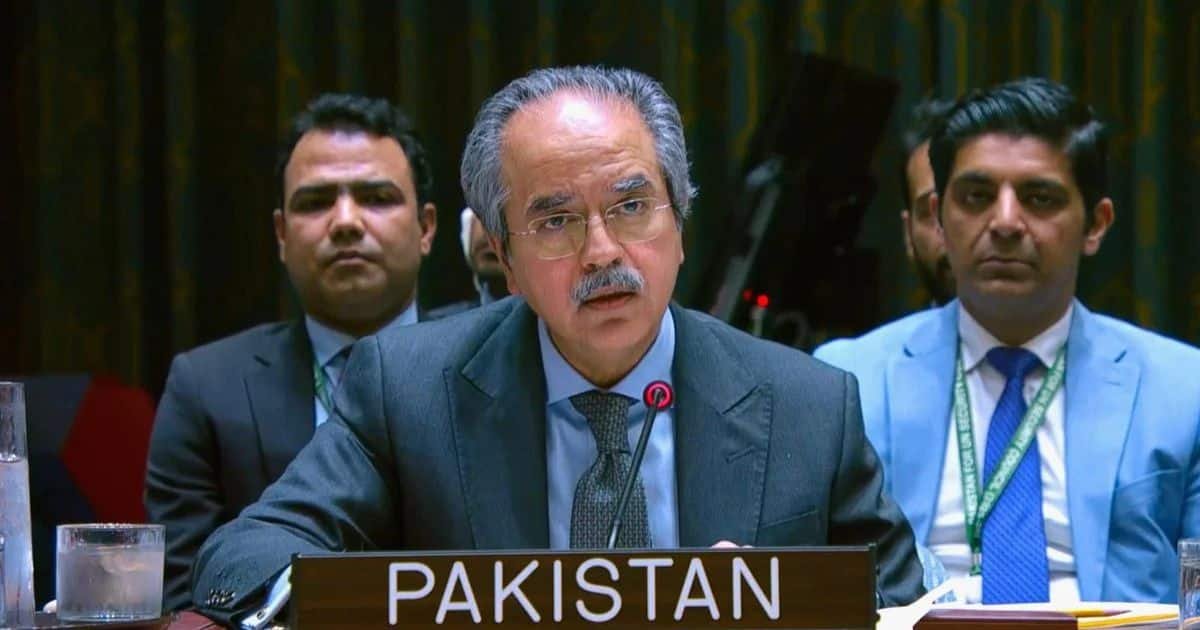
Pakistan’s Permanent Representative to the UN, Ambassador Asim Iftikhar Ahmad, delivered a powerful address, labeling the Israeli strike as a “brazen and illegal assault” and a clear violation of Qatar’s sovereignty.
“The brazen and illegal assault is not an isolated incident, rather it is part of a broader and consistent pattern of aggression and violation of international law by Israel that undermines regional peace and stability,” Ambassador Ahmad stated.
He further highlighted that the “Israeli strikes targeted a residential neighbourhood, deliberately endangering civilians, and thus, also constitute a grave breach of the International Humanitarian Law.”
He described the strike as a direct attempt to sabotage ongoing diplomacy, especially as delicate peace negotiations for Gaza were reportedly nearing a breakthrough. “Striking the territory of a principal mediator and those directly involved in negotiations is a deliberate attempt to sabotage diplomacy, derail peace efforts, and prolong the suffering of civilians,” he added.
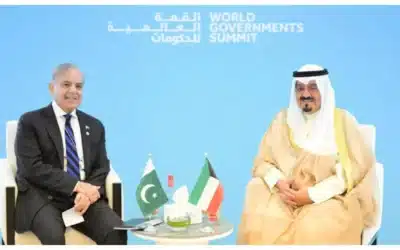
Ambassador Ahmad reaffirmed Pakistan’s solidarity with Qatar, referencing the recent visit of Prime Minister Shehbaz Sharif and Foreign Minister Ishaq Dar to Doha as a demonstration of unwavering support.
Heated Exchange with Israeli Ambassador
In a sharp exchange, Israel’s ambassador attempted to justify the strike by drawing an analogy to the US raid that killed Osama bin Laden in Pakistan. “When bin Laden was eliminated in Pakistan, the question asked was not why target a terrorist on foreign soil. The question was why was a terrorist given shelter at all. The same question must be asked today. There’s no immunity for bin Laden and there can be no immunity for Hamas,” he argued.
Ambassador Ahmad immediately exercised his right of reply, rejecting the analogy as “unacceptable, indeed ludicrous.” He accused Israel of attempting to deflect attention from its own “illegal actions and violations of international law.”
“It [Israel] is an occupier, a serial violator of the UN Charter and international law, that threatens the international community, humanitarian organisations, and even the United Nations itself — and does so with impunity,” Ahmad countered, reinforcing Pakistan’s frontline role in the global fight against terrorism and its commitment to upholding international law.
You May Like To Read: India Blocks the SCO Application of Azerbaijan, Amid the Pakistan-Armenia Diplomatic Surge
Qatar and International Community React
Qatar’s Prime Minister, Sheikh Mohammed bin Abdulrahman bin Jassim Al-Thani, strongly denounced the attack, calling it a “violation of the UN Member State’s sovereignty.” He criticized Israel for attacking a mediator and the negotiating teams, contrasting it with the U.S. approach during the Afghanistan peace talks. “We will not be deterred by those who call for war and destruction,” he declared.
Other major powers, including the United States, France, the United Kingdom, and China, also weighed in, with many expressing concern over the escalation and reaffirming the need for a political solution. The debate underscored the deep divisions within the Security Council and highlighted Pakistan’s crucial role in advocating for international law and accountability.
You May Like To Read: President Asif Ali Zardari Embarks on Official Visit to China