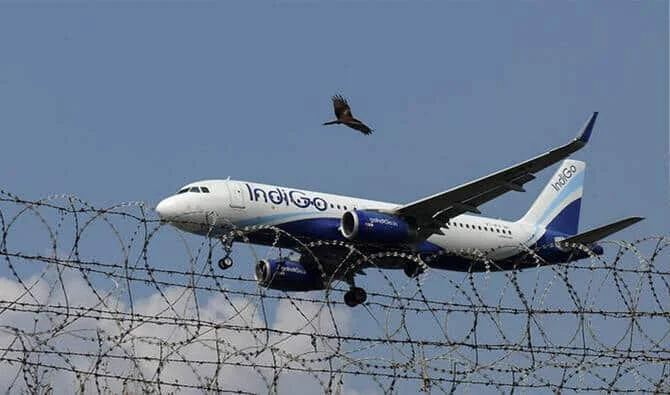





In a move that continues to inflict severe, compounding financial damage on India’s aviation sector, the Pakistan Airports Authority (PAA) has officially extended its total airspace ban on all Indian-registered aircraft until July 24, 2026.
The fresh Notice to Airmen (NOTAM), enacted late Tuesday, ensures that both of Pakistan’s vital Flight Information Regions (FIRs)—Karachi (OPKR) and Lahore (OPLR)—remain completely closed to all Indian civilian, commercial, and military flights.
Pakistan has once again extended restrictions on Indian aircraft using its airspace, with the Pakistan Airports Authority (PAA) issuing a fresh Notice to Airmen (NOTAM).
According to the latest directive, the ban will continue to apply to Indian-registered commercial and… pic.twitter.com/w8TWUyOkLI
— Bloom Pakistan (@bloom_pakistan) June 17, 2026
The blanket ban, originally triggered on April 23, 2025, following intense cross-border military escalation in the Pahalgam area of Indian-occupied Kashmir, has evolved into a highly effective instrument of economic friction. By forcing Indian carriers to completely bypass the Pakistani landmass, Islamabad has created a punishing operational bottleneck for New Delhi’s international long-haul fleets.
1. The Geometry of the Rerouting: High-Altitude Friction
The PAA’s administrative decree directly translates into a logistical nightmare for Indian flag carriers operating flights to Europe, Central Asia, and North America:
-
The Detour Penalty: By cutting off the direct Lahore and Karachi transit corridors, flights departing from New Delhi or Mumbai toward Western destinations are forced into circuitous, southerly paths over the Arabian Sea, bypassing Pakistan via cumbersome routes through the UAE or Oman.
-
The Flight-Time Inflation: This geographic detour adds anywhere from 90 minutes to nearly 3 hours of extra flight time per leg, dramatically throwing off international crew schedules, reducing aircraft utilization rates, and forcing painful flight cancellations across high-yield European networks.
2. The Air India Bleed: Shareholders Disclose Global Collapse
While the airspace closure serves as a sovereign security buffer for Pakistan, it is acting as a major financial shock to India’s premier airline group, which is currently enduring a historic financial crisis:
-
The Transnational Loss Reveal: According to the newly released annual report from shareholder Singapore Airlines (SIA)—which retains a 25.1% stake in the carrier—the Air India Group posted a historic, catastrophic annual loss of $2.8 billion (3.56 billion Singapore dollars) for the fiscal year ending March 31, 2026.
-
The Audit Warning: The financial strain is so pronounced that global auditing giant KPMG formally noted “indicators of impairment” regarding international investments in Air India, explicitly citing the toxic operational combination of the prolonged Pakistani airspace ban, elevated jet fuel prices, and the broader Middle East shipping conflicts.
-
Desperate Cost-Cutting: In a telling sign of the domestic panic caused by this $2.8 billion bleed, Air India recently took the unprecedented step of stripping away basic amenities, unbundling its tickets to launch a “Basic Fare” category that eliminates complimentary meals on domestic routes to conserve cash.
3. Strategic Gridlock: The Persistent Ceasefire Context
The PAA’s decision to lock down its skies until late July reflects a broader defense posture that prioritizes total vigilance along the western and eastern air boundaries:
-
The Air Dominance Legacy: The strict enforcement of the NOTAM serves as a reminder of the sharp air battles of May 2025, where Pakistani air defense networks successfully protected sovereign skies, creating a highly effective deterrence model that has kept the physical Line of Control (LoC) quiet but locked down.
-
The Institutional Stance: Military planners in Rawalpindi and civilian authorities in Islamabad remain unyielding. While a nominal ground ceasefire has held for over a year, the refusal to normalize civilian aviation pathways indicates that Pakistan will continue to utilize its airspace as a critical point of leverage against New Delhi until fundamental regional security disputes are addressed under international norms.
Critical Analysis
The Pakistan Airports Authority’s decision to extend the restriction on Indian aircraft until July 24 is a clear demonstration of how geographic leverage can be used to achieve significant strategic goals without firing a single shot. By keeping the Karachi and Lahore Flight Information Regions firmly locked, Islamabad is waging a highly effective war of economic attrition that exploits New Delhi’s structural vulnerabilities.
Exploiting Geography for Economic Impact
Airspace is often viewed as a purely regulatory or safety matter, but in the context of South Asian geopolitics, it functions as a powerful tool of economic pressure. Pakistan’s unique geography makes it the natural and most efficient gateway for any flight traveling from northern India to Europe or North America.
By closing off this essential corridor, Islamabad forces Indian airlines to absorb all the operational downsides of longer routes. The resulting increase in fuel consumption and extended flight times hit airlines directly in their bottom lines. This pressure is vividly reflected in Air India’s staggering $2.8 billion annual loss, proving that Pakistan’s defensive aviation policies are having a profound, measurable impact on India’s corporate and state-backed transport infrastructure.
Creating Regional Disruption as a Tool for Deterrence
This prolonged airspace ban does more than just damage airline finances; it reshapes the broader strategic landscape between the two neighbors. By showing a willingness to sustain this closure over many months, Pakistan sends a clear signal that it is fully prepared to absorb any minor loss of transit fee revenues to protect its security interests and maintain pressure on its neighbor.
This policy creates a powerful form of deterrence. It forces Indian policymakers and military planners to constantly factor the massive, ongoing costs of this aviation bottleneck into their wider strategic calculations, making any future border escalations or political misadventures an incredibly expensive proposition.
Leveraging Airspace Integrity for Diplomatic Strength
Furthermore, the airspace closure provides Pakistan with valuable leverage on the international diplomatic stage. As global airlines and international aviation bodies like ICAO look for ways to restore efficiency and reduce carbon emissions across Eurasian flight paths, the keys to unlocking these optimal routes remain firmly in Islamabad’s hands.
By linking the reopening of its skies to broader regional stability and the behavior of its neighbor, Pakistan ensures that its core security concerns cannot be ignored by global stakeholders. This policy turns a defensive boundary measure into an active diplomatic asset, allowing Pakistan to negotiate from a position of clear strength while its neighbor continues to bear the heavy operational costs of a restricted sky.