


The Foreign Office (FO) of Pakistan has officially debunked highly publicized intelligence rumors claiming that Deputy Prime Minister and Foreign Minister Ishaq Dar leaked sensitive Iranian nuclear intentions during a high-profile meeting with U.S. Secretary of State Marco Rubio in Washington.
Update |
Pakistan has firmly rejected allegations that Deputy Prime Minister and Foreign Minister Ishaq Dar shared Iranian intelligence or nuclear-related messages with US Secretary of State Marco Rubio.
The Foreign Office described the reports as baseless, speculative, and… pic.twitter.com/Ph7fihxmeQ
— South Asia Times (@_southasiatimes) June 4, 2026
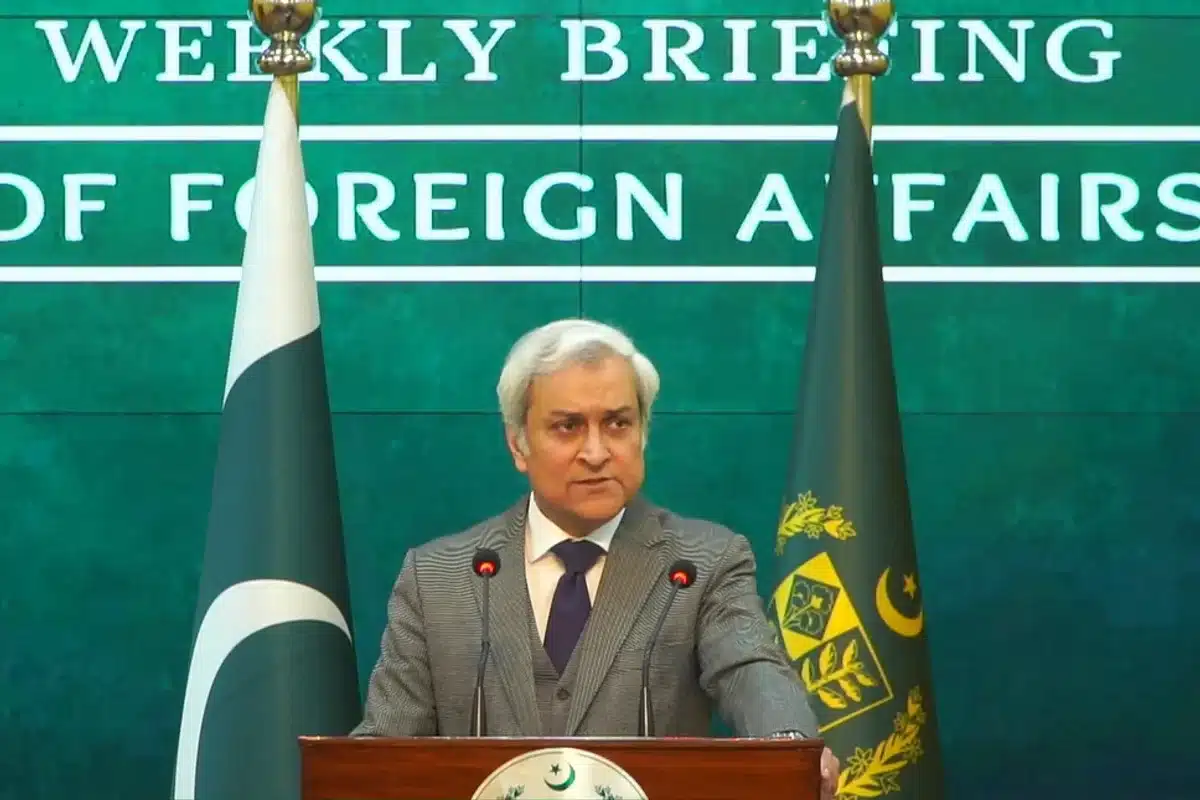
During a weekly press briefing on Thursday, FO Spokesperson Tahir Andrabi categorically rejected the claims, which originally surfaced via former CIA analyst Larry Johnson. The rumor alleged that Dar had transmitted a backdoor warning that Iran was prepared to detonate a nuclear weapon if current Gulf escalations continued.
“No such information was shared,” Andrabi declared. This official denial aligns directly with statements made by Secretary Rubio during a congressional hearing on Wednesday, where he confirmed to Congressman Scott Perry that no such nuclear message had ever been relayed by Pakistani leadership.
The diplomatic clarification comes amid extreme, volatile kinetic friction in the Gulf, where an April ceasefire hosted by Pakistan has fractured into dangerous gray-zone warfare—exemplified by recent U.S. strikes near the Strait of Hormuz and a retaliatory Iranian missile attack that heavily damaged Kuwait International Airport.
Shifting focus to regional stability, the Foreign Office issued an uncompromising, severe denunciation of India’s newly unveiled “Link-3 Project.” The proposed 26.2 billion Indian rupee infrastructure plan aims to construct a link tunnel to divert 1.9 million acre-feet of water annually from the Chenab River—a western river legally allocated to Pakistan—into the eastern Beas basin. Spokesperson Andrabi labeled the unilateral project a “grave violation” of the historic 1960 Indus Waters Treaty (IWT) and broader international water law, warning that Pakistan retains all necessary options to defend its survival.
Critical Analysis: Strategic Backchannels, Transboundary Water Weaponization, and Existential Security
The Foreign Office’s dual-pronged briefing exposes two highly precarious security matrices that threaten the geopolitical stability of both the Middle East and South Asia:
The Realpolitik of the Pakistani Conduit and Nuclear Panic
The rapid, synchronized denials from both Islamabad and Washington regarding the alleged “nuclear leak” highlight the delicate nature of Pakistan’s intermediary status. As a rare diplomatic actor maintaining warm ties with both Tehran and Washington, Pakistan has positioned itself as the primary host and backchannel conduit for the ongoing U.S.-Iran peace process.
The rumor that Pakistan was used to deliver an atomic ultimatum reflects deep-seated Western anxieties regarding Iran’s nuclear breakout timeline under the current naval blockade. By immediately shutting down this narrative, the Foreign Office is protecting Pakistan’s credibility as a neutral, trusted diplomatic bridge, ensuring that upcoming high-stakes negotiations aimed at lifting the competing blockades around the Strait of Hormuz are not sabotaged by speculative intelligence leaks.
The Weaponization of Hydrology and Treaty Subversion
India’s planned August 1 launch of the Chenab-Beas Link Tunnel, alongside a controversial “silt flushing” operation at the Salal Dam in Reasi, marks a significant, hostile departure from the spirit of the Indus Waters Treaty. The IWT is widely considered one of the world’s most successful transboundary water agreements because it strictly isolates water management from broader geopolitical warfare.
By initiating an inter-basin transfer of the Chenab without official consultation or treaty-mandated notices, New Delhi is testing a doctrine of hydrological coercion. Diverting 1.9 million acre-feet of water from an agrarian economy like Pakistan—already facing climate-induced water scarcity—is a direct, existential threat to the food and economic security of 250 million people.
Legal Warfare and the Shift in Pakistani Deterrence
Spokesperson Andrabi’s explicit invocation of the Vienna Convention on the Law of Treaties and the 1977 UN Convention on Watercourses signals that Pakistan is preparing for extensive international legal warfare. Historically, Pakistan has relied heavily on the World Bank’s internal IWT arbitration mechanisms to resolve engineering disputes (such as the Kishanganga or Ratle hydro-projects).
However, by describing India’s actions as an attempt to “weaponize water” with “grave consequences for regional peace,” Islamabad is signaling that it views this structural diversion not as a technical disagreement, but as an act of non-kinetic aggression.
The “All Options” Doctrine as an Ultimatum
The repetition of the phrase “we retain all options in this regard” is a calculated strategic warning. In the vocabulary of South Asian deterrence, this deliberate ambiguity implies that Pakistan will not limit its response to international courts if its vital lifelines are choked.
By explicitly linking water security to national survival, Islamabad is attempting to trigger international diplomatic intervention, urging global powers to restrain New Delhi before water manipulation escalates into an active, multi-domain regional crisis that South Asia cannot afford.
Pakistan retains ‘all options’ against India’s Chenab-Beas water diversion project: FO
Read More: https://t.co/58jmVJBRoo#ARYNews
— ARY NEWS (@ARYNEWSOFFICIAL) June 4, 2026