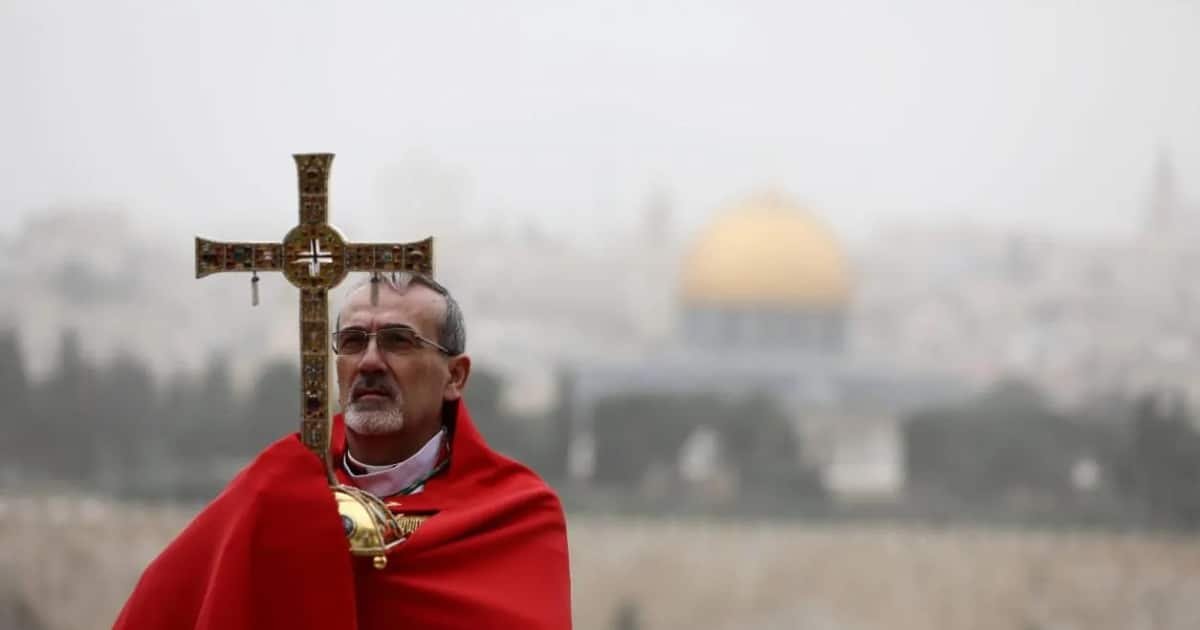



In a move described as a “manifestly unreasonable” violation of religious freedom, Israeli police on Sunday prevented the Latin Patriarch of Jerusalem, Cardinal Pierbattista Pizzaballa, from entering the Church of the Holy Sepulchre. The incident marks the first time in centuries that the head of the Catholic Church in the Holy Land has been barred from celebrating Palm Sunday Mass at Christendom’s holiest site.
The restriction has sparked a diplomatic firestorm, drawing sharp condemnations from European leaders and the Vatican as the Middle East conflict continues to stifle religious life in the Old City.
🇮🇱 🇮🇹 Israeli police have prevented the Latin Patriarch of Jerusalem, Cardinal Pierbattista Pizzaballa, from entering the Church of the Holy Sepulchre to celebrate Palm Sunday mass, the Latin Patriarchate of Jerusalem said ➡️ https://t.co/D0Yh442v29 pic.twitter.com/ZPQEjuCMtZ
— AFP News Agency (@AFP) March 29, 2026
The Incident: A Centuries-Old Tradition Broken
The Latin Patriarchate of Jerusalem reported that Cardinal Pizzaballa and the Custos of the Holy Land, Fr. Francesco Ielpo, were stopped by police while proceeding privately to the church.
-
No Procession: Despite the Church having already cancelled the traditional public procession from the Mount of Olives to comply with war-time safety protocols, the private entry of the senior-most clerics was still denied.
-
Police Justification: Israeli authorities cited strict emergency regulations that limit public gatherings to 50 people following the February 28 outbreak of war. Police stated the Old City’s narrow corridors pose a “real risk to human life” for emergency response during mass casualty incidents.
-
The Church’s Stance: The Patriarchate labeled the decision “fundamentally flawed” and “tainted by improper considerations,” noting that the Church had acted with “full responsibility” since the start of the conflict.
Global Diplomatic Backlash
The blocking of the top Catholic figure for Israel and the Palestinian territories has triggered immediate international repercussions:
-
France: President Emmanuel Macron condemned the decision on X, stating that worship for “all religions” must be guaranteed and noting a “worrying series of violations” regarding Jerusalem’s holy sites.
-
Italy: Prime Minister Giorgia Meloni called the action an “offence to the faithful” and to any community respecting religious freedom. Foreign Minister Antonio Tajani took the extraordinary step of summoning Israel’s ambassador over the incident.
-
The Vatican: Pope Leo XIV, during his Angelus prayer in Rome, paid tribute to Middle Eastern Christians who “cannot fully live the rites of these holy days” due to the “terrible conflict.”
A Deserted Holy Week in Jerusalem
The atmosphere in the Old City remains somber as Holy Week begins under the shadow of Operation Epic Fury.
-
Shuttered Streets: Local residents described the Old City as a “ghost town,” with shops closed and traditional street celebrations forbidden for the first time in living memory.
-
Impact on Pilgrimage: The cancellation of processions has left thousands of local worshippers and remaining pilgrims in a state of “deep sorrow,” confined to small, private indoor prayers.
Strategic Context: The Religious Toll of War
As Pakistan leads a quadrilateral mediation effort in Islamabad to end the US-Israel-Iran war, the incident in Jerusalem underscores the deepening social and religious friction in the region. Analysts suggest that the “Gaza model” of total restriction is now being applied to Jerusalem’s Status Quo, further complicating the delicate diplomatic balance the “Islamabad Option” seeks to restore.
You May Like To Read: US and Iran Express Confidence in Pakistan to Mediate Peace as Regional Powers Convene for High-Stakes Summit
Check out our latest video: