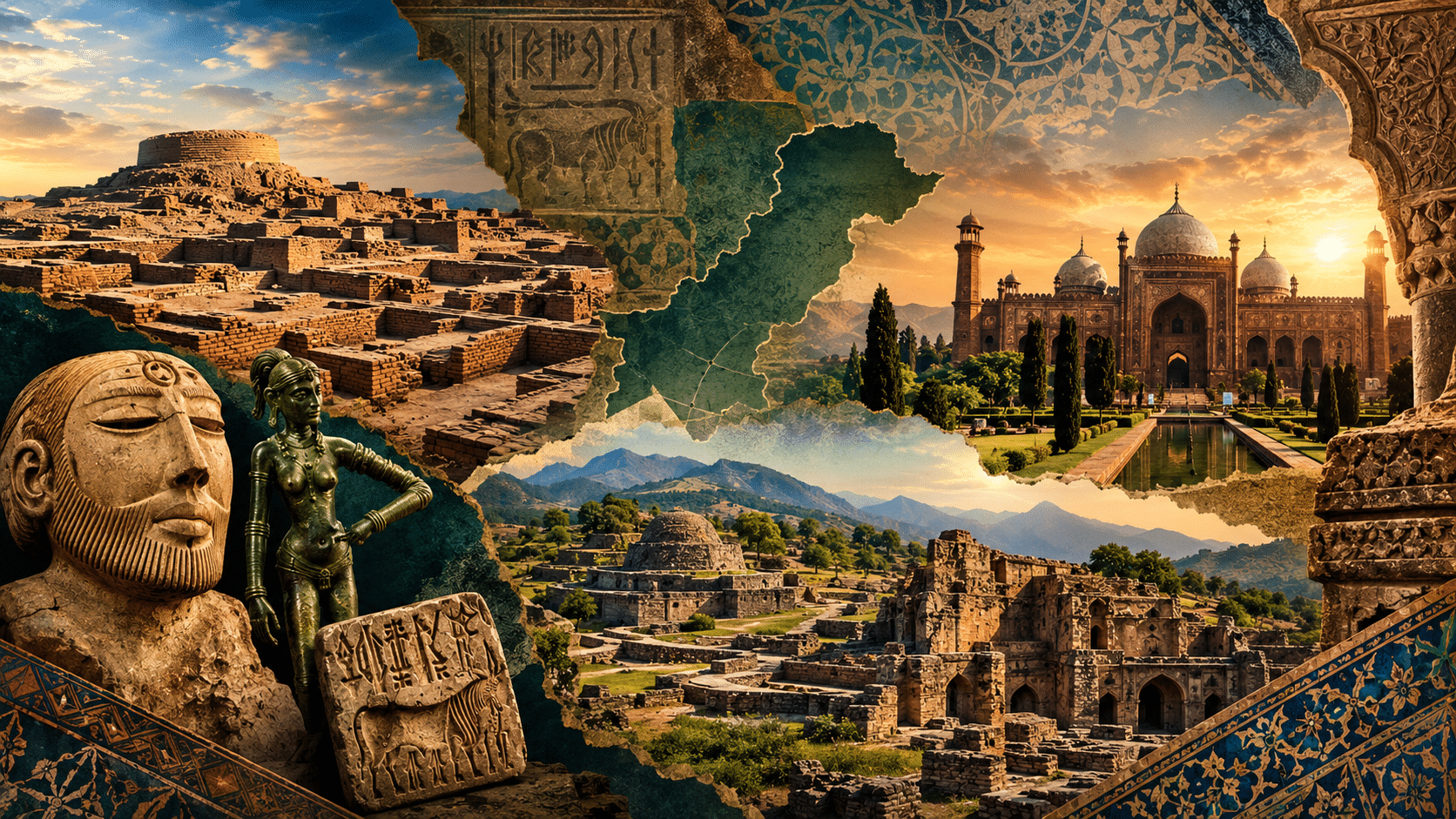





Pakistan, created on August 14, 1947, has a very rich history. It is home to some of the oldest civilizations. Every archaeological and architectural site embodies thousands of years of history. From the sun-baked ruins of the Indus Valley Civilization to the Mughal Gardens, everything reminds one of the subcontinent’s glorious and eventful past. Pakistan has many historical sites; however, UNESCO has identified six as World Heritage Sites—offering a window into South Asia’s past. This article lists all the UNESCO World Heritage Sites and answers the questions curious readers have—such as when they were built, who built them, why they matter, and the lesser-known stories that make them fascinating.
1. Ruins of Mohenjo-daro
The archaeological ruins of Mohenjo-daro, also called the Mound of the Dead, were built around 2500 BCE. They are situated in present-day Sindh and are one of the best-preserved urban settlements of the ancient Indus Valley Civilization. The person who constructed Mohenjo-daro remains unknown. Although the walls bear the Indus Script, which has not been deciphered, much of the relevant information remains a mystery. However, the city and the society were extraordinarily advanced for their time. The city’s grid-pattern streets, covered drainage system, and multi-story brick houses validate this claim.
Historical Significance
Most people do not know that Mohenjo-daro predates ancient Egypt’s New Kingdom and even Classical Greece. Moreover, the urban planning and sophistication of Mohenjo-daro’s infrastructure were neither replicated nor matched again for centuries. The Great Bath in the ruins suggests the site was used for ritual purification. Therefore, it can be inferred that the society collectively was either religious or prioritized a civic life.
It is believed the city was mysteriously abandoned around 1900 BCE. However, the reason is unknown. Multiple theories attempt to explain why it was abandoned. Some speculate that river flooding, shifting trade routes, or invasion forced the dwellers of this highly sophisticated society to abandon it. No conclusive evidence supports these claims, and the actual reason remains shrouded in mystery.
Lesser-known Fact
Archaeologists uncovered various artifacts from the ruins. In the 1920s, archaeologists excavated the famous “Priest-King” bust and the “Dancing Girl” bronze statue. These objects were so refined that archaeologists initially doubted their original age. The site is also sinking due to rising groundwater levels and salinity. Therefore, conservation of this World Heritage Site is an urgent global concern.
2. Taxila
Taxila is located near modern-day Rawalpindi. Taxila housed a Buddhist civilization and served as a center of learning from the 6th Century BCE to the 5th Century CE. Various rulers conquered the area, building and expanding it over time. Prominent rulers include the Achaemenid Persians, Alexander the Great’s Greek successors, the Mauryan Empire under Ashoka, and later the Kushans.
Historical Significance
Taxila’s location is strategically important; it is at the center of ancient trade routes and connects with Central Asia, Persia, and South Asia. As a result, it naturally became a hub for commerce, religion, and scholarship.
Taxila is credited with one of the ancient world’s earliest universities, living up to its reputation as a learning hub. Scholars from different parts of the world, particularly across Asia, came here to study medicine, philosophy, and the arts. Ashoka the Great, an influential Buddhist patron, expanded the site significantly and improved its infrastructure.
Lesser-known Fact
The Huns attacked Taxila multiple times, most notably in the 5th Century CE, which contributed to the civilization’s eventual decline. Some scholars argue that Taxila functioned less like modern-day universities offering different courses and degrees, and more like a cluster of independent teaching centers; however, this nuance is lost in modern and popular retellings.
3. Ruins of Takht-e-Bahi and Sahr-e-Bahlol
Takht-e-Bahi literally means Throne of Origins; it is perched on a hilltop in Khyber Pakhtunkhwa. Takht-e-Bahi is a Buddhist monastic complex; its construction began around the 1st Century. This site is located near the ruins of the fortified city of Sahr-e-Bahlol, contemporary with Takht-e-Bahi. Both landmarks are ancient relics of the Gandhara Civilization, renowned for blending Greek and Buddhist artistic traditions.
Historical Significance
Takht-e-Bahi and Sahr-e-Bahlol were originally built as monasteries; their basic purpose was to serve monks who practiced and taught Buddhism, as the religion flourished under Kushan patronage.
Another important fact regarding this site is that it exemplified Gandhara Art, a unique fusion of Hellenistic Sculpture Techniques and Buddhist Iconography. This site preserves the memories and legacy of Alexander the Great’s campaign through this region.
Lesser-known Fact
Takht-i-Bahi is also one of the few Gandharan sites to survive to date and remain largely intact despite repeated attacks, although nearby settlements have been destroyed. Nevertheless, because of its hilltop and remote location, it is believed this site survived the brunt of time.
4. Lahore Fort and Shalamar Gardens
Lahore Fort was rebuilt by the Mughal Emperor Akbar in 1566, though earlier structures had existed for centuries. The Shalamar Gardens, by contrast, were built on the orders of another Mughal Emperor, Shah Jahan, in 1641. Interestingly, Shah Jahan is the same Mughal Emperor who commissioned the construction of the Taj Mahal, situated in modern-day Agra, India.
The Lahore Fort was built as an imperial residence and the seat of Mughal Power in Punjab. It was symbolic, representing the Mughal Empire’s power and presence in the Subcontinent’s Punjab. The Shalamar Gardens, on the other hand, were designed primarily for royal pleasure and retreat, showcasing Persian-inspired landscape and architecture.
Historical Significance
The Lahore Fort and the Shalimar Gardens are pinnacles of Mughal Architecture and a testament to Mughal administrative ambition. It presents a unique blend of military fortification and aesthetics, undoubtedly a hallmark of Mughal statecraft.
After the fall of the Great Mughal Empire, the Lahore Fort passed into the hands of later rulers such as the Sikhs and British Colonizers. Each left its mark on this beautiful architecture, subtly modifying and expanding it to suit its taste and aesthetics. Ranjit Singh, a prominent ruler of pre-partition Punjab, added to the Lahore Fort and had the Sheesh Mahal, which literally means the Palace of Mirrors, constructed.
Lesser-known Fact
Here is an important and fascinating detail about the Shalamar Gardens. The three descending terraces originally featured 410 fountains, and to ensure water reached all of them, engineers built a novel gravity-fed canal system. It is without a doubt an interesting feat of 17th-century hydraulic engineering.
5. Makli Necropolis
Makli Necropolis is situated in modern-day Sindh. It spans over 10 kilometers, and it is considered the largest funerary site in the world. It was constructed in the 14th and 18th centuries. The numbers are not exact, but approximately half a million graves and tombs built by various dynasties are located here, including those of famous figures such as Samma, Arghun, Mughal Rulers, and Tarkhan.
Historical Significance
Thatta was a center of political and spiritual power. Makli therefore became the preferred burial ground for the saints, scholars, royalty, and other influential figures of that time. People believed that those buried there would receive spiritual blessings.
The site bears traces of centuries of history and reflects evolving funerary architecture. It beautifully blends Hindu, Persian, and Islamic styles, creating a distinct Sindhi aesthetic that stands out.
Lesser-known Fact
Although the Makli site is comparatively larger in scale, it is not as well known as other UNESCO-recognized heritage sites, such as Mohenjo-daro. UNESCO considers it a pinnacle of craftsmanship, particularly the glazed tile work. It is the finest example of Islamic funerary art in South Asia.
6. Rohtas Fort
Sher Shah Suri, an Afghan ruler who briefly dethroned the Mughal Emperor Humayun, built Rohtas Fort between 1541 and 1548. Rohtas Fort is located near Jhelum; it was originally built as a massive military stronghold to suppress the rebellion of the local Gakhar Tribes and guard against Humayun’s anticipated return as he sought to reclaim his throne.
Historical Significance
The Rohtas Fort is a masterpiece of early Muslim Military Architecture in South Asian history. Its massive walls stretch up to 4 kilometers, and it has 12 monumental gates. Ironically, Sher Shah Suri died on May 22, 1545, at Kalinjar Fort in modern-day India, before the Rohtas Fort could be completed; he never set foot inside it. Eventually, in 1555, Mughal Emperor Humayun reclaimed the throne.
Lesser-known Fact
Rohtas Fort was never attacked or even besieged; its massive scale and design proved a major deterrent, fulfilling its strategic purpose without a single major battle.
Why These Sites Matter Today
The six UNESCO World Heritage Sites located in Pakistan are more than just tourist attractions. They offer a glimpse into Pakistan’s historical landscape, providing an uninterrupted timeline of human ingenuity. They stretch from the sophisticated urban grid of Mohenjo-daro to the formidable military architecture of Rohtas Fort. Each site is a relic of the past, serving as a physical archive of South Asia’s dynamic history, preserving the essence of the spiritual scholarship of Taxila, the artistic synthesis of Gandhara at Takht-e-Bahi, the artistic grandeur of Mughal Lahore, and the enduring craftsmanship of the Makli Necropolis.
Preserving these monuments is imperative because they are not bricks and stones; they are much more than that. Preservation is about conserving the rich, cross-cultural heritage that has shaped succeeding human civilizations. These sites remind us that the modern nation stands upon thousands of years of profound history. Pakistan is recently expanding its tentative list to 37 additional sites. Recognizing the country’s heritage will grow significantly, and it will certainly expand tourism, broaden global cultural appreciation, and improve Pakistan’s soft image.