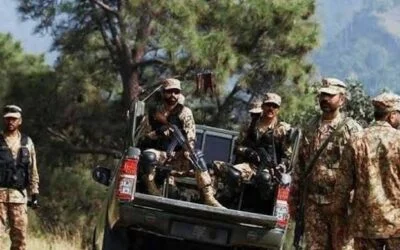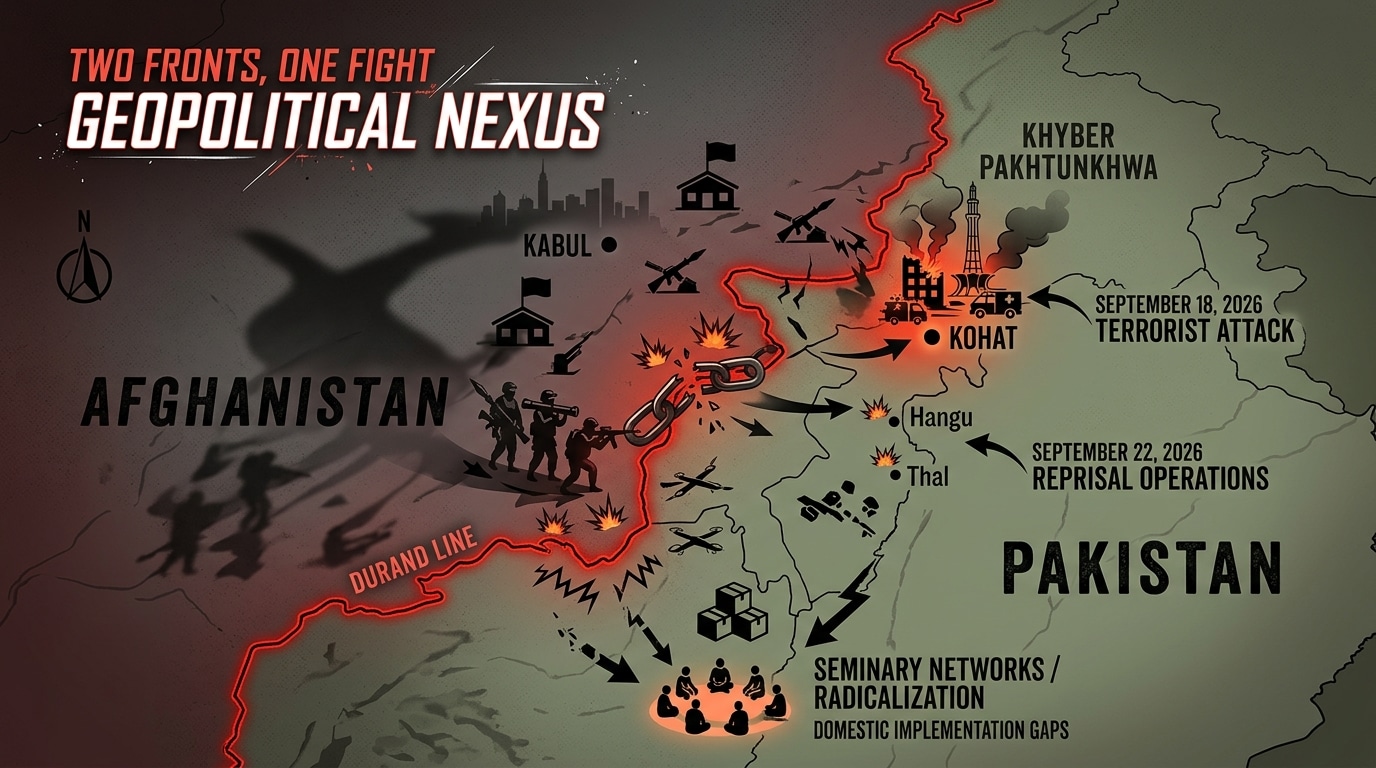




On September 18, 2026, a suicide bomber struck near a mosque during Friday prayers in Kohat, Khyber Pakhtunkhwa, before gunmen stormed a nearby police facility and held it for roughly twenty hours. At least 31 people were killed, including 16 police personnel, before all eight attackers were killed. Four days later, Pakistani forces struck back across the border, with the Ministry of Information and Broadcasting claiming 37 militants killed in ground operations around Kohat, Hangu and Thal, followed by airstrikes on hideouts inside Afghanistan.
Kohat was not an isolated event. It was the latest expression of a regional militant architecture that Pakistani officials, UN monitors and independent analysts increasingly describe in the same terms: a nexus linking the Tehreek-i-Taliban Pakistan (TTP), the Afghan Taliban government, and Al Qaeda.
A Sanctuary, Not a Rogue Faction
The UN Security Council’s Analytical Support and Sanctions Monitoring Team has documented this relationship across successive reports. Its 38th report, issued in August 2026, found that Afghanistan continues to host TTP, Al Qaeda and Islamic State-Khorasan networks capable of moving training, funding and logistics across the Pakistani border. The 36th report, from July 2025, found the TTP “continued to receive substantial logistical and operational support from the de facto authorities” in Kabul, and monitors estimate roughly 6,000 TTP fighters are currently sheltered on Afghan soil. The Team has also assessed that Al Qaeda has effectively “blended itself with TTP,” operating through its regional affiliate, Al Qaeda in the Indian Subcontinent, sustaining a low-visibility presence across several Afghan provinces that provides the TTP with money, training expertise and ideological continuity.
Michael Semple, a former EU representative in Afghanistan who negotiated directly with the Taliban, told Al Jazeera after Kohat that an attack of that sophistication “could not be attempted without planning, logistics and training,” fitting a pattern of the Afghan Taliban “providing sanctuary to both al-Qaeda and different factions of the TTP.” Kabul continues to deny hosting any group that threatens another state — a denial the UN Monitoring Team has repeatedly called “not credible.”
The Domestic Gap Behind the Cross-Border One
None of this excuses what remains an unfinished job at home. Cross-border strikes address the sanctuary problem; they do not substitute for the National Action Plan’s unmet promises. Adopted after the 2014 Army Public School massacre, NAP was meant to dismantle seminary financing networks, curb hate speech, shut down proscribed groups operating under new names, and strengthen prosecutions. Pakistan’s own government reviews have acknowledged implementation on precisely these fronts has been “far from satisfactory.” Reporting on the country’s roughly 26,000-plus seminaries has repeatedly found basic registration and audit requirements first promised in 2015 still unmet, with provincial governments wary of confronting seminary networks’ street power. Judicial data tells a similar story: thousands of terrorism suspects have been acquitted or bailed against only a handful of executions, doing little to deter local facilitation. Political will, diverted by shorter-term crises and coalition politics, has rarely been sustained long enough to close these gaps.
What Actually Closing the Gap Would Require
External sanctuary and domestic drift are two ends of one failure, so the response has to work on both fronts at once.
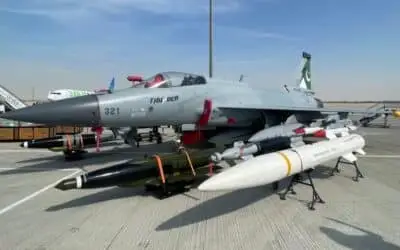
Kinetic measures. Precision intelligence-based operations, like the recent Kohat-Hangu-Thal clearance, should remain targeted rather than indiscriminate, since civilian casualties from cross-border strikes have historically hardened local sympathy for militants rather than eroding it. Better border management — fencing, surveillance technology and manned checkpoints along the Durand Line — matters more than periodic airstrikes for choking off infiltration routes. Intelligence-sharing and fusion between military, police and civilian agencies needs to move faster than the militants who exploit the gaps between them.
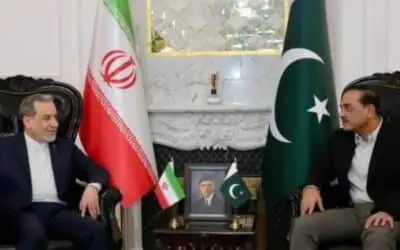
Non-kinetic measures. Seminary registration and financial audits need to move from promise to enforcement, with genuine provincial buy-in rather than federal directives that stall at the door of resistant clerics. Terrorism prosecutions need faster courts, protected witnesses and judges, and forensic capacity that can secure convictions rather than acquittals. Counter-radicalisation programmes for returnees and at-risk youth in the former tribal districts deserve the same sustained funding as military operations, not the leftover budget. And diplomatically, Pakistan needs to keep building the emerging regional consensus — visible in recent UN reporting and in shared frustration from China, Iran and Central Asian states — that pressures Kabul with something more than bilateral complaints.
Two Fronts, One Fight
Airstrikes on hideouts in Kunar or Khost can degrade capacity temporarily, but they cannot close a seminary financing loophole in Punjab or convict a facilitator in a Peshawar courtroom. Pakistan has shown, including this past week, that it can act decisively against external sanctuary. Whether it can summon the same consistency against the slower, more politically uncomfortable work at home is the question that will determine whether Kohat becomes a turning point or simply the latest entry in a long list.