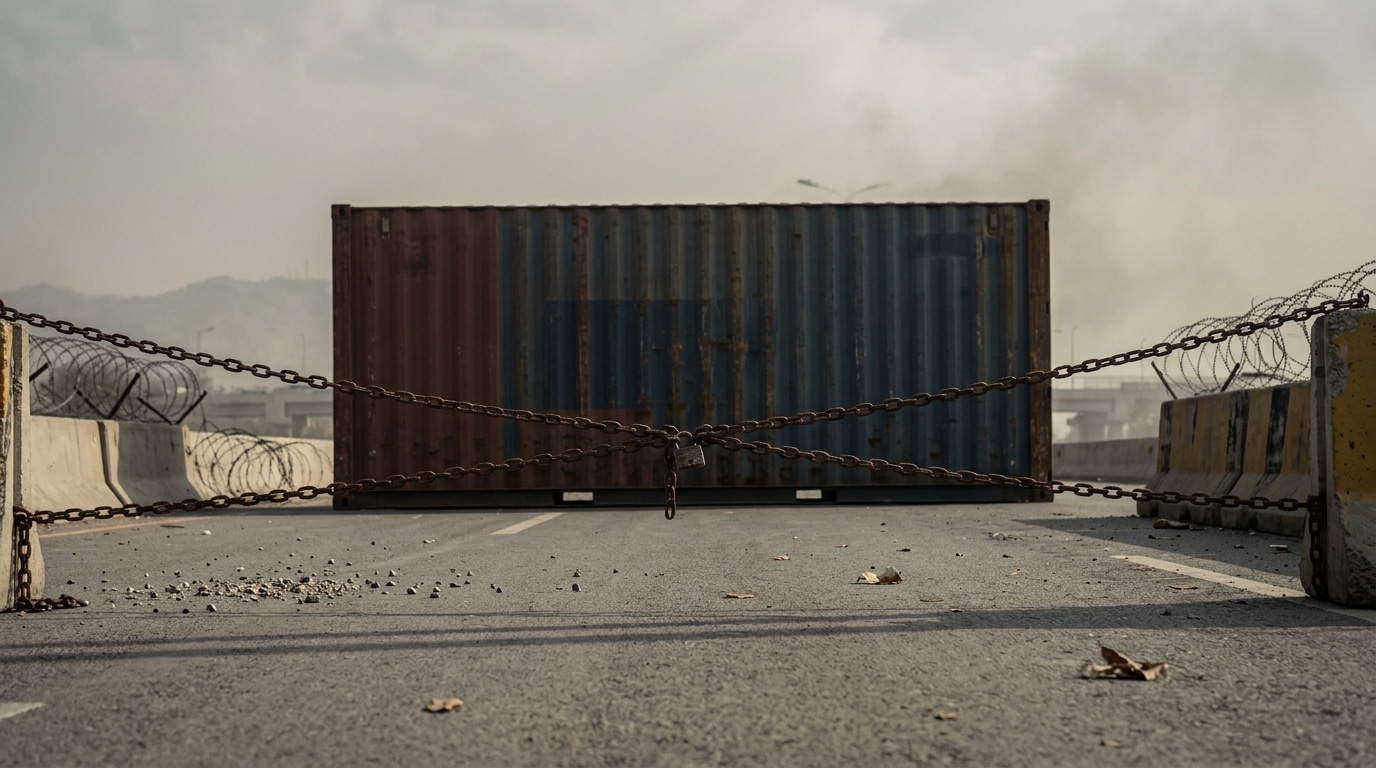



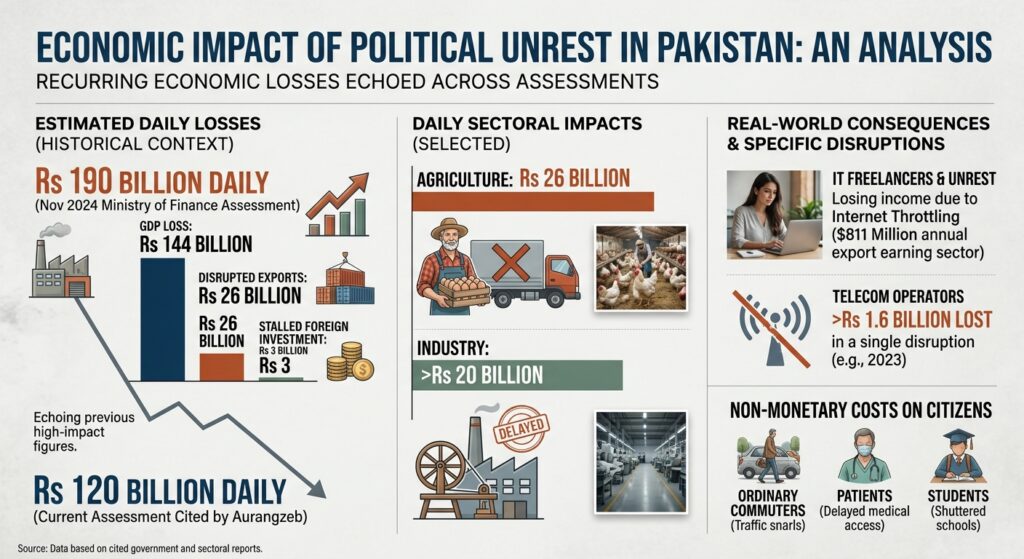
Pakistan Tehreek-i-Insaf called for a nationwide protest march on September 27, and later postopned it to the first week of October, and the country’s response has become familiar: Rangers deployed across Islamabad and four Punjab districts, Section 144 imposed in the capital and parts of Punjab, and Finance Minister Muhammad Aurangzeb warning that the disruption could cost the economy roughly Rs120 billion a day. This isn’t a one-off. It’s the latest instance of a pattern that has repeated, under different parties and different grievances, for over a decade.
None of this is about whether PTI’s demands have merit, or whether any party’s demands do. It’s about what happens to ordinary Pakistanis, and to the country’s institutions, when protest becomes road blockage, and road blockage becomes the default tool of political contestation.
What the Numbers Actually Say
The Rs120 billion daily figure Aurangzeb cited this month isn’t a new invention — it echoes a Ministry of Finance assessment from the November 2024 PTI march, which put daily losses at Rs190 billion, with Rs144 billion of that coming directly off GDP, Rs26 billion from disrupted exports, and Rs3 billion from stalled foreign investment. Agriculture alone lost an estimated Rs26 billion a day; industry lost more than Rs20 billion.
These aren’t abstractions. Behind them are poultry farmers unable to move stock, freight companies watching Karachi-Lahore consignment costs jump by tens of thousands of rupees overnight, and IT freelancers — a sector that earned Pakistan $811 million in exports — losing income whenever internet services are throttled during unrest, as happened in 2023 when telecom operators alone lost over Rs1.6 billion in a single disruption. Ordinary commuters, patients trying to reach hospitals, and students facing shuttered schools absorb costs no ministry report captures in rupee terms.
Who Actually Pays
The pattern holds regardless of which party calls the march or which government is in power. During the 2014 sit-ins, the government told the Supreme Court that the crisis had cost Rs547 billion; industry figures put it closer to Rs800 billion. In 2022, economists estimated Rs100–150 billion in daily losses during that year’s Azadi March. Different years, different leaders, same mechanism: road closures choke supply chains, businesses shut their doors, tax collection falls, and the state spends heavily on security deployments it would not otherwise need.
Violence compounds the damage further. The November 2024 protest alone left several dead by independent counts and thousands arrested — costs no economic model can price, but which fall hardest on families with no stake in the political dispute at all.
The Deeper Cost: Institutions Under Strain
Beyond the rupee figures lies a quieter cost. Each large-scale protest pulls Rangers and police away from routine law enforcement and counterterrorism duties — a real trade-off at a moment when security forces are already stretched along the Afghan border and against domestic militant networks. Each Section 144 order and internet suspension which only adds to the sufferings of ordinary citizens. And each cycle of confrontation between a party and the state deepens polarization rather than resolving anything, leaving the underlying grievance exactly where it started once the shipping containers come down.
A Better Way Exists
Pakistan’s constitution and legal framework already provide the tools for resolving political disputes without paralyzing the country: parliament, the courts, the Election Commission of Pakistan, and negotiated dialogue between political actors. When leaders disagree with government decisions, arrests, or election outcomes, these are the forums built to adjudicate exactly those disputes — slower and less dramatic than a march on the capital, but far less costly to the country as a whole.
None of this is an argument against the right to protest, which is constitutionally protected and central to any democracy. It’s an argument for how that right gets exercised. A peaceful demonstration that doesn’t block highways, shut down cities, or force internet blackouts costs the country almost nothing and still makes its point. A long march that seals off the capital for days costs everyone, including the people the protest claims to speak for.
The Bottom Line
Pakistan doesn’t lack a system for resolving political disputes. What it needs is the discipline, from every party, to use the institutions that already exist rather than the streets. Until that shift happens, each protest season will keep extracting the same toll — economic, physical and institutional — regardless of who called it or why.