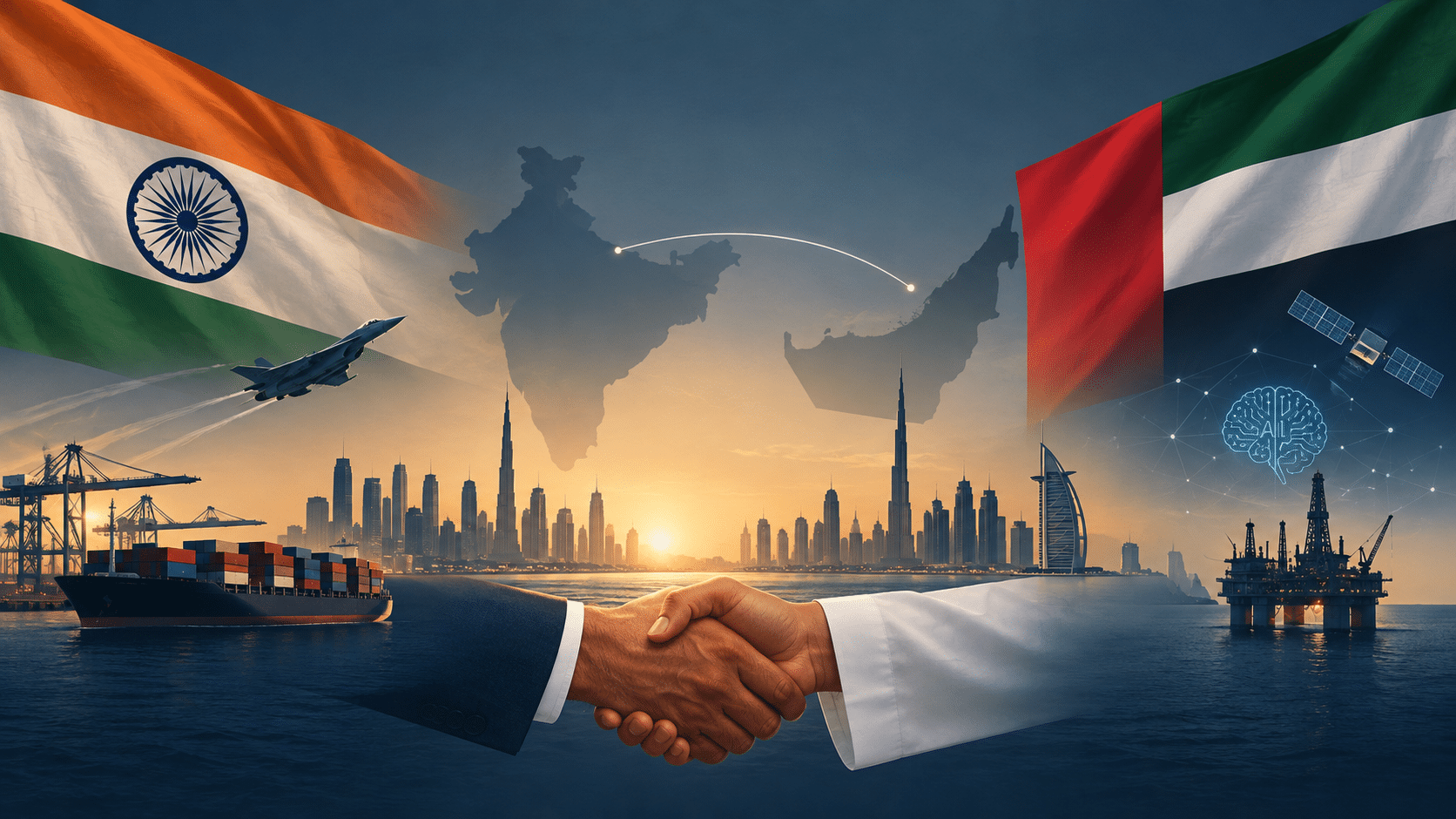



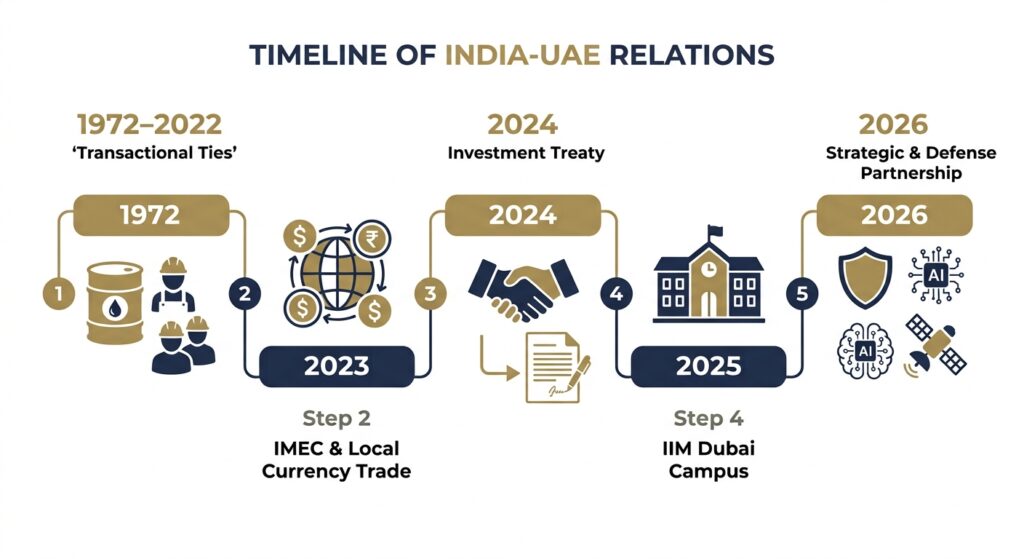
Relations between India and the United Arab Emirates (UAE) date back to 1972. For decades, the dynamics of their ties were transactional. UAE provided India with oil, whereas India would provide manpower for the Gulf. This dynamic has changed, particularly since 2023; the two countries have developed a wider partnership that encompasses artificial intelligence, defense technology, and intelligence in addition to the older ties of energy and trade.
High-Level Visits
The clearest sign of the shifting dynamics became evident when the Indian Prime Minister Narendra Modi met UAE President Sheik Mohamed bin Zayed Al Nahyan, and in the regularly exchanged visits since 2023. The trend is mutual; ministers, crown princes, and central bank governors from both countries have been exchanging visits.
In the year 2023, both countries backed the India-Middle East-Europe Economic Corridor, abbreviated as IMEC. Moreover, their central banks signed deals to conduct trade in local currencies. Thereafter, in 2024, the UAE’s Abu Dhabi Crown Prince visited India, during which a Bilateral Investment Treaty was signed. In 2025, education was also involved in the scope of their cooperation; a campus of IIM Ahmedabad was opened in Dubai. By 2026, the relationship had taken a strategic angle. A Letter of Intent covering defense, energy, AI, space and digital cooperation, followed by a finalized Strategic Defense Partnership Framework.
$100 Billion Trade
The bilateral trade and the money flow are telling a similar story. The bilateral trade between New Delhi and the UAE crossed $100 billion in the fiscal year 2024-25, understandably aided by the development of the Comprehensive Economic Partnership Agreement (CEPA)—whereby tariffs were lowered, and markets were made more accessible for the stakeholders.
The numbers, however, are not perfectly balanced. New Delhi exported goods worth $36.6 billion, whereas the UAE imported goods worth $63.4 billion. The gap of $27 billion settled in the UAE’s favor. It suggests that India still relies on the Gulf’s Energy and investment, whereas the UAE benefits from the huge consumer market and cheap labor pool in India.
The Bilateral Investment Treaty has opened the doors for UAE’s capital to flow into Indian infrastructure, renewable energy, technology and logistics. Additionally, retail payments have also become easier, with UPI-AANI and RuPay-JAYWAN linking the two countries’ digital payment systems. Both governments have mutually agreed to expand bilateral trade, aiming to double it by 2032.
The Diaspora Link
The diaspora link between India and the UAE is a cogent factor in enhancing their bilateral ties. At least 3.5 million Indians are working in the UAE—arguably one of the largest expatriate communities in the Gulf. They send remittances back home, their labor contributes to the strengthening of the UAE economy, and they provide their bilateral ties with a human dimension that outlasts any trade or security cooperation treaty.
Deepening Defence Ties
Security Cooperation between the UAE and India has also expanded. New Delhi and the UAE have been conducting various joint military exercises such as Desert Cyclone in India and Desert Flag in the UAE. The joint military exercises have become a prominent feature of their dynamics since 2023. The Joint Defense Cooperation Committee has also met repeatedly, most recently in New Delhi, and the bilateral cooperation now encompasses maritime security, cyber defense, unmanned systems, and defense-industry partnerships.
One deal between the UAE and India has been particularly prominent. India has been negotiating with the UAE over BrahMos Missiles and the Akashteer Air Defense System. If the defense-trade agreement materializes, it would be one of the largest Indian defense exports. It would also mark a major shift in the UAE’s ammunition preferences, from Western or Russian military hardware to Indian hardware.
Mutual Benefits
The expanding ties between the UAE and India are beneficial for both stakeholders. It serves India’s need to diversify its trade partners, reducing dependence on a single partner, while strengthening its own security and defense exports.
Whereas, for the UAE, the benefits are in terms of energy security, capital, and a foothold in a region New Delhi has been trying to build deeper ties with for years. The India-UAE agreements are simultaneously working alongside forums like G20, BRICS and I2U2.
The Bottom Line
What started as a transactional relationship limited to energy and labor exports is turning into a strategic partnership. Both stakeholders are signing multiple deals across various sectors—trade, defense, artificial intelligence, military exports, cybersecurity, technology, connectivity, intelligence sharing—and steadily solidifying their relations. Decades-old relations have turned two friendly states into countries with intertwined interests. The execution of the signed agreements would determine the trajectory of bilateral ties.
Frequently Asked Questions (FAQs)
Q1: Trade dynamics between India and UAE?
The bilateral trade between New Delhi and the UAE crossed $100 billion in the fiscal year 2024-25, understandably aided by the development of the Comprehensive Economic Partnership Agreement. New Delhi exported goods worth $36.6 billion. UAE imported goods worth $63.4 billion.
Q2: How many Indians are working in UAE?
3.5 million Indians are working in the UAE, arguably one of the largest expatriate communities in the Gulf.
Q3: Joint Military Exercises between UAE and India?
New Delhi and the UAE have conducted joint military exercises such as Desert Cyclone in India and Desert Flag in the UAE. The Joint Defense Cooperation Committee has also met repeatedly, recently in New Delhi, and now encompasses maritime security, cyber defense, unmanned systems, and defense-industry partnerships.
Q4: Is UAE now buying weapons from India?
India has been negotiating with the UAE over BrahMos Missiles and the Akashteer Air Defense System. If the defense-trade agreement materializes, it would be one of the largest Indian defense exports to the UAE.