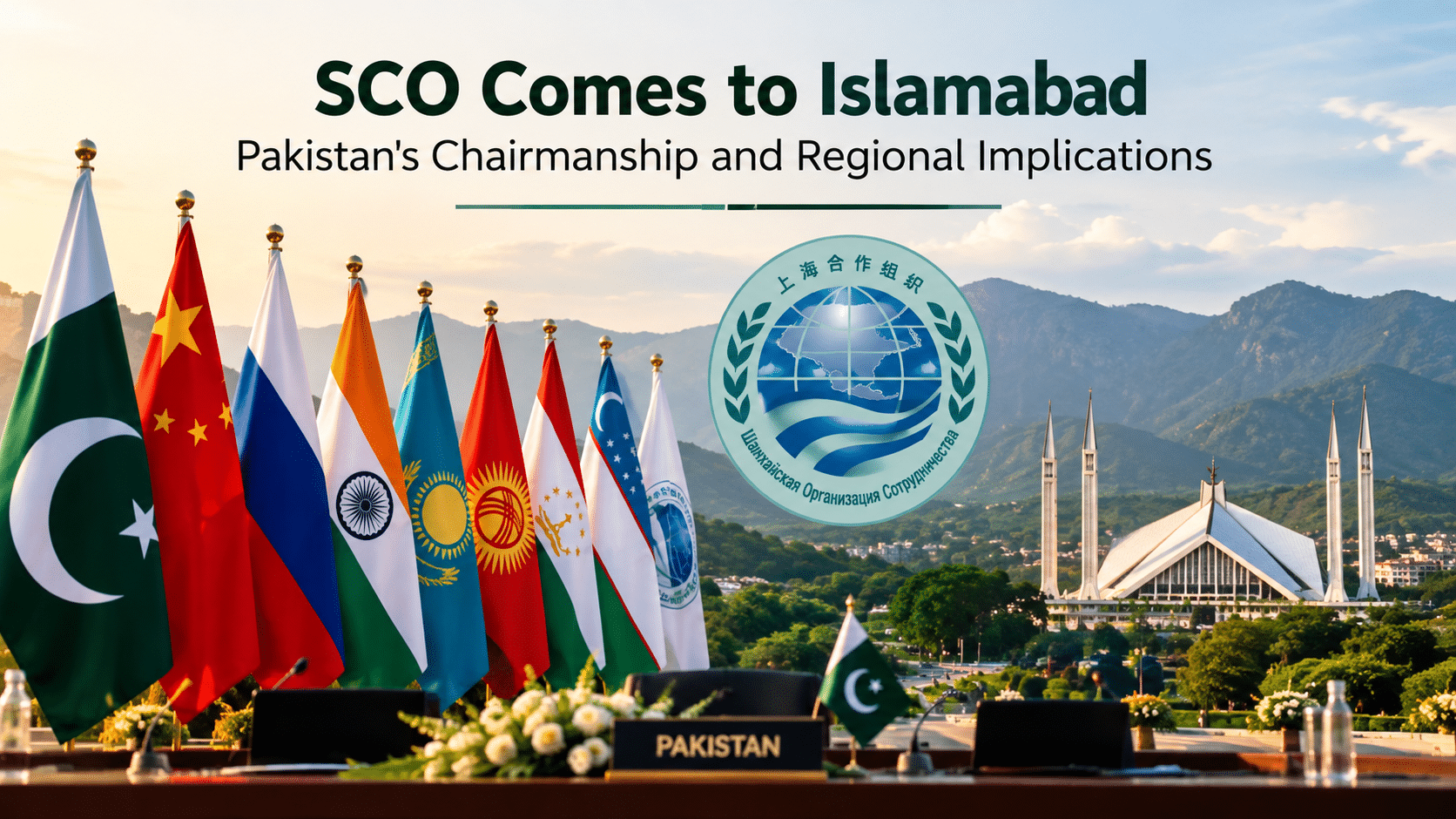





National coordinators of the Shanghai Cooperation Organisation (SCO) meet in Islamabad from September 28 to 30, marking the first working session of Pakistan’s chairmanship of the SCO Council of Heads of State for 2026-27. The Foreign Office says the meeting will cover cooperation, coordination, and preparations for upcoming events under the chairmanship theme “Turning Vision into Action: Connectivity, Innovation and Shared Prosperity.” It is also the first concrete step toward August 2027, when Islamabad hosts the full SCO summit — prompting the Capital Development Authority to invite bids for upgrading the Jinnah Convention Centre and push hotels toward international standards ahead of an expected influx of delegations.
🔊PR No.2️⃣6️⃣8️⃣/2️⃣0️⃣2️⃣6️⃣
Curtain Raiser: First Meeting of SCO Council of National Coordinators, Islamabad (28-30 September 2026)
🔗⬇️ pic.twitter.com/lONYHH2K0V
— Ministry of Foreign Affairs – Pakistan (@ForeignOfficePk) September 27, 2026
Pakistan assumed the chairmanship at the 26th SCO summit in Bishkek, Kyrgyzstan, on September 1, 2026, where Prime Minister Shehbaz Sharif proposed prioritising IT and AI, energy, poverty reduction, disaster management, health, culture and sports.
What is the SCO?
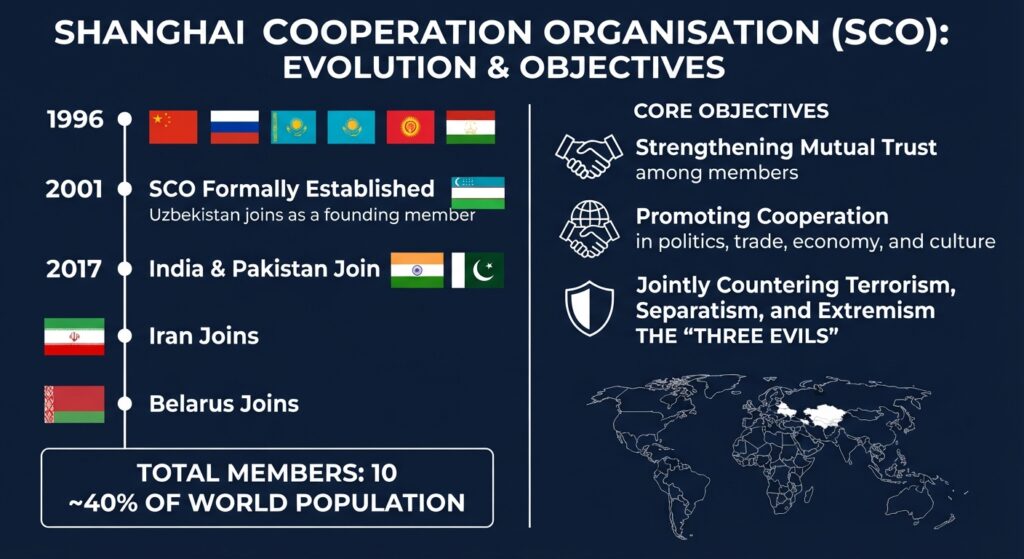
The Shanghai Cooperation Organisation grew out of the “Shanghai Five” — China, Russia, Kazakhstan, Kyrgyzstan and Tajikistan — and was formally established in 2001 with Uzbekistan joining as a founding member. India and Pakistan became full members in 2017, Iran in 2023, and Belarus in 2024, making it ten members covering roughly 40 percent of the world’s population. Its stated objectives are strengthening mutual trust among members, promoting cooperation in politics, trade, security and culture, and jointly countering terrorism, separatism and extremism — the “three evils” the organisation was originally built to confront.
Recent Summits
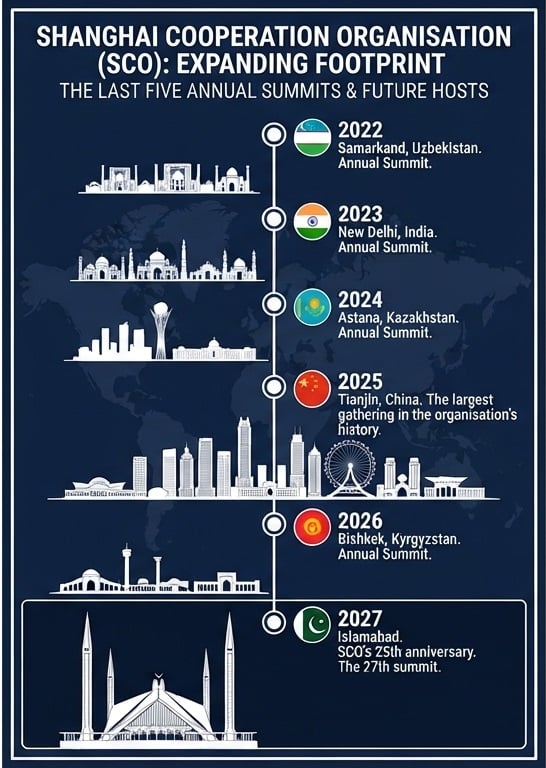
The last five annual summits trace the SCO’s expanding footprint:
- Samarkand, Uzbekistan (2022)
- New Delhi, India (2023)
- Astana, Kazakhstan (2024)
- Tianjin, China (2025). The largest gathering in the organisation’s history.
- Bishkek, Kyrgyzstan (2026)
- SCO’s 25th anniversary. Islamabad will host the 27th summit in 2027.
SCO’s Achievements
The organisation’s clearest success is institutional survival and expansion — from six founding members to ten, plus a growing list of observers and dialogue partners. Its Regional Anti-Terrorist Structure has enabled intelligence-sharing among Central Asian states long troubled by cross-border militancy. Trade and connectivity initiatives, along with joint military exercises like Peace Mission, have given the bloc practical substance beyond declarations.
Yet its record on hard outcomes is thinner. The SCO has never resolved a serious inter-member dispute — India-Pakistan and India-China tensions persist inside an organisation meant to build trust among them. It lacks a shared currency mechanism, a unified trade framework, or binding enforcement powers.
Why Progress Has Been Limited
Three structural reasons stand out.
- The SCO operates by consensus, meaning any member can block a decision, which favours lowest-common-denominator outcomes.
- Member states often carry bilateral rivalries into the room — India rarely aligns with Pakistan or China on security language, complicating joint statements.
- The SCO overlaps with other groupings — the CSTO, BRICS, and China’s own Belt and Road framework — diluting its distinct institutional identity and giving members reason to hedge rather than fully invest.
Expanding SCO’s Influence
Deeper impact would require moving from summit declarations to enforceable protocols — on trade facilitation, digital connectivity standards, and counterterrorism data-sharing. A permanent SCO development fund, discussed for years but never operationalised, could finally give the bloc financial teeth. Expanding people-to-people and youth exchange programmes, alongside Pakistan’s proposed focus on IT and AI cooperation, could also build constituencies for the SCO beyond foreign ministries.
Pakistan’s Role
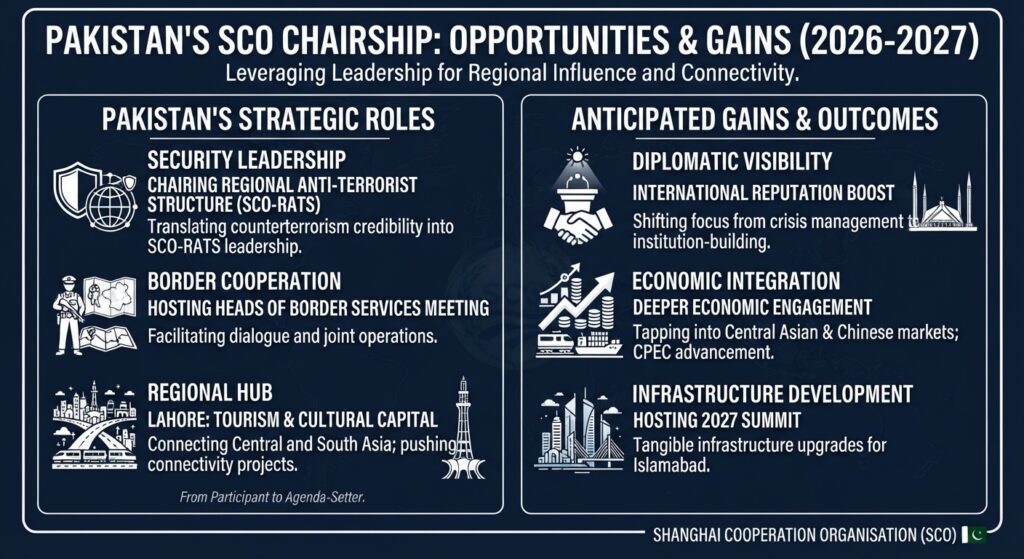
Pakistan chairs the SCO’s Regional Anti-Terrorist Structure, assumed last September, and hosted the 12th meeting of Heads of Border Services in July. The Lahore has been designated the SCO’s Tourism and Cultural capital. These are meaningful but largely administrative roles. The current chairmanship is Pakistan’s opportunity to shift from participant to agenda-setter — using its 2026-27 term to push concrete connectivity projects, position itself as a bridge between Central and South Asia, and translate its counterterrorism credibility into a leadership role on SCO-RATS cooperation.
Islamabad’s Gains
A well-executed chairmanship offers diplomatic visibility at a moment when Pakistan needs it, deeper economic engagement with Central Asian and Chinese markets, and a platform to advance regional connectivity ambitions tied to CPEC. Hosting the 2027 summit also brings tangible infrastructure upgrades to Islamabad and a chance to reset the country’s international image around institution-building rather than crisis management.
Conclusion
The SCO remains a work in progress — expansive in membership, cautious in ambition. Pakistan’s chairmanship arrives at a moment when the organisation needs exactly what Islamabad is promising: a push from vision to action. Whether that promise survives contact with the SCO’s consensus-bound structure will become clear well before delegates arrive in Islamabad for the 2027 summit.
You May Like To Read: Pentagon Reveals Updated Cost of War with Iran: $29 Billion