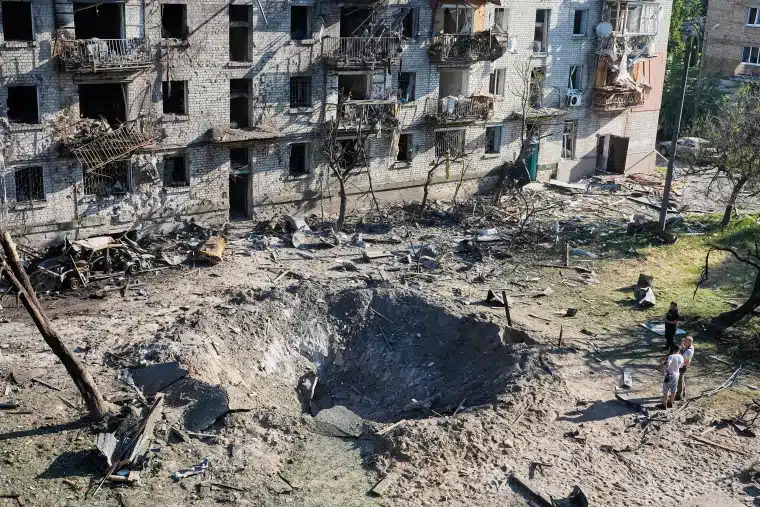





Russia has unleashed its largest and second-deadliest aerial bombardment of the capital this year, launching an overwhelming wave of 74 missiles and 496 unmanned aerial vehicles (UAVs) overnight. The combined strike has left at least 18 people dead and scores more wounded, systematically targeting residential sectors, military facilities, and energy infrastructure across Kyiv and surrounding districts.
The assault began just hours after Ukrainian President Volodymyr Zelenskyy cut short an official state visit to Dublin, returning to Ukraine after intercepting critical intelligence data that pointed to an imminent, massive retaliatory strike by Moscow.
Russian air strikes kill eight, injure dozens in Ukraine’s Kyiv https://t.co/BYeWf7FOyD
— The Straits Times (@straits_times) July 2, 2026
The Strategic Balance: Interception Rates and the Ballistic Deficit
The sheer volume of the Russian saturation attack was designed to overwhelm Ukraine’s integrated air defense network. While the Ukrainian Air Force demonstrated exceptional efficiency against lower-tier threats, the final breakdown reveals a critical vulnerability to high-speed kinetic weapons:
-
The Drone and Cruise Success Rate: Ukrainian air defense units successfully neutralized 476 out of 496 incoming drones and shot down 48 out of 74 missiles, intercepting the vast majority of subsonic threats before they could impact the city center.
-
The Ballistic Vulnerability: Despite these high interception rates, 25 advanced ballistic missiles penetrated the defense umbrella, striking 33 locations across the capital. Local administration officials confirmed that these supersonic ballistic variants remain Ukraine’s primary defense gap, directly causing the structural collapse of a nine-story apartment building and setting off major fires in the central Shevchenko Boulevard.
Retaliation Logistics: The Fight Over Russia’s Energy Infrastructure
The Kremlin has explicitly framed this massive air operation as a direct, high-precision retaliation for Ukraine’s ongoing “40-day blitz” against domestic Russian economic assets. Deep-penetration Ukrainian drone strikes have increasingly targeted Russia’s fossil fuel sector, hitting major infrastructure including the NORSI oil refinery in the Nizhny Novgorod region and triggering a severe summer fuel crisis within Russia.
By executing this large-scale combined strike, Moscow is attempting to shift the economic costs of the war back onto Ukraine, hitting military airports in Poltava and Dnipropetrovsk alongside Kyiv’s domestic power networks to signal that it will continue to increase pressure to achieve its geopolitical objectives.
Diplomatic Context: The Push for Pac-2 and Pac-3 Interceptors
This catastrophic air siege occurred on the eve of an upcoming NATO summit, where President Zelenskyy is prepared to make an urgent, specific appeal for advanced Western defense systems. Ukraine’s current air defense infrastructure is struggling to cope with the speed and trajectory of land- and sea-launched ballistic threats.
To counter this, Kyiv is aggressively pushing the United States and its European allies to expedite the delivery and local manufacturing licenses for American-made Pac-2 and Pac-3 Patriot interceptor missiles—the only specialized weapons systems capable of tracking and destroying supersonic ballistic threats before they impact dense civilian centers.