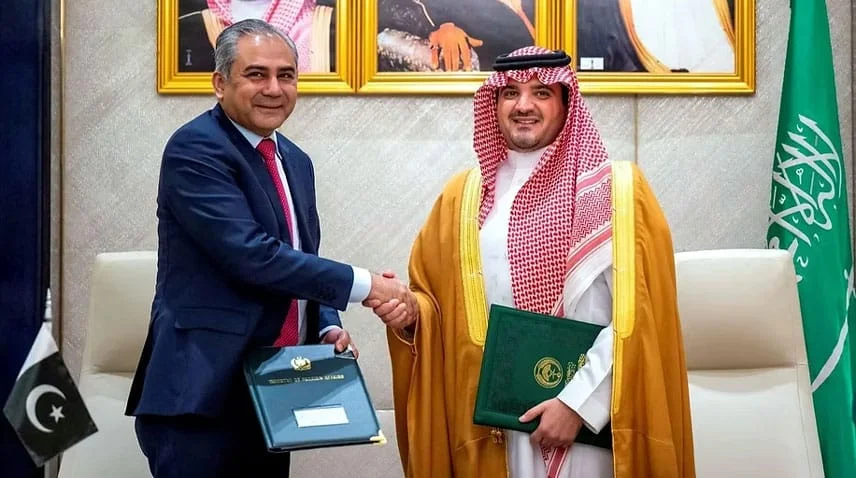





Following high-level security summits in the Kingdom, Federal Interior Minister Mohsin Naqvi and his Saudi counterpart, Prince Abdulaziz bin Saud bin Naif, have formally signed a comprehensive Memorandum of Understanding (MoU) to institutionalize bilateral security relations.
The agreement establishes a legally binding operational framework that shifts the Pak-Saudi security alliance from traditional, reactive military assistance into a structured system of deep interior ministry integration. By focusing directly on internal security, technology transfer, and joint capacity building, the new protocol creates a unified front against evolving transnational threats, narcotics trafficking networks, and asymmetric security challenges facing both capitals.
Pakistan and Saudi Arabia sign Memorandum of Understanding to further strengthen their bilateral security relations@MohsinnaqviC42 @MOIofficialGoP @PakinSaudiArab @KSAembassyPK #RadioPakistan #news https://t.co/7u2zoj7uMb pic.twitter.com/mjQqayjNp5
— Radio Pakistan (@RadioPakistan) July 2, 2026
Technical Pillars of the Interior Ministry Integration
The newly finalized security protocol is designed to systematically upgrade the domestic security capabilities of both nations across three core operational fields:
1. Joint Training and Applied Research
The agreement bridges the gap between law enforcement academia and field operations. Under the terms of the MoU, Pakistan’s Ministry of Interior and the Saudi Ministry of Interior will launch joint scientific, training, and research initiatives. This includes regular officer exchange programs, collaborative anti-smuggling research, and standardized operational training designed to harmonize the investigative and tactical techniques of federal law enforcement agencies in both countries.
2. Institutional Capacity Building
The MoU creates a formalized framework for the regular exchange of professional expertise to build institutional capabilities in areas of mutual interest. A key part of this includes deploying advanced Pakistani security and biometric tracking expertise to help optimize domestic law enforcement systems in Saudi Arabia, balanced by the integration of modern Saudi cyber-forensic and intelligence infrastructure into Pakistani domestic security units.
3. High-Level Security Coordination
Before signing the accord, the two ministers held an intensive review of regional threat matrices. The discussion centered on expanding real-time security coordination between the internal security agencies of both countries. This includes establishing secure, direct communication hotlines to counter transnational criminal networks, coordinate counter-terrorism financing operations, and streamline the protective frameworks for critical diplomatic and economic infrastructure in both countries.
Conclusion: Securing the Internal Front
The formalization of this interior ministry MoU rounds out the broader strategic shield established under the historic September 2025 Strategic Mutual Defence Agreement. While the Pakistan Air Force continues its forward combat deployments on Saudi soil to deter external aggression, this internal security pact ensures that the domestic law enforcement architectures of both nations are equally synchronized. By anchoring their decades-old partnership in formal agreements covering training, research, and institutional integration, Islamabad and Riyadh have locked in a robust framework capable of maintaining absolute internal and regional stability.