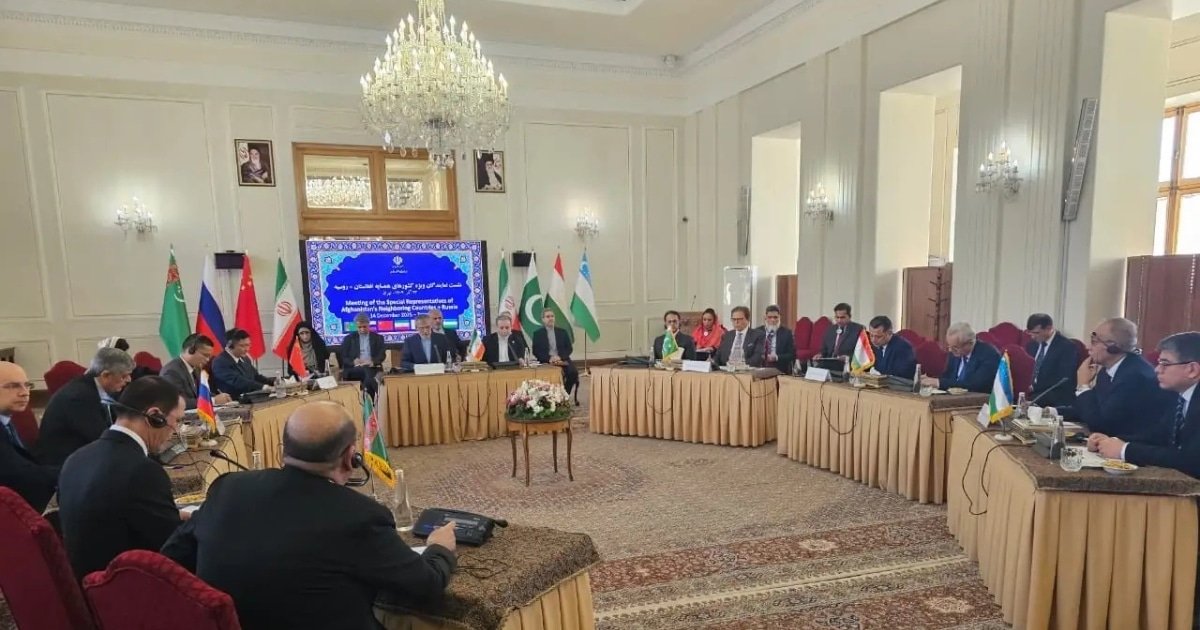


Special Representatives for Afghanistan from regional neighboring countries, alongside Russia, concluded a critical high-level meeting in Tehran today, affirming that Afghanistan’s future stability hinges on regional cooperation and rejecting “imported prescriptions” from foreign powers.
The gathering, which included envoys from Pakistan, China, Russia, Tajikistan, Uzbekistan, and Turkmenistan, addressed shared security concerns, economic potential, and strategies for engagement with Afghanistan’s de facto authorities. The Afghan regime declined an invitation to attend.
Participated in the Meeting of Special Representatives for Afghanistan of the Neighbouring Countries + Russia, hosted by Iran, today.
In my remarks, I agreed with the assessment of all participating countries that the continued threat of terrorism emanating from Afghan soil is a… pic.twitter.com/HlMZllFtMH— Mohammad Sadiq (@AmbassadorSadiq) December 14, 2025
Pakistan Demands Action Against Terrorism
Pakistan’s Special Representative for Afghanistan, Mohammad Sadiq, made an unequivocal call for the current de-facto rulers in Kabul to eliminate militant groups operating from Afghan territory.
“The continued threat of terrorism emanating from Afghan soil is a big challenge for the region,” Mr. Sadiq stated. He stressed that a stable Afghanistan, free from terrorist elements, is the prerequisite for gaining the confidence of its neighbors and unlocking its vast potential for economic connectivity. “It is, therefore, imperative that the current de-facto rulers take steps to ameliorate their suffering. And the foremost step in this regard would be to rid their soil indiscriminately of all types of terrorists.”
Iran Emphasizes Regional Solutions
Hosting the meeting, Iran underscored the principle that neighboring states are the “most natural and reliable” actors for ensuring Afghanistan’s stability. Iranian Foreign Minister Araghchi emphasized that attempts to impose “trans-regional decisions” have historically failed.
You May Like To Read: John Cena takes Final Bow: WWE Legend Retires from Ring after 24-Year Career
“Afghanistan’s stability and development are not only a humanitarian necessity but also a strategic imperative for the entire region,” Minister Araghchi argued. He called for collective responsibility among regional nations to integrate Afghanistan into regional political and economic structures, emphasizing its potential as a vital corridor for trade and energy transit across Central, West, and South Asia. Iran also offered to expand cooperation in transportation, trade, energy, and consular services.
Key Outcomes and Consensus
- Rejection of External Intervention: Participants agreed that Afghanistan’s long-term stability must be achieved through indigenous, regional mechanisms, without relying on external actors or foreign prescriptions.
- Counter-Terrorism Mandate: There was clear consensus on the urgent need for Afghanistan’s de-facto authorities to take verifiable action to dismantle all terrorist groups within its borders to build regional trust.
- Economic Integration: The forum reaffirmed Afghanistan’s strategic geoeconomic importance and pledged to seek ways to integrate the country into regional economic structures to ensure long-term stability and prosperity.
The meeting concluded with a commitment to sustained dialogue, acknowledging the significant impact that any tension between regional neighbours, such as Pakistan and Afghanistan, has on the wider region.