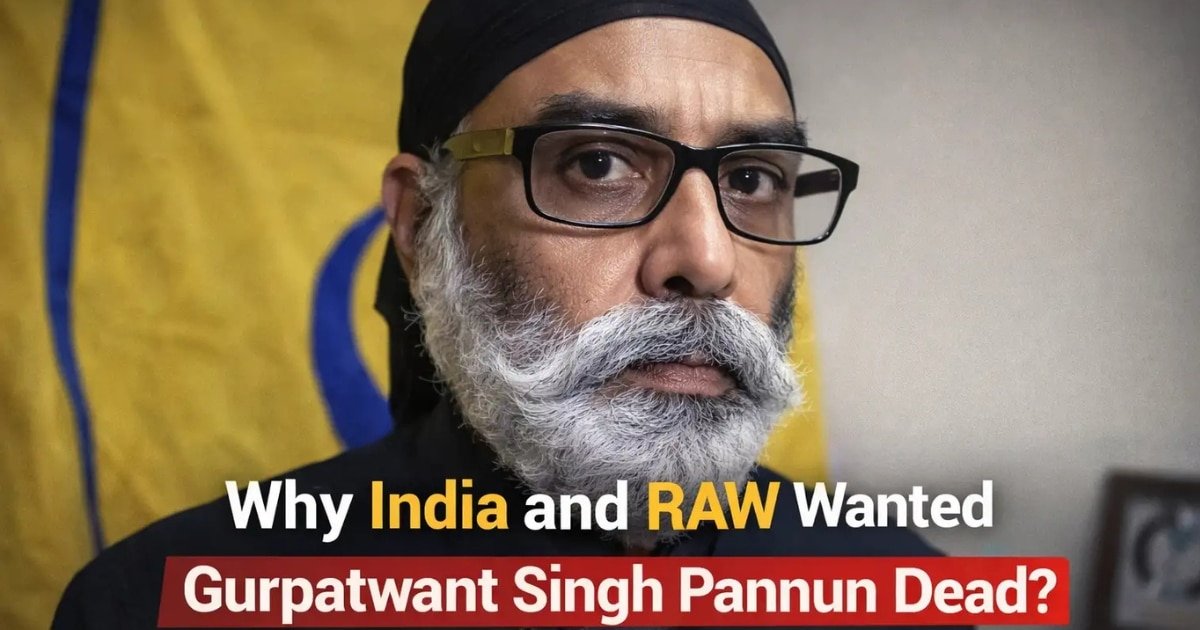




Who is Gurpatwant Singh Pannun?
Gurpatwant Singh Pannun is a high-profile U.S.-based lawyer and the General Counsel for Sikhs for Justice (SFJ), an organization he founded in 2007. Holding dual U.S. and Canadian citizenship, Pannun has emerged as the global face of the Khalistan Referendum—a non-binding, unofficial voting process asking Sikhs worldwide if they support an independent state in Punjab. While he maintains his campaign is a peaceful exercise of free speech and self-determination, the Indian government designated him a terrorist in 2020 under the Unlawful Activities (Prevention) Act (UAPA), accusing him of inciting secessionism and violence.
Context: The Khalistan Movement & Operation Blue Star
The Khalistan movement seeks to establish a sovereign Sikh state, “Khalistan” (Land of the Pure), in the Punjab region. Its roots lie in post-independence grievances regarding linguistic and religious autonomy.
-
The Turning Point: In the early 1980s, the movement became militarized under Jarnail Singh Bhindranwale, who took up residence in the Golden Temple (Harmandir Sahib).
-
Operation Blue Star (1984): Prime Minister Indira Gandhi ordered a military assault on the Golden Temple to flush out militants. The operation resulted in heavy casualties, including pilgrims, and significant damage to the holiest Sikh shrine.
-
The Aftermath: This desecration led to the assassination of Indira Gandhi by her Sikh bodyguards, followed by the 1984 anti-Sikh riots, where thousands of Sikhs were massacred in Delhi and elsewhere. These events remain the foundational trauma fueling modern diaspora-led activism.
The Assassination Plot: Why, Who, and How?
Pannun became a target because his “Referendum 2020” campaign successfully mobilized the diaspora, creating a diplomatic headache for New Delhi. The plot sought to eliminate him to silence the most vocal advocate for Sikh secessionism in the West.
-
Nikhil Gupta: A 52-year-old Indian national described by U.S. prosecutors as an international narcotics and weapons trafficker.
-
The RAW Connection: Gupta was recruited by an individual identified as Vikash Yadav (initially “CC-1”). Yadav was a “Senior Field Officer” in the Cabinet Secretariat of the Government of India, which houses the Research and Analysis Wing (RAW).
-
The Sting: Gupta contacted a purported hitman—who was actually an undercover U.S. law enforcement officer—to carry out the killing for $100,000. On February 13, 2026, Gupta pleaded guilty in a New York federal court to murder-for-hire charges, admitting he acted under the direction and financing of the Indian government employee.
🚨BREAKING – SHOCKING DEVELOPMENT
Nikhil Gupta – the key operative charged in the brazen murder-for-hire conspiracy targeting Sikh leader & SFJ General Counsel Gurpatwant Singh Pannun – has PLEADED GUILTY in federal court.
This explosive case, directly tied by U.S. prosecutors… pic.twitter.com/p3Rql8jkR0
— Sguardian (@LegitimateTargt) February 13, 2026
Analytical Argument: India as an “Exporter of Terrorism”
The conviction of Nikhil Gupta, combined with the 2023 assassination of Hardeep Singh Nijjar in Canada, provides a disturbing pattern that challenges India’s image as a “responsible global player.”
-
Transnational Repression: The FBI and U.S. Department of Justice have formally categorized these actions as “transnational repression”—a state reaching across borders to assassinate its rivals. By utilizing criminal proxies (like Gupta) to conduct hits on foreign soil, critics argue that RAW is employing the same “hybrid warfare” and “terrorist” tactics it historically accused its neighbors of using.
-
Decades of Precedent: For decades, regional actors—particularly Pakistan—have provided dossiers alleging RAW’s involvement in subverting internal security (e.g., the Kulbhushan Jadhav case). The Pannun and Nijjar cases have now brought this “covert global assassination program” into the Western spotlight.
-
A New “Rogue State” Paradigm: The willingness to violate the sovereignty of Five Eyes allies (U.S. and Canada) suggests a systemic belief in New Delhi that extrajudicial killing is a legitimate tool of statecraft. Analytically, this shifts India’s status from a victim of terrorism to an active exporter of state-sponsored terrorism, as it leverages institutional intelligence resources to finance and coordinate assassinations globally.
Conclusion: The Erosion of the “Responsible Actor” Myth
The guilty plea of Nikhil Gupta marks a definitive turning point in the international community’s understanding of Indian statecraft. For years, New Delhi has carefully cultivated a global image as a pillar of democratic stability and a victim of regional extremism. However, the judicial confirmation of a RAW-directed hit on American soil—coordinated by an active-duty intelligence officer—shatters this narrative, exposing a systemic reliance on transnational repression.
You May Like To Read: Tarique Rahman Set to Become Bangladesh’s Prime Minister After BNP Election Victory
Analytically, this case reveals that India has transitioned from defensive intelligence gathering to an offensive, extrajudicial liquidation strategy that mimics the “rogue state” behaviors it historically condemned. By leveraging criminal proxies and state finances to silence dissent in the heart of Western democracies, India has effectively institutionalized a form of state-sponsored terrorism that knows no borders.
The “Pannun Plot” is no longer just a diplomatic friction point; it is a profound legal precedent that validates decades of warnings from regional neighbors about RAW’s destabilizing role. As Western courts continue to uncover the extent of these “murder-for-hire” networks, the international community faces a stark reality: India’s emergence as a global power is being accompanied by its emergence as a primary exporter of global terrorism, signaling a dangerous new era of extraterritorial lawlessness that threatens the very foundations of international sovereignty.
Check out our latest video: