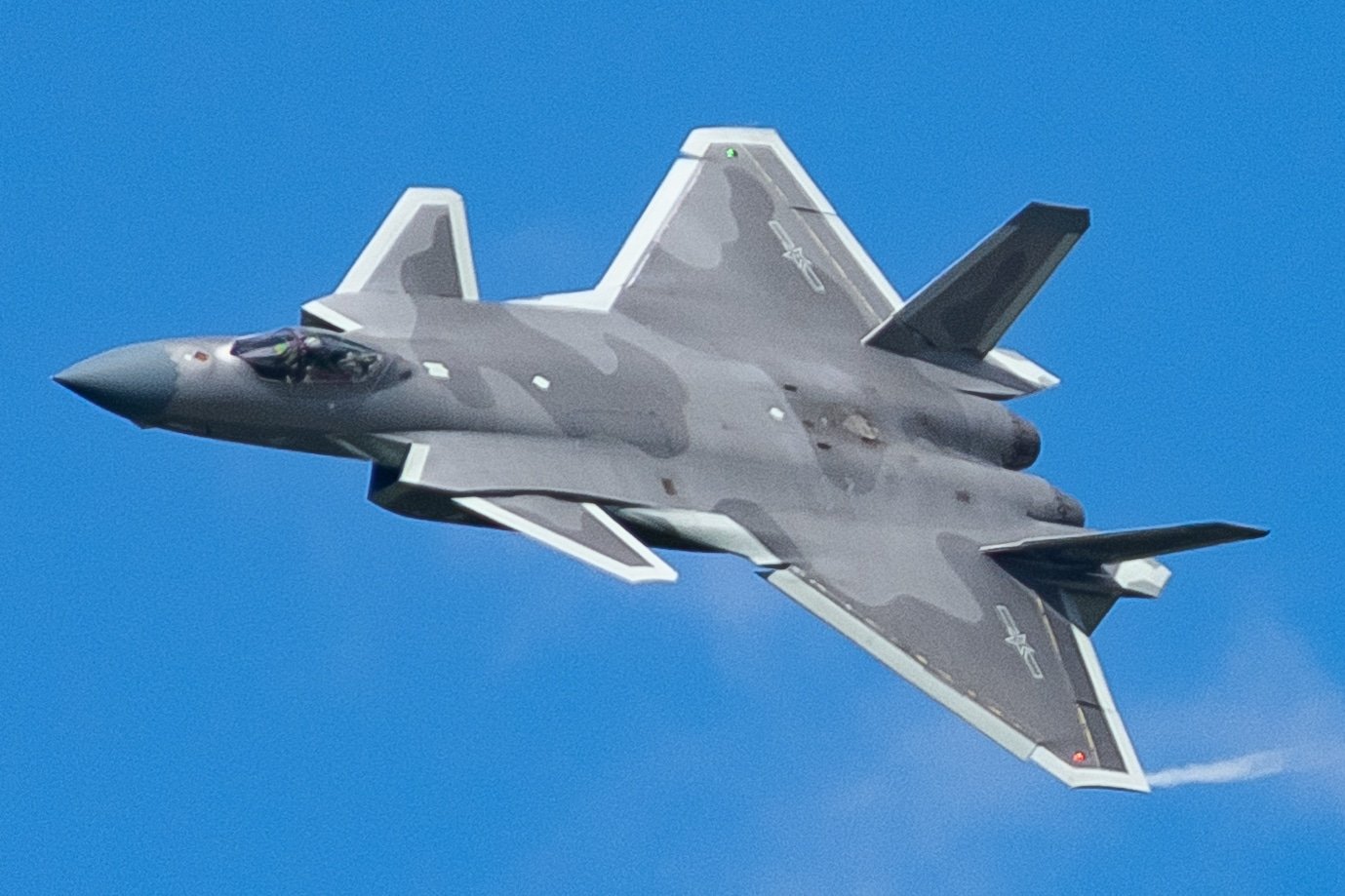





Beijing – The People’s Liberation Army Air Force (PLAAF) has reached a significant milestone in its fifth-generation fighter program, confirming an operational fleet of at least 300 Chengdu J-20 stealth aircraft. The development underscores Beijing’s accelerating pace in fielding advanced combat aircraft and places China firmly as the world’s second-largest operator of fifth-generation fighters, behind only the United States.
The confirmation emerged this week as four J-20s arrived in Changchun, Jilin Province, ahead of a high-profile air show. Independent analyst Andreas Rupprecht identified one aircraft, serial number 63106, as the 300th production unit, citing the construction code “CB10300” visible on its fuselage. Three other J-20s, serials 63005, 63101, and 63201, were also observed, all linked to the 19th Air Brigade stationed at Zhangjiakou in Ningyuan Autonomous Province.
For the first time, imagery circulating on social media shows a J-20 on static public display, signaling Beijing’s growing confidence in showcasing its most advanced airpower platform.
This milestone aligns with earlier projections. A June 2024 assessment by The Diplomat estimated around 250 J-20s built, with over 200 in active service. In just over a year, production has surged by at least 50 additional airframes, confirming China’s ability to rapidly scale output.
By comparison, the U.S. Air Force currently operates 180 F-22 Raptors, of which about 32 are older variants used for training and testing. FlightGlobal’s World Air Forces 2025 report also counted approximately 246 F-35As in active service with the U.S. Air Force, alongside hundreds more in Navy and Marine Corps inventories. While the combined U.S. fifth-generation fleet remains larger, the production tempo of the J-20 narrows the gap year by year.
Analysts view this expansion as a key step in Beijing’s long-term strategy to challenge U.S. air dominance in the Indo-Pacific. The J-20, often compared to the F-22 Raptor and F-35 Lightning II, has been integrated into multiple operational brigades across China, bolstering the PLAAF’s ability to project power, extend reach, and normalize advanced stealth tactics within its combat doctrine.
“The J-20’s rapid rise from prototype to a 300-strong fleet in less than a decade highlights Beijing’s focus on modernizing its combat aviation forces at a scale unmatched outside the United States,” said one defense analyst. “This development significantly enhances China’s capacity to contest U.S. and allied air superiority in Asia.”
While the U.S. continues to invest in modernization programs — including incremental F-35 upgrades, F-22 sustainment, and the forthcoming Next Generation Air Dominance (NGAD) platform — the expansion of the J-20 fleet reflects a long-term arms race that will shape the balance of airpower in the Indo-Pacific and beyond.
The J-20’s growing prominence cements its role as the backbone of China’s modern airpower, positioning the PLAAF as a central competitor in the global fifth-generation fighter race.