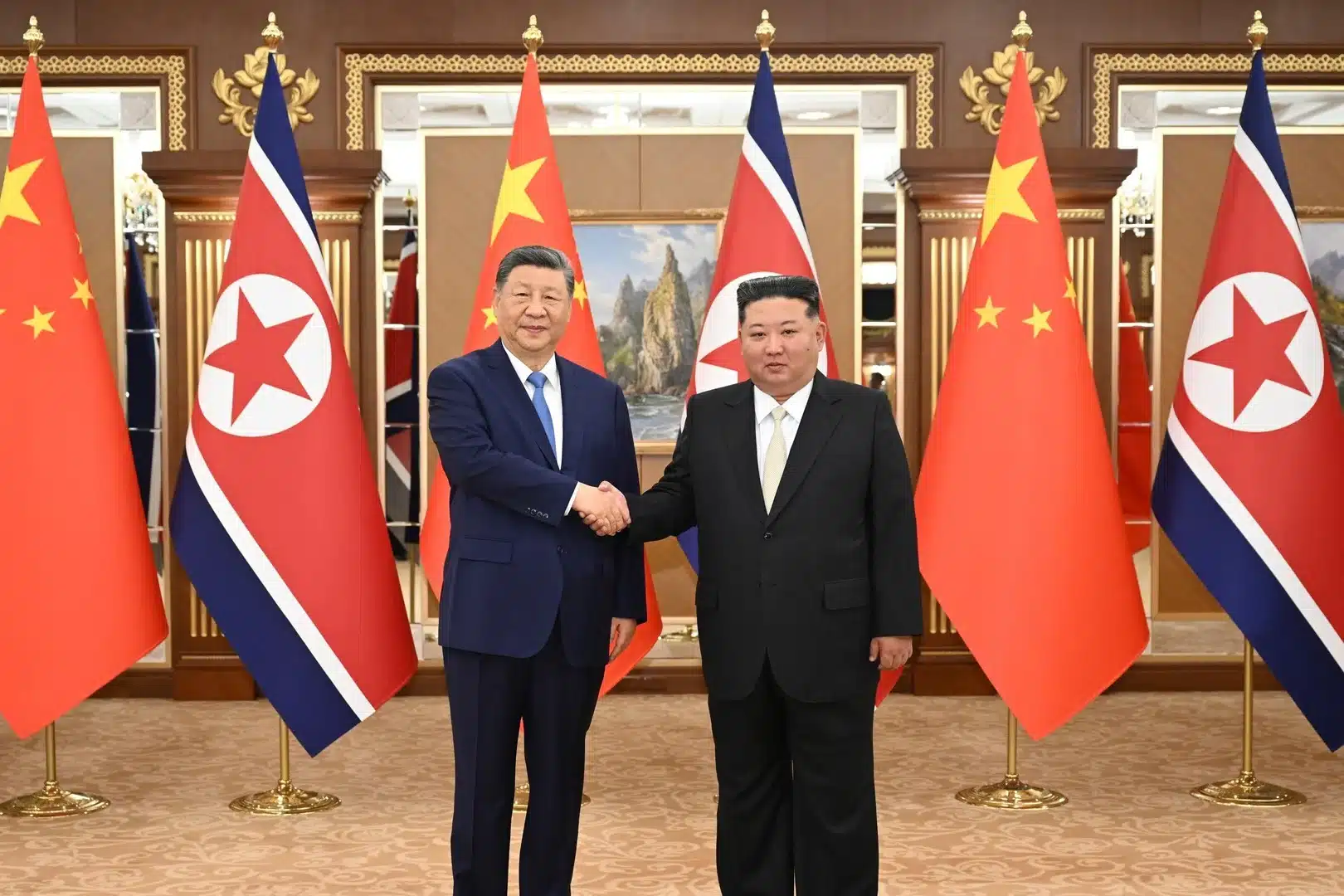





In a major diplomatic departure from recent foreign policy patterns, Chinese President Xi Jinping landed in the North Korean capital on Monday morning for a high-stakes bilateral summit with Supreme Leader Kim Jong Un. The visit marks Xi’s first trip to Pyongyang since 2019, underscoring a significant shift in Beijing’s regional strategy as it moves to address changing power dynamics on the Korean Peninsula.
Chinese President Xi Jinping visits North Korea for talks with Kim Jong Un as ties deepen. https://t.co/CgoXKrhVCE pic.twitter.com/5pDGryfjfw
— ARISE NEWS (@ARISEtv) June 8, 2026
The historic summit comes exactly one year after the two leaders met in Beijing during China’s massive military parade marking the 80th anniversary of the end of World War II.
The decision by President Xi to travel personally to North Korea is a rare move for the Chinese leader, who has steadily reduced his overseas travel from an average of 14 trips per year pre-2019 down to approximately six annually. Before his arrival, President Xi wrote an editorial in North Korean state media declaring that relations between Beijing and Pyongyang have reached a “new historical starting point,” setting a collaborative tone for the bilateral talks.
The Economics of the Moscow-Pyongyang Axis and Peninsula Security Metrics
The geopolitical landscape surrounding the Korean Peninsula has shifted rapidly due to North Korea’s growing military and financial partnership with Russia. Technical defense assessments and intelligence data submitted ahead of the summit highlight the complex security environment in East Asia:
-
The $14.4 Billion Shift: Financial intelligence estimates from South Korea’s Institute for National Security Strategy indicate that Moscow has transferred up to $14.4 billion to North Korea since 2023 in exchange for artillery shells, ballistic missiles, and troop deployments. Crucially, less than $1.5 billion arrived in visible material goods, suggesting that the vast majority was delivered via sensitive, unobservable precision military technology.
-
Accelerating Weapons Capabilities: Pyongyang has already executed eight major missile tests since the start of 2026. This includes the May unveiling of a new AI-guided tactical cruise missile, alongside recent state media disclosures showing Kim Jong Un inspecting a new factory built for the exponential expansion of weapons-grade nuclear materials.
-
The Regional Counter-Allies: The summit occurs immediately after the Shangri-La Dialogue in Singapore, where discussions surfaced regarding a potential military-logistics support pact between South Korea and Japan. This development, coupled with Japan’s expanding defense budget, has raised concerns in Beijing regarding a tightening U.S.-led containment structure in East Asia.
Critical Analysis: Senior Partner Realignment, Deterrence Disruption, and the Trump Summit Factor
President Xi’s surprise arrival in Pyongyang reveals a calculated effort by Beijing to manage its security environment and assert its position as the primary regional power:
Reclaiming Leverage from the Russian Shadow
For decades, Beijing maintained clear dominance as the senior partner in the China-North Korea relationship, controlling up to 95% of Pyongyang’s total external trade. Russia’s invasion of Ukraine drastically disrupted this dynamic by turning North Korea into a vital supplier of munitions and manpower for Moscow’s war effort.
The resulting multi-billion-dollar financial and technological windfall from Russia has granted Kim Jong Un a level of economic independence from China that he has never previously enjoyed. Xi Jinping’s trip is a direct response to this shifting leverage, designed to reassert China’s traditional influence and prevent Pyongyang from leaning too heavily into Moscow’s strategic orbit.
The Danger of a Militarily Emboldened North Korea
While China maintains a formal mutual defense treaty with North Korea, Beijing’s security establishment is deeply concerned about Pyongyang acquiring advanced Russian military technology. A militarily emboldened North Korea—equipped with advanced Russian satellite tracking, submarine capabilities, or nuclear propulsion components—disrupts the regional balance of power.
Beijing views a predictable status quo as vital to its economic stability. If North Korea feels insulated by Russian technology and launches aggressive provocations, it risks triggering a major military buildup from the U.S., Japan, and South Korea, bringing unwanted Western naval and missile assets directly to China’s doorstep.
Economic Incentives as an Alternate Containment Tool
To counter Russia’s influence, President Xi is expected to offer North Korea a substantial package of economic incentives and trade concessions. Unlike Russia, which primarily offers sensitive military components and currency transfers, China can provide long-term structural economic support, including energy infrastructure, food security, and access to massive consumer markets.
By tying North Korea’s domestic economic development back to Chinese supply chains, Beijing hopes to create a stable, non-military framework of dependency that reduces Kim’s incentive to trade artillery for high-end Russian weapons technology.
Backchannel Diplomacy and the Upcoming Trump-Kim Dialogue
The timing of the summit suggests that Beijing is also positioning itself as a central player in potential future negotiations between North Korea and the United States. Following South Korean institutional reports that a late-2026 meeting between Kim Jong Un and U.S. President Donald Trump is under discussion, Xi’s presence ensures that China’s interests cannot be sidelined.
By engaging Kim now, Xi can shape North Korea’s negotiating parameters ahead of any potential summit with Washington, ensuring that any future agreement regarding sanctions relief or nuclear freezes aligns with Beijing’s long-term vision for a neutralized, stable Korean Peninsula.