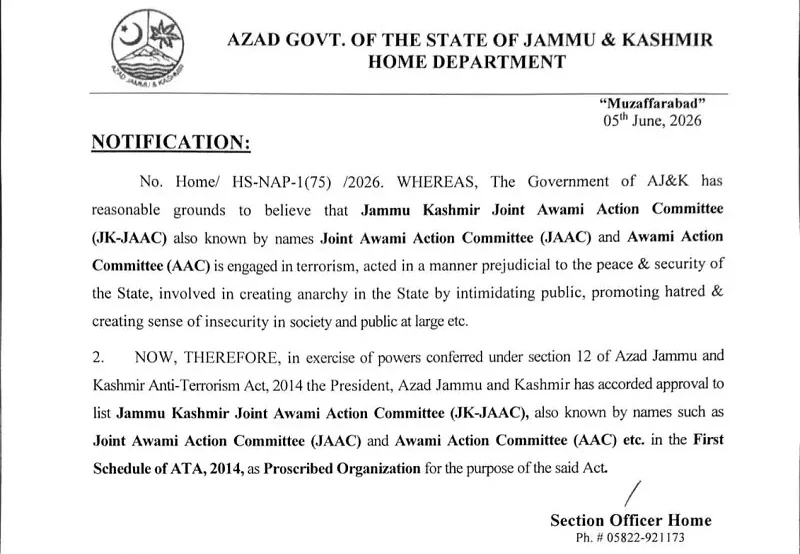





In a major pre-emptive move to secure the region, the Government of Azad Jammu and Kashmir (AJK) has officially declared the Jammu Kashmir Joint Awami Action Committee (JK-JAAC) a proscribed organization. The group has been placed under the First Schedule of the region’s Anti-Terrorism Act (ATA), 2014, effective immediately.
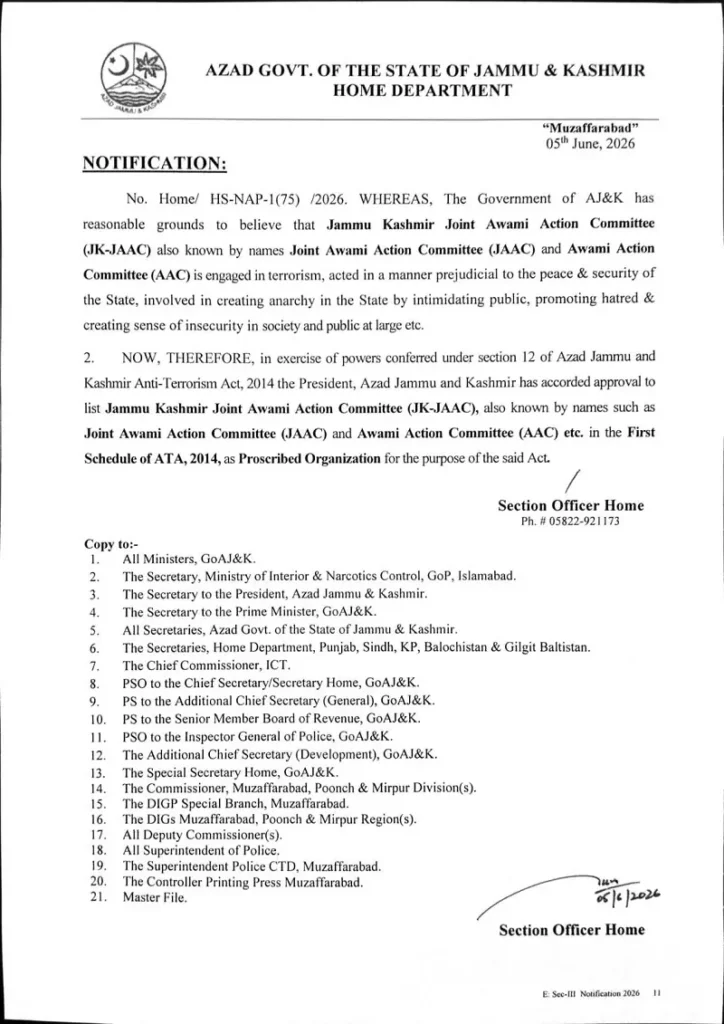
Notification of Home Department AJK Banning Joint Awami Action Committee (JAAC) Under Anti-Terrorism Act
An official notification issued by the AJK Home Department states that the group, also known as the Awami Action Committee (AAC), has systematically engaged in activities “prejudicial to peace and security” and is involved in “creating anarchy in the state by intimidating the public and promoting hatred.”
The state level ban follows the JAAC’s persistent refusal to engage in institutional dialogue with a government-designated implementation committee. It comes as the group continues to mobilize for a massive, regional “wheel-jam” strike called for June 9—the exact date the AJK Election Commission has mandated for candidates to begin filing nomination papers for the upcoming July 27 general elections.
Breaking: The Home Department of Azad Jammu & Kashmir has officially banned the Jammu Kashmir Joint Public Action Committee (also known as Joint Awami Action Committee).
It has been declared a proscribed organization and placed in the First Schedule under the Azad Jammu &… pic.twitter.com/UJcKyeywRS
— Red Marker – پیرِ ٹویٹر (@RedMarkar) June 6, 2026
Paramilitary Forces En Route as Civil Infrastructure Grinds to a Halt
Anxious to prevent a repetition of the violent, destabilizing clashes that paralyzed the territory during a weeklong JAAC strike late last year, the federal government in Islamabad has initiated a rapid security deployment.
The structural scale of the state’s security and administrative clampdown includes:
-
Massive Troop Influx: AJK Inspector General of Police Captain (retired) Liaqat Ali Malik formally requested 14,000 additional federal paramilitary personnel to reinforce local police lines from June 7 to June 21. Heavy convoys of security forces were documented entering Muzaffarabad on Friday to establish a security perimeter.
-
Travel Advisory & Evacuation: In a highly unusual step, the AJK administration issued an urgent directive warning outsiders to completely avoid traveling to the region, while ordering current tourists and visitors to vacate the territory immediately.
-
Educational Postponements: The University of Azad Jammu and Kashmir announced on Friday the immediate postponement of its Spring 2026 term examinations, originally scheduled to commence on June 8, until further orders.
-
Digital Blackout Warnings: Speculation is mounting across regional social media networks that authorities are preparing to suspend high-speed mobile data and internet services across the territory to disrupt the JAAC’s digital mobilization frameworks.
Critical Analysis: Refugee Seats, and July 27 Electoral Clash
The decision to proscribe the JAAC under anti-terror laws highlights a profound structural crisis between local nationalist movements and the traditional political framework governing AJK:
Core Flashpoint: Abolishing the Refugee Seats
The current standoff is driven by the JAAC’s contentious demand to abolish the 12 legislative seats reserved exclusively for refugees from Indian-occupied Jammu and Kashmir who settled in mainland Pakistan following the 1947 partition. These seats are voted on by refugees residing outside of AJK across Pakistan’s four main provinces.
The JAAC and its supporters argue that these 12 seats function as a built-in political backdoor. Because mainstream Pakistani political parties (such as the PML-N, PPP, or PTI) generally sweep these refugee constituencies in mainland Pakistan, they can easily manufacture a majority in the Muzaffarabad assembly, effectively dictating who forms the AJK government regardless of how the local resident population votes. By striking on June 9, the JAAC is attempting to physically halt the nomination process to force a constitutional overhaul of this system.
State’s Narrative: Protecting Franchise and Preventing Sabotage
By placing the JAAC under the First Schedule of the Anti-Terrorism Act, the AJK government is attempting to completely change the terms of the debate. The state’s legal narrative frames the JAAC not as a civil rights protest movement, but as a subversive entity explicitly trying to derail the July 27 democratic elections.
The AJK Legislative Assembly issued a firm defense of the refugee seats on Thursday, viewing them as a vital symbolic link to the broader Kashmiri freedom struggle. From the government’s perspective, the JAAC’s tactical timing—matching its wheel-jam strike perfectly with the opening of the election filing window—is a clear attempt to disrupt the constitutional process through intimidation rather than institutional politics.
Shadow of Past Bloodshed and Digital Blackout
The deployment of 14,000 external security personnel shows how anxious Islamabad is to prevent a repeat of the violent clashes seen in late 2025. During previous JAAC strikes, heavy-handed policing led to widespread riots, fatal casualties, and an economic standstill. The massive influx of paramilitary forces is a double-edged sword: while it provides the state with the raw manpower needed to protect public property, it also increases the risk of a flashpoint incident if forces use excessive kinetic pressure against local protestors.
Furthermore, the anticipated suspension of internet services demonstrates the state’s reliance on digital containment strategies. While a digital blackout temporarily neutralizes the JAAC’s command-and-control networks, it also inflicts severe economic harm on the region’s growing freelance IT sector, turning neutral digital professionals against the local administration.