




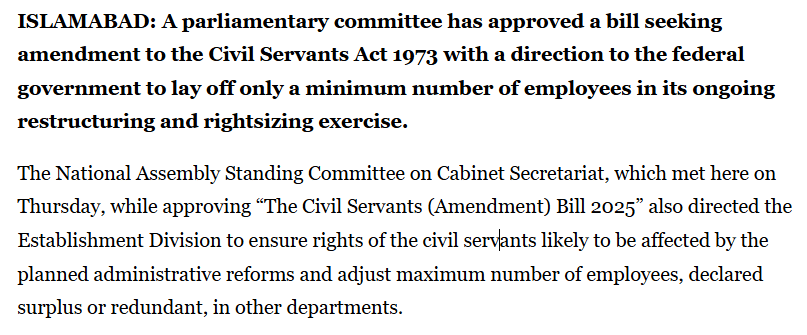
On July 11, 2025, the National Assembly’s Standing Committee on the Cabinet Secretariat approved the Civil Servants (Amendment) Bill 2025, which amends the Civil Servants Act, 1973, to legally enable restructuring, merging, and abolishing departments deemed redundant or financially unsustainable. The bill mandates:
- Mandatory asset declaration by all civil servants.
- Empowerment of the federal government to abolish or merge underperforming entities.
- Rightsizing through retrenchment with voluntary severance packages (“golden handshake”) instead of surplus pool placement, especially for PBS 1–5 grades, with plans to outsource low‑grade tasks to private sector.
- Age relaxation of up to 10 years for young appointees to allow greater flexibility in recruitment.
- A clear process for minimum layoffs with re-absorption of about 90% of displaced employees into other roles.
While signalling a shift from blanket cost‑cutting toward selective streamlining, critics warn that simply rightsizing without systemic culture change will not deliver sustainable outcomes.

Source: Dawn
Source: Dawn
Effectiveness: Efficiency, Corruption & Accountability
Performance vs. Patronage
Despite reforms like the Performance Management System (PMS), Common Training Programme (CTP), and Specialized Training Programmes (STPs), these remain ineffective where political patronage undermines merit-based progress. Analysts such as Dr Adil Najam warn: “a corrupt civil service cannot deliver clean governance” without insulating recruitment and evaluations from interference. As Dr Nadeem Ul Haque highlights, lateral entry and performance‑based progression hold promise only if supported by rigorous oversight.
VoxDev research finds that promotions still reflect personal networks and discretionary decisions, even where merit matters, suggesting internal reputational incentives can outweigh transparency unless structures are redesigned to reward performance systematically.
Decentralisation and Local Accountability
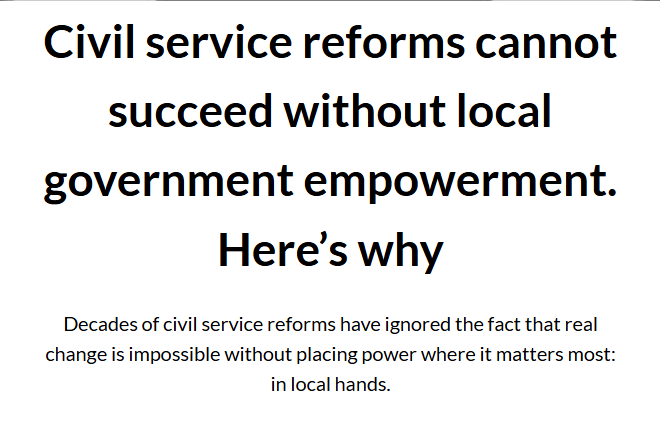
Dawn columnist Dr Javed Younas argues that civil service reform is futile without meaningful decentralisation. The heavily centralised bureaucracy deploys officers across provinces arbitrarily, inhibiting specialisation and disconnecting bureaucrats from communities they serve. Historical local governance under Musharraf revealed how empowered district governments with bureaucratic accountability can boost performance, something reversing without constitutional protections left local reforms short‑lived.
Source: Dawn
Broader Reform Agenda: Uraan Pakistan & IMF Governance Review
Uraan Pakistan and SOE Reform
As part of Uraan Pakistan, the government’s National Economic Transformation Plan launched in Dec 2024, the Ministry of Finance introduced a performance‑linked funding model for state‑owned enterprises (SOEs). This model ties subsidies, equity injections, and guarantees to measurable metrics such as ROIC, EVA, and ESG benchmarks, marking a shift from unconditional support to outcome‑based financing.
IMF Governance Diagnostic
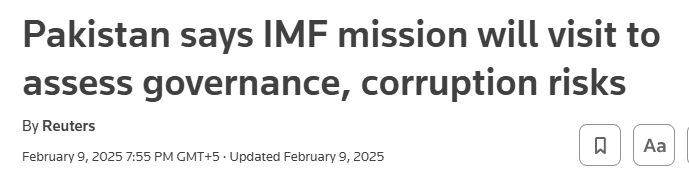
In early 2025, the IMF launched a Governance and Corruption Diagnostic Assessment under its Extended Fund Facility. The mission will review Pakistan’s fiscal governance, central bank operations, financial sector oversight, rule of law, and AML–CFT frameworks, key areas where civil service reforms intersect with institutional integrity.
Source: Reuters
Case Study: Kohistan Scandal and Accountability Machinery
In Upper Kohistan, Khyber Pakhtunkhwa, the massive Rs 30–40 billion corruption scandal in the provincial “Security and Deposit Works KP 10113” account exposed systemic failures in oversight and governance. NAB and PAC inquiries recovered over Rs 30 billion and led to arrests, revealing forged cheques, shell accounts, luxury assets, and wider collusion involving bureaucrats, contractors and bank staff. The scandal underscores that legal frameworks and bill‑based reforms must be matched by enforcement of anti‑corruption bodies like NAB and ACE, and strengthened financial audits.
Global Benchmarks & Lessons
Reformers often point to Singapore, Rwanda, Ghana, and New Zealand as models where high salaries, meritocratic recruitment, asset disclosures, and prosecutions create a culture of integrity not just a framework. Success requires:
- Independent recruitment commissions (e.g. FPSC/PSCs) audited by external civil society.
- Asset and conflict‑of‑interest declarations for all public officials.
- Independent bodies for performance auditing, supplemented with citizen‑driven oversight.
Political Context: Reform vs. Political Inertia
However, administrative reforms alone are unlikely to yield sustainable outcomes unless accompanied by deeper political and institutional changes. Performance evaluations, lateral entry, or digital governance mechanisms can only be effective when complemented by robust political accountability, empowered parliamentary oversight, and a clear separation between bureaucratic functioning and political interference. In the absence of genuine political will and structural checks, even the most well-designed civil service models risk becoming hollow frameworks, technocratic on paper but ineffective in practice.
Is Pakistan Ready for Performance-Based Governance?
The Civil Servants (Amendment) Bill 2025 is a step beyond mere rightsizing. It adds tools such as asset disclosure, structured retrenchment, and age-relaxed recruitment to the reform arsenal. However, to translate rightsizing into performance-based governance demands whole‑system transformation: decentralised accountability, institutional autonomy, digital enforcement, and separation from political interference.
The combination of IMF-backed governance reform, SOE performance funding, and legal scaffolding around civil service offer promising entry points. But public scandals like Kohistan highlight that without robust enforcement and cultural change, laws alone won’t deter maladministration.
To foster a truly efficient, ethical, and responsive civil service, Pakistan must not only rightsize and reorganize, it must also rebuild incentives, codify transparency, empower local governance, and safeguard the bureaucracy from politicisation. Only then will the transition from cost-cutting to performance-based governance become real and lasting.