Scope and Scale of Environmental Crime
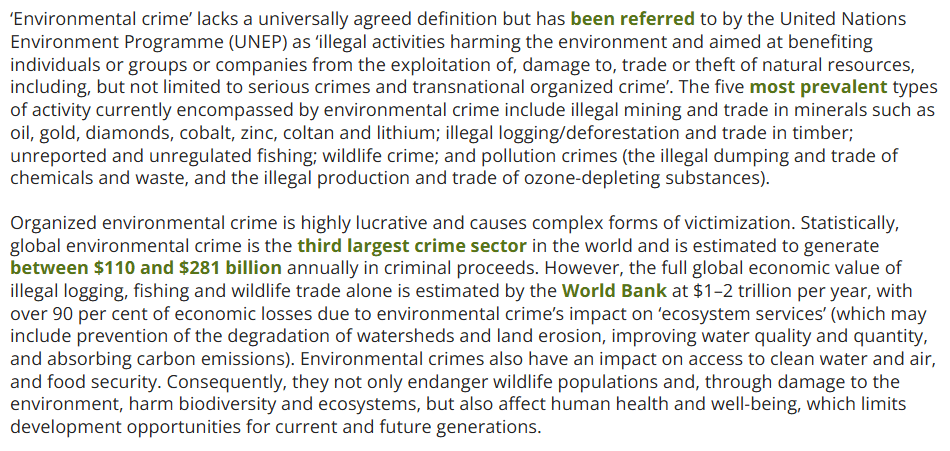
Environmental crime—including illegal mining, logging, wildlife trafficking, and water theft—is now considered one of the fastest growing sectors of organized crime globally, estimated to generate up to $1–2 trillion annually in economic damage to ecosystems and state revenues. In Pakistan, such green crimes exploit weak regulatory institutions, poor enforcement, and profitable markets.
Source: Envirosecurity
Illegal Logging & Timber Mafia
Pakistan has witnessed organized illegal deforestation by what local media have termed a “timber mafia.” In Hazro, Attock district, eucalyptus plantations were felled systematically—often with the alleged support of forest department officials—to supply high-end furniture markets. Changa Manga, once the world’s largest artificial forest, has lost over 60% of its original area due to timber syndicates implicated in collusion and corruption. Such entrenched networks not only devastate forest cover and biodiversity, but also divert revenue from government to criminal enterprises, while reinforcing patronage dynamics.

Source: Dawn
Wildlife Trafficking Networks
Though not widely documented in Pakistan, traffickers exploit porous borders with Afghanistan and the Middle East to smuggle protected species—such as rare birds, reptiles, and medicinal plants. Globally, wildlife crime ranks among the most lucrative transnational markets, valued at between $5 billion to $23 billion annually. In South Asian ecosystems, poachers operate within syndicates that often overlap with logging and mining rings, fostering convergence of illicit networks.
Unregulated Mining and Sediment Plunder
Parts of Pakistan are facing unregulated artisan mining—particularly for placer gold in the Indus River basin. In Nizampur, Nowshera district, over 1,200 heavy machines daily excavate the riverbed, degrading aquatic ecosystems, threatening turtle breeding grounds, and muddying water essential for agriculture and communities. These operations are reportedly run by powerful mafia figures with political connections. Because most gold extracted escapes official channels, the government loses both mineral revenue and environmental oversight.
You May Like To Read: Western Feminism vs. Pakistani Feminist Movements
Illegal mining globally is not only destructive but also feeds organized criminal networks, often involving corruption, tax evasion and violent enforcement of turf.
Water Theft Syndicates
Pakistan ranks among the world’s most water-stressed countries, projected to face severe scarcity by 2040. While formal water theft is less studied, unauthorized borehole drilling, tampering with public water services, and unlicensed extraction—particularly around industrial, agricultural or municipal zones—are widespread practices that effectively constitute water theft. Ad hoc private water vendors tapping rivers or hydrants can operate informally, evading payment and regulations. As water becomes scarcer, organized rent-seeking and collusion with local officials could establish entrenched illegal water markets.
Corruption and Criminal Convergence
Environmental crime in Pakistan displays patterns observed globally: illegal logging, mining, and wildlife trafficking often converge within the same syndicates, with bribes paid to facilitate extraction, transport, and illegal trade.. These illicit economies intersect with other threats—including drug smuggling, land grabbing, and violent coercion—creating complex networks that undermine rule of law and state stability.
Impacts on Pakistan’s Ecology & Economy:
- Environmental degradation: forest loss, soil erosion, biodiversity decline, river ecosystem collapse.
- Revenue leakage: lost mineral royalties, timber taxes, and official export earnings weaken public finances.
- Social and rural harm: communities lose grazing land, wood fuel resources, water access, and soil fertility.
- Corruption entrenchment: collusion with local officials erodes institutional integrity; evading taxes funds further illicit activities.
Regulatory Responses and Gaps
Despite policies under the Forest Acts and Environmental Protection Agencies, enforcement remains limited due to understaffed forest departments, lack of forensic tools, and absence of integrated task forces to tackle convergent crimes. Moreover, Pakistan lacks a nationwide wildlife enforcement framework akin to cross-border task forces like ASEAN‑WEN operating in Southeast Asia.
You May Like To Read: Flash Floods in Gilgit-Baltistan
Toward Solutions: A Way Forward
- Establish specialized multi-agency units combining revenue, forest, wildlife, water and tax authorities with judiciary and police.
- Adopt satellite and community-based monitoring to track deforestation and illegal mining hotspots before syndicates extract resources.
- Legal reform and asset recovery laws targeting criminal profits from resource crimes and seizing machinery and land.
- International cooperation under CITES, UNODC and INTERPOL frameworks to disrupt wildlife and timber smuggling syndicates.
- Engage civil society and local communities in real-time reporting and legal redress, especially for marginalized forest-dependent populations.
Pakistan’s environmental underworld—comprising organized wildlife trafficking, forestry crime, unregulated mining and water theft—inflicts severe ecological, fiscal, and governance damage. These “green crimes” are not stand-alone challenges but often orchestrated by syndicates deeply embedded in broader illicit economies and state patronage networks. Tackling them demands not only stronger enforcement but institutional reform, cross-border cooperation, and adoption of digital surveillance and legal tools to reclaim Pakistan’s natural asset base and uphold rule of law.