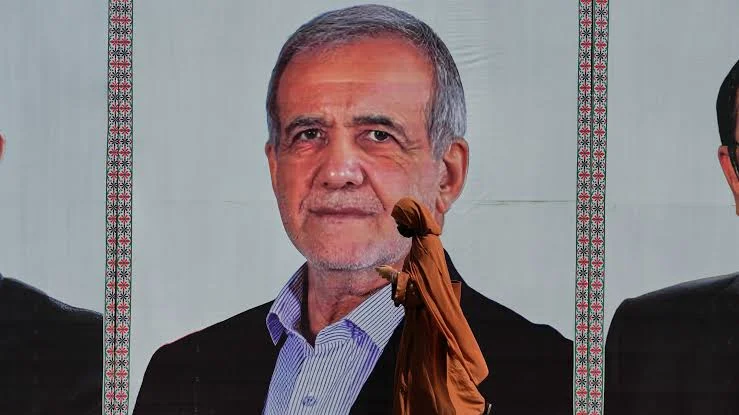





Marking a critical turning point in regional diplomacy, the President of the Islamic Republic of Iran, Masoud Pezeshkian, arrived in the Pakistani capital on Tuesday for a historic, high-stakes state visit. The trip represents President Pezeshkian’s first overseas diplomatic mission since the United States and Israel launched coordinated operations on February 28, signaling deep structural alignment between Tehran and Islamabad.
The Iranian head of state and his high-level ministerial delegation were received with full military honors at a military airbase near Islamabad by Pakistani President Asif Ali Zardari, Prime Minister Shehbaz Sharif, and Deputy Prime Minister and Foreign Minister Ishaq Dar. In a deeply symbolic tribute, Pezeshkian arrived aboard a special state aircraft designated Minab 168—venerating the memory of the 168 schoolgirls killed in a devastating first-day missile strike on an elementary academy in the southern city of Minab.
Foreign Minister of Iran, H.E. Seyyed Abbas Araghchi @araghchi arrived in Islamabad today as part of the delegation accompanying the President of the Islamic Republic of Iran, H.E. Dr. Masoud Pezeshkian, on his State Visit to Pakistan.
Upon arrival at Nur Khan Airbase, Foreign… pic.twitter.com/g2hFXaTTiz
— Ministry of Foreign Affairs – Pakistan (@ForeignOfficePk) June 23, 2026
Strategic Agenda: Solidifying the Bürgenstock 60-Day Peace Roadmap
President Pezeshkian’s state visit follows the conclusion of the first formal round of technical negotiations in Bürgenstock, Switzerland, mediated directly by Pakistan and Qatar.
The day-long diplomatic visit provides an essential venue for the Iranian leadership to extend formal gratitude to Pakistan for its instrumental role in brokering the landmark Islamabad Memorandum of Understanding (MoU), digitally signed on June 18 by President Pezeshkian and U.S. President Donald Trump, with Prime Minister Sharif endorsing as the principal mediator.
Multi-Layered Bilateral and Legislative Consultations
Following an exclusive face-to-face meeting between President Pezeshkian and Prime Minister Sharif, the two nations launched comprehensive, delegation-level bilateral talks. According to Pakistan’s Ministry of Foreign Affairs (MoFA), the technical working groups are focusing on a broad spectrum of mutual interests, including:
-
Strategic Energy & Macro-Trade: Formulating legal frameworks to capitalize on the temporary U.S. sanctions waiver, allowing Iran to restore vital oil and petrochemical flows through stable Pakistani energy corridors.
-
Border Security & Counter-Terrorism: Deploying synchronized defense patrols along the Pak-Iran border to insulate the frontier against hostile, non-state actors looking to destabilize the fragile regional truce.
-
Regional Infrastructure & Connectivity: Accelerating joint transportation initiatives to hook Eurasian transit corridors directly into global maritime trading nodes.
In tandem with executive-level deliberations, high-level legislative consults are scheduled in Islamabad. Senate Chairman Yousaf Raza Gilani, National Assembly Speaker Ayaz Sadiq, and Deputy Prime Minister Ishaq Dar will formally call on the Iranian leader to secure broad parliamentary backing for the implementation of the peace accords.
Critical Analysis
The high-stakes parameters of the Islamabad summit reveal profound transformations in Southwest Asian geopolitical realities:
1. The Weaponization of Strategic Aviation Symbolism
President Pezeshkian’s choice to fly into Pakistan aboard the newly christened Minab 168 aircraft represents a highly calculated use of political symbolism. By transforming a state transport asset into a mobile memorial for the civilian casualties of the first-day missile strikes, Tehran is ensuring that the human cost of the conflict remains central to the diplomatic narrative.
This overt messaging serves a dual purpose: it strengthens domestic political solidarity within Iran’s conservative factions while subtly signaling to international policy networks that any permanent treaty negotiated over the next 60 days must include formal accountability or reparations for non-military infrastructure damage.
2. The Emerging Verification Gap and the Swiss Implementation Dilemma
While President Pezeshkian’s visit celebrates the successful structural layout of the Islamabad MoU, serious cracks are already emerging between what Washington claims was agreed upon in Switzerland and Tehran’s actual enforcement boundaries. In Washington, Vice President JD Vance announced that the U.S. team had successfully secured a commitment to return International Atomic Energy Agency (IAEA) inspectors to examine damaged nuclear infrastructure.
However, concurrently with Pezeshkian’s landing in Islamabad, Iran’s Foreign Ministry explicitly ruled out granting UN inspectors access to bombed enrichment facilities. This direct contradiction highlights a major implementation challenge: if Iran treats the 60-day roadmap as a tool purely for immediate sanctions mitigation and the release of its $12 billion in frozen capital, while refusing on-site American verification, the Trump administration’s domestic critics will label the deal a strategic capitulation, potentially triggering a collapse of the ceasefire before the August 21 deadline.
3. Pakistan’s Evolution from a Non-Aligned State to a Indispensable Peace Broker
President Pezeshkian’s decision to make Pakistan his very first international destination following two major regional conflicts (the 2025 multi-day war and the 100-day war of 2026) highlights a profound shift in Islamabad’s geopolitical leverage. Historically, Pakistan was frequently forced to navigate a delicate balance between its security alliance with Washington and its adjacent border vulnerabilities with Tehran.
By taking a bold, active role as the primary mediator of the Islamabad MoU, the Sharif-Munir civil-military leadership has successfully turned a structural vulnerability into an asset of global importance. Hosting these high-level technical sessions proves that Pakistan is no longer merely reacting to regional conflict; it is actively shaping the security architecture of West Asia, making it an indispensable partner for both Western and Eurasian powers.