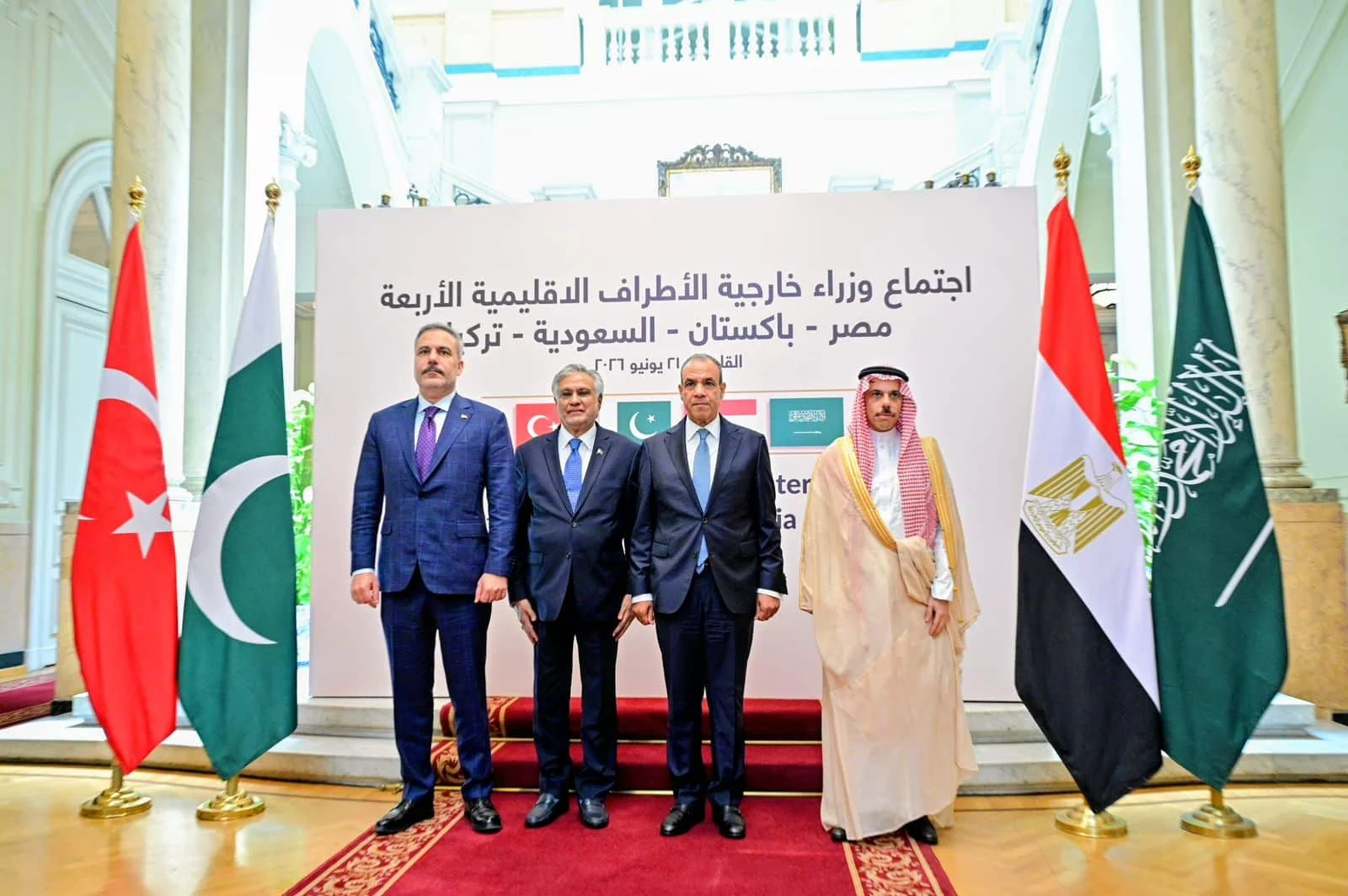





In a major diplomatic alignment on Sunday, the foreign ministers of the Regional Four (R-4) bloc—comprising Pakistan, Saudi Arabia, Türkiye, and Egypt—convened for a high-stakes emergency session in Cairo to formally endorse the landmark “Islamabad Memorandum of Understanding” (MoU) signed on June 17, 2026.
The Ministerial meeting, held at the invitation of the Arab Republic of Egypt, took place concurrently with the opening of high-level civil-military technical negotiations between the United States and Iran in Bürgenstock, Switzerland. The synchronized diplomatic tracks reflect a coordinated effort across Middle Eastern and South Asian capitals to secure the fragile 60-day ceasefire and construct a permanent peace architecture following the devastating 100-day regional war.
🔊PR No.1️⃣4️⃣9️⃣/2️⃣0️⃣2️⃣6️⃣
Joint Statement: Fourth Consultative Meeting of the Foreign Ministers of the Arab Republic of Egypt, the Islamic Republic of Pakistan,the Kingdom of Saudi Arabia and the Republic of Turkiye, Cairo Arab Republic of Egypt – June 21,2026
🔗⬇️ pic.twitter.com/k5v4W6CzGN
— Ministry of Foreign Affairs – Pakistan (@ForeignOfficePk) June 21, 2026
The Joint Cairo Declaration: Global Supply Chains and Regional Safeguards
In a comprehensive joint statement released by Pakistan’s Foreign Office (FO), the R-4 ministers hailed the Islamabad MoU as a vital milestone that averted systemic risks to global energy markets, international maritime corridors, and macroeconomic supply lines.
Key Provisions of the R-4 Joint Communiqué:
-
Endorsement of the Mediation Track: The bloc explicitly praised Pakistan’s “instrumental efforts” and leading role in brokering the agreement, alongside the critical diplomatic support provided by co-mediator Qatar.
-
Gulf and Levant Security Contingencies: The ministers stressed that the upcoming phase of technical negotiations must fully integrate and address the sovereign security concerns of regional states, particularly regarding the stability of the Gulf Arab States and the Levant region.
-
The Centrality of Palestine: Reaffirming that regional security cannot be decoupled from the Palestinian cause, the R-4 framework declared a just, comprehensive, and lasting peace to be conditional on the realization of the legitimate rights of the Palestinian people. The bloc demanded the establishment of an independent Palestinian state based on the pre-June 4, 1967 borders, with East Jerusalem as its capital, in strict accordance with relevant United Nations Security Council Resolutions.
Following the successful conclusion of the diplomatic sessions, Deputy Prime Minister and Foreign Minister Ishaq Dar departed Cairo Sunday evening, making a spiritual transit stop in Medina, Saudi Arabia, before returning to Islamabad.
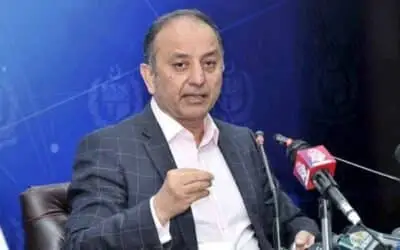
Deputy Prime Minister / Foreign Minister Senator Mohammad Ishaq Dar @MIshaqDar50 participated in the 4th Meeting of the Regional Four (R-4) Foreign Ministers (of Pakistan, Saudi Arabia, Türkiye, Egypt) in Cairo, Egypt today.
The Ministers reviewed progress on the Islamabad MoU,… pic.twitter.com/PL9nKLz6US
— Ministry of Foreign Affairs – Pakistan (@ForeignOfficePk) June 21, 2026
High-Level Engagement: R-4 Foreign Ministers Call on President El-Sisi
Following the ministerial debates, the R-4 foreign ministers were jointly received by Egyptian President Abdel Fattah El-Sisi at the Presidential Palace in Cairo.
During the audience, Deputy Prime Minister Ishaq Dar conveyed the warm greetings and highest regards of Pakistan’s state leadership—President Asif Ali Zardari, Prime Minister Shehbaz Sharif, and Chief of Defence Forces Field Marshal Syed Asim Munir—to the Egyptian head of state.
President El-Sisi highly commended Pakistan’s “constructive and responsible” role in driving regional de-escalation, expressing deep optimism that the next phase of negotiations would result in verifiable, lasting peace. In a significant bilateral breakthrough, President El-Sisi formally accepted Prime Minister Sharif’s invitation to state-visit Pakistan, with both capitals directing their diplomatic staff to coordinate the itinerary at the earliest opportunity.
Critical Analysis
The Cairo R-4 summit highlights a profound transformation in the geopolitical alignment of the Middle East and its adjacent security zones:
1. The Consolidation of the R-4 as a New Geopolitical Arbiter
The institutional emergence of the R-4 framework (Pakistan, Saudi Arabia, Türkiye, Egypt) represents a structural shift toward middle-power autonomy in the management of Middle Eastern conflicts. Historically, regional crises were addressed via Western intervention or fragmented through competing mini-lateral blocs (such as the pro-Iran Axis of Resistance versus traditional Gulf alignments).
By uniting the premier military, economic, and diplomatic heavyweights of the Sunni Muslim world, the R-4 forms a powerful regulatory mechanism. This bloc possesses the collective leverage to enforce compliance on both Washington and Tehran, ensuring that any permanent bilateral U.S.-Iran settlement does not compromise the security interests of the Gulf or the Levant.
2. The Operationalization of Multi-Tiered “Inside-Outside” Diplomacy
The events of June 21 demonstrate a sophisticated execution of multi-tiered diplomatic strategy:
| Tier | Location | Key Actors | Core Objective |
| The In-Group Track | Bürgenstock, Switzerland | PM Shehbaz Sharif, Field Marshal Asim Munir, US VP JD Vance, Iranian Speaker Ghalibaf | Hard security guarantees, tactical verification, and military de-confliction protocols. |
| The Outer-Ring Track | Cairo, Egypt | FM Ishaq Dar, R-4 Ministers, President El-Sisi | Regional consensus building, diplomatic legitimacy, and safeguarding global economic compliance. |
This multi-tiered approach ensures that while the operational details are hammered out in private Swiss sessions, the broader regional architecture is simultaneously anchored in Cairo, mitigating the risk of sabotage by excluded or anxious regional stakeholders.
3. Binding the U.S.-Iran Peace Track to the 1967 Border Framework
By explicitly embedding a hardline position on the Palestinian cause into the Cairo declaration, the R-4 has placed a strategic barrier around the U.S.-Iran technical negotiations. The declaration sends an unambiguous message to the Trump administration: a localized truce between Washington and Tehran that ignores the ongoing operations in Gaza, the West Bank, and Lebanon will not receive the broader diplomatic or economic normalization of the region’s core powers.
By demanding an independent Palestinian state based on the 1967 lines as an “indispensable foundation” for peace, the R-4 is effectively using its collective control over energy transit corridors and regional security cooperation to force the Palestinian issue back onto the main international agenda, complicating any attempts by Washington or Tel Aviv to bypass it.
4. The Rising Diplomatic Profile of Pakistan’s State Leadership
The specific diplomatic messages conveyed by FM Ishaq Dar to President El-Sisi underscore the unified, institutional nature of Pakistan’s current foreign policy. By explicitly naming President Zardari, Prime Minister Sharif, and Field Marshal Asim Munir, Pakistan presents a solid, predictable civil-military front to its international partners.
This internal cohesion has significantly enhanced Islamabad’s credibility abroad. President El-Sisi’s praise for Pakistan’s “responsible” leadership, coupled with Vice President Vance’s public support, confirms that major global and regional players view Pakistan’s current leadership as a capable and necessary anchor for complex international mediation.